Exact2Pass

Last Update 12 hours ago Total Questions : 299
The Designing Cisco Data Center Infrastructure for Traditional and AI Workloads v1.2 (DCID 300-610) content is now fully updated, with all current exam questions added 12 hours ago. Deciding to include 300-610 practice exam questions in your study plan goes far beyond basic test preparation.
You'll find that our 300-610 exam questions frequently feature detailed scenarios and practical problem-solving exercises that directly mirror industry challenges. Engaging with these 300-610 sample sets allows you to effectively manage your time and pace yourself, giving you the ability to finish any Designing Cisco Data Center Infrastructure for Traditional and AI Workloads v1.2 (DCID 300-610) practice test comfortably within the allotted time.
Which factor determines the choice of platform designing a Cisco HyperFlex infrastructure to support computer-aided design applications?
Which protocol prevents fiber failures from causing a Layer 2 loop in a dark fiber DCI?
Refer to the exhibit.
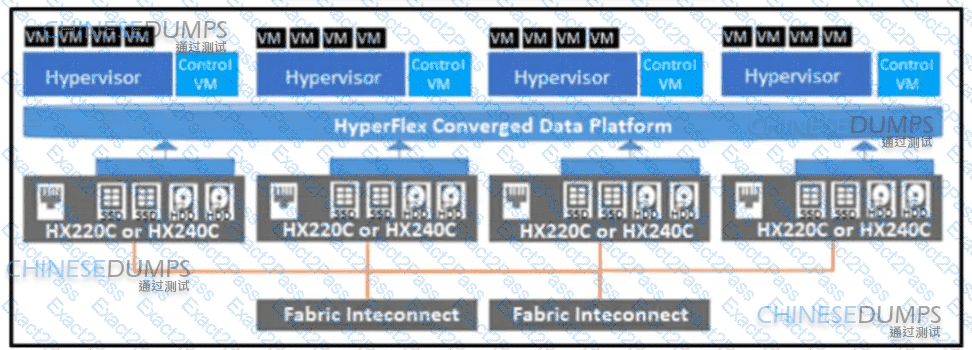
A Cisco engineer is configuring a next-generation Cisco HyperFlex HX data platform with 2 x Cisco UCS 6248UP fabric interconnects. 8 x Cisco HX-Series HX240c-M4SX servers, plus 8 x Cisco UCS B200-M4 blade servers Cisco UCS 5108 blade chassis, and Cisco UCS 2204XP fabric extenders The solution is configured with HX Release 4 5(2a) using VMware ESXi 7 0 U2 After the engineer migrates all customer VMs to the new solution platform, the engineer decides to create HX Native snapshots for all the VMs The engineer performs the operation and notices that some of the VMs are not creating snapshots. What is the most probable reason that the HX Native snapshots are not created?
What is an advantage of using OTV as compared to VPLS for data center redundancy?
What are two advantages of using Cisco vPC as compared to traditional access layer designs? (Choose two.)
An end user is experiencing network latency when accessing a database in a disaster recovery site. The monitoring team concluded that the database was writing simultaneously to the storage arrays on the primary and disaster recovery sites.
Which design resolves this issue?
Which Cisco HyperFlex feature provides virtual machine-level cost scaling for desktop virtualization growth?
A customer deploying Cisco UCS blade servers must centrally manage VLANs carried by the server interfaces. Interface properties must be updated in one location and applied to multiple servers simultaneously, including after the servers have been deployed. Which technology must the customer use?
Which set of actions ensures that the Cisco UCS network configuration contains the required VLAN settings and that those settings are consistently applied through the service profile templates?
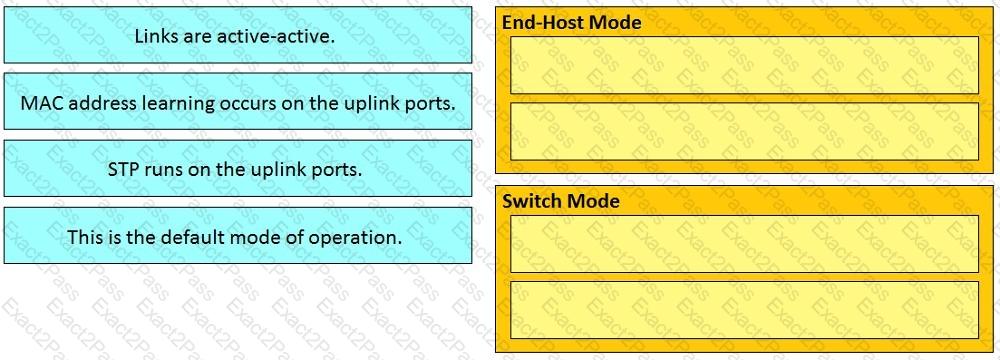
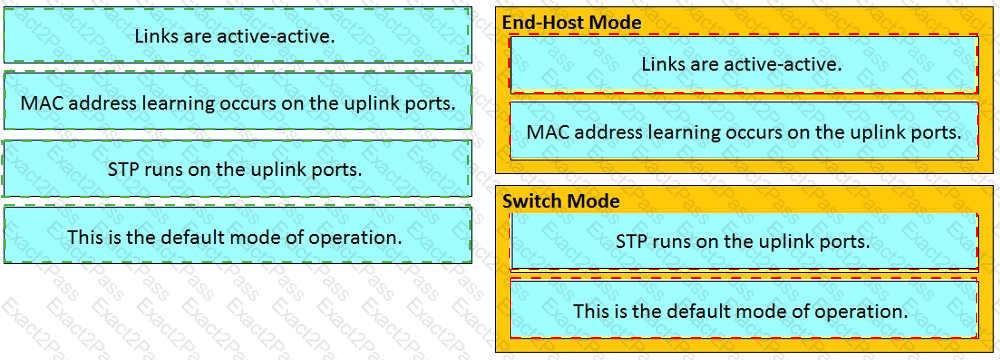
Drag and drop the feature descriptions from the left onto the correct UCS Fabric Interconnect modes on the right.