Exact2Pass

Last Update 17 hours ago Total Questions : 242
The Implementing Cisco Advanced Call Control On-Premises content is now fully updated, with all current exam questions added 17 hours ago. Deciding to include 300-815 practice exam questions in your study plan goes far beyond basic test preparation.
You'll find that our 300-815 exam questions frequently feature detailed scenarios and practical problem-solving exercises that directly mirror industry challenges. Engaging with these 300-815 sample sets allows you to effectively manage your time and pace yourself, giving you the ability to finish any Implementing Cisco Advanced Call Control On-Premises practice test comfortably within the allotted time.
What is a capability of the gateway-preferred, network-based recording option in Cisco UCM?
An engineer is configuring a call park feature in Cisco Unified Communications Manager Express. Which command does the engineer use to ensure that the call is reverted to the user after 60 seconds?
A company has an SRST gateway running an IOS XE image. The company plans to enable the IPv6 addressing companywide. To enable the IPv6 in a unified SRST gateway to support SIP phones, what are two supported supplementary features for an IPv6 fallback scenario? (Choose two.)
An administrator is configuring an Intercluster Lookup Service between 10 Cisco UCM clusters. Due to security requirements, certificate-based authentication must be used. Due to the deployment size, the administrator wants to avoid manually exchanging certificates between the clusters. Which two steps must be followed to meet these requirements? (Choose two)
Phone A calls to phone B, but phone B has Call Forward All set to a PSTN number. The route list responsible for the phone B call to the PSTN has a standard local route group configured. Which route group must be used to send the call to the PSTN?
An administrator wants to use the Call Queuemg feature on Cisco UCM to allow new customers to wait in the queue while other agents are not available to take their call. Which configuration step enables this feature?
Refer to the exhibit.
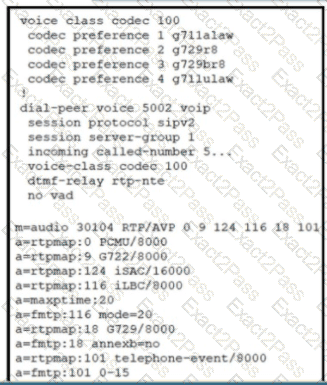
The Cisco Unified Border Element receives an INVITE matching inbound dial peer 5002. The outbound dial peer supports only iLBC. and a Local Transcoding Interface is allocated. Based on the configuration and SDP from the INVITE message, which codec is chosen by Cisco Unified Border Element for the inbound call leg?
A company has users that are logged in to hunt groups. However, there is a requirement for hunt group configurations to provide an option to turn on audible ringtones when calls to a line group arrive at a phone that is logged out and on a break. This ringtone alerts a logged-out user that there is an incoming call to a hunt list to which the line is a member, but the call does not ring at the phone of that line group member because of the logged-out status. Which action meets this requirement?
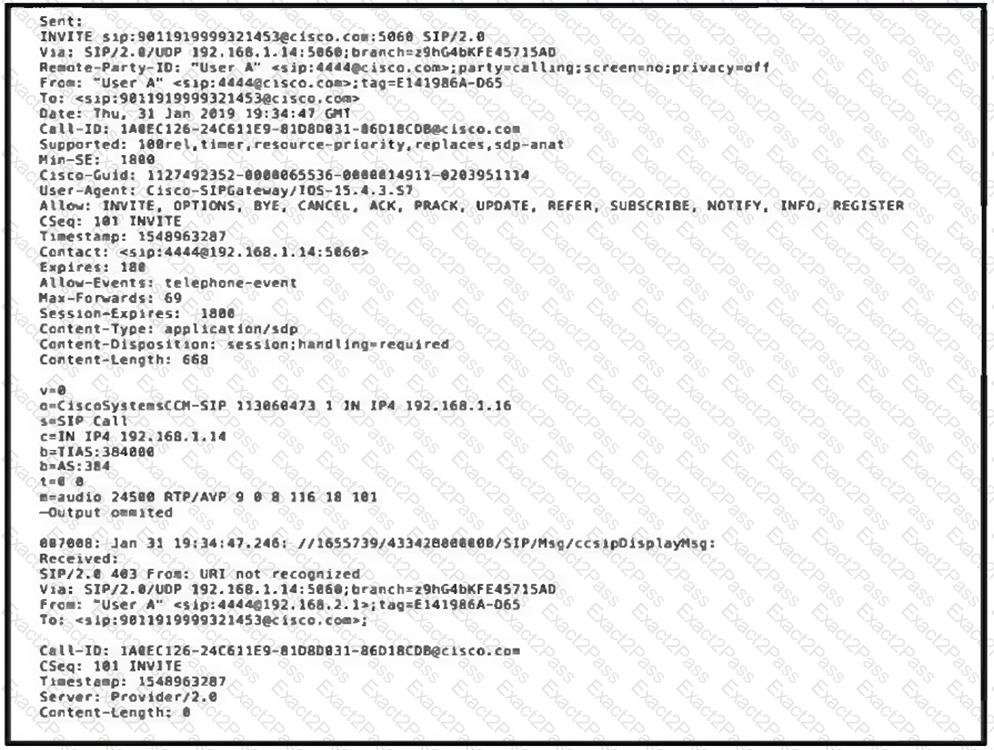
Refer to the exhibit. An administrator is trying to test outbound calls toward the ITSP but cannot complete the call and receives a SIP error. ITSP is consulted, and the issue is that the ANI that is being sent is not the DID provided 8005532447. Which configuration change sends the correct ANI on the INVITE sent to ITSP to fix the error?
A single site reports that when they dial select numbers, the call connects, but they do not get audio. The administrator finds that the calls are not routing out of the normal gateway but out of another site ' s gateway due to a TEHO configuration. What is the next step to diagnose and solve the issue?

