Summer Sale Special Limited Time 70% Discount Offer - Ends in 0d 00h 00m 00s - Coupon code: buysanta

Exact2Pass Menu

Implementing Cisco Collaboration Cloud and Edge Solutions (300-820 CLCEI)

Last Update 17 hours ago Total Questions : 207

The Implementing Cisco Collaboration Cloud and Edge Solutions (300-820 CLCEI) content is now fully updated, with all current exam questions added 17 hours ago. Deciding to include 300-820 practice exam questions in your study plan goes far beyond basic test preparation.

You'll find that our 300-820 exam questions frequently feature detailed scenarios and practical problem-solving exercises that directly mirror industry challenges. Engaging with these 300-820 sample sets allows you to effectively manage your time and pace yourself, giving you the ability to finish any Implementing Cisco Collaboration Cloud and Edge Solutions (300-820 CLCEI) practice test comfortably within the allotted time.
Question # 11

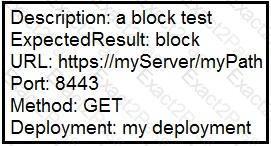
Refer to the exhibit. A collaboration engineer creates an allow list test file for a Mobile and Remote Access deployment. Which lines are needed to format the test in the file correctly?

A.

https://myServer:8443/myPath.block, “my deployment”, “a block test”, GET

B.

“my deployment”, block, GET https://myServer:8443/myPath, “a block test”

C.

a block test:https:8443:GET “myServer/myPath”:my deployment:block

D.

a block test,https:8443,GET “myServer/myPath”,my deployment:block

Question # 12

What allows endpoints behind a NAT to discover the paths through which they will pass media?

A.

RTP

B.

TLS

C.

SNMP

D.

ICE

Question # 13

Cisco media traversal technology has enabled a secure environment where internal video endpoints call and receive calls from external video endpoints. How does the Expressway-C and Expressway-E communicate?

A.

Expressway-C establishes an outgoing request to Expressway-E, enabling the Expressway-E in the DMZ to notify the internal Expressway-C of an incoming call from an external endpoint.

B.

Internal endpoints are registered to Expressway-E in the DMZ. Expressway-C, which is also in the DMZ, will receive and make calls on behalf of Expressway-E because they are in the same network.

C.

Expressway-E establishes an outgoing request to Expressway-C, enabling the Expressway-C in the DMZ to notify the internal Expressway-E of an incoming call from an external endpoint.

D.

Internal endpoints are registered to Expressway-C in the DMZ. Expressway-E, which is also in the DMZ, will receive and make calls on behalf of Expressway-C because they are in the same network.

Question # 14

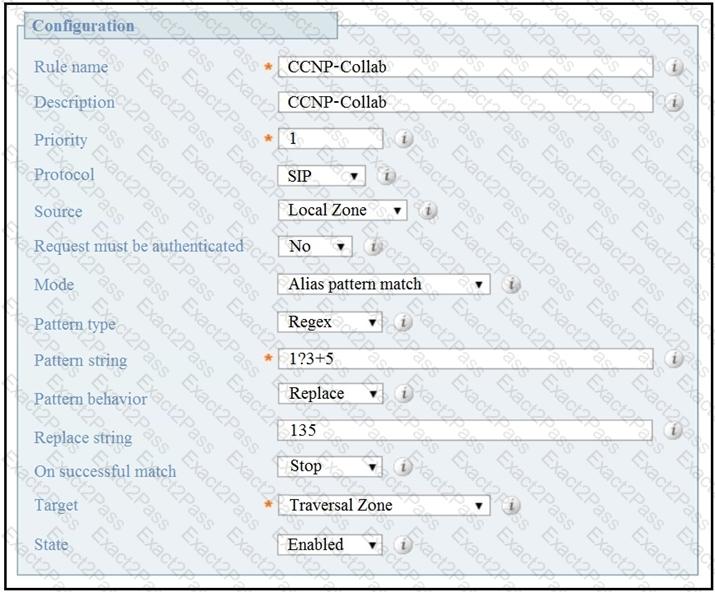
Refer to the exhibit.

When configuring a search rule that routes calls to a zone, what occurs when 13358 is dialed?

A.

13358 is replaced by 135, and then is sent to the local zone.

B.

13358 is replaced by 135 and remains in the same zone.

C.

13358 is replaced by 135, and then is sent to the traversal zone.

D.

13358 is sent directly to the traversal zone.

Question # 15

An engineer configures a Cisco Collaboration environment to use Mobile and Remote Access for external access for company users. The engineer uses OAuth with refresh on the Cisco UCM SIP lines for extra security and improved user experience. During the setup, Mobile and Remote Access does not work, it is enabled on the Cisco UCM and Cisco Expressways. SIP trunks on ports 5090 and 5091 are configured to avoid conflicts with other SIP trunks between internal Cisco UCM clusters. The traversal zone also uses port 6500. The traversal zone between Expressways shows no errors, and the requests hit Expressway-E from the Internet. What is the reason that the solution does not work?
A.

Mobile and Remote Access does not support OAuth with refresh with this configuration.

B.

The default port for Mobile and Remote Access is 6001. Therefore, the traversal port must be port 6001 for Mobile and Remote Access to work.

C.

The default port for Mobile and Remote Access is 6500, which creates a conflict with the existing traversal zone port.

D.

The default port for Mobile and Remote Access is 5091, which creates a conflict with the existing SIP trunks.

Question # 16

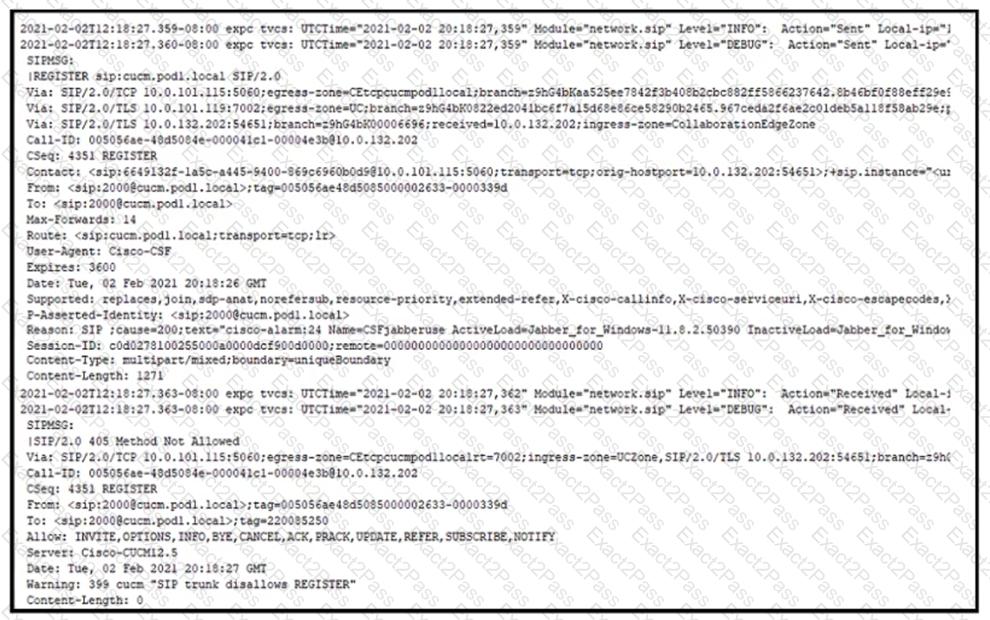
Refer to the exhibit. An engineer is deploying mobile and remote access in an environment that already had functioning Business to Business calling. Mobile and remote access SIP registrations are failing. To troubleshoot, SIP logs were collected. How is this issue resolved?

A.

Change the SIP profile on the SIP trunk for the Expressway-E to Standard SIP Profile for TelePresence Endpoint

B.

Change the “Incoming Port” in the SIP Trunk Security Profile for the Expressway-C to not match SIP line registrations

C.

Enable autoregistration for the appropriate DN range on the Cisco UCM servers running the CallManager service

D.

Write a custom normalization script since the “vcs-interop” normalization script does not allow registrations

Question # 17

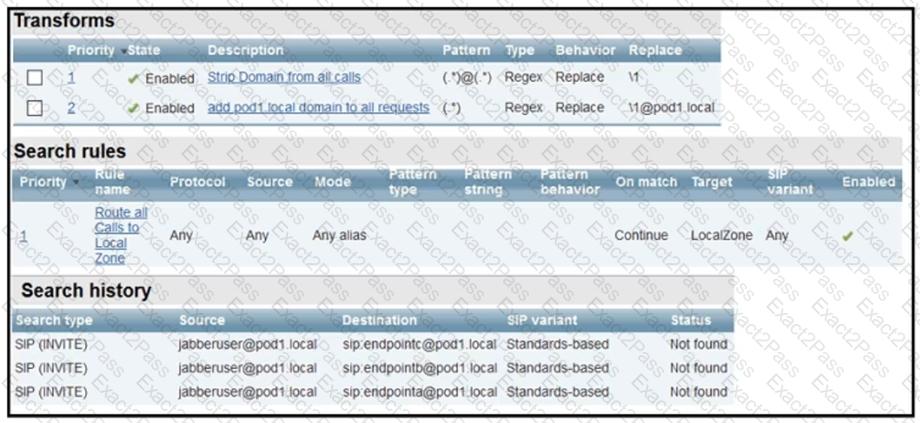
Refer to the exhibit.

Calls to locally registered endpoints are failing. At present, there are two endpoints

registered locally to this Expressway. An H.323 endpoint with an alias of “EndpointA” is registered, and a SIP endpoint with an alias of “EndpointB@pod1.local” is also registered. How is this issue resolved?

A.

The dialplan must be redesigned to use the transforms to convert the alias into SIP URI format and then use separate search rules for each format that needs to be dialed within the local zone.

B.

The calls are failing because there are insufficient licenses. Additional licenses must be installed for the Expressway to route these calls.

C.

The current search rule does not match the call, so the search rule must be modified to include a SIP Variant of “Standards-Based”.

D.

Calling parties are placing calls with the wrong domain. End-users must be instructed not to use the

pod1.local domain as that is owned by the local system. Calls to any other domain would work.

Question # 18

A collaboration engineer is configuring Cisco Webex Edge for video conferencing devices to provide support for Cisco Webex Control Hub configuration management. Which configuration control mode must be set on Cisco UCM for Control Hub to manage the on-premises device configuration?

A.

Webex Edge only

B.

endpoint only

C.

Cisco UCM and endpoint

D.

Cisco UCM only

Question # 19

An administrator configures a secure SIP trunk in Cisco UCM to Expressway-C. The SIP trunk fails to become active, and an examination of a packet capture finds that the TLS handshake failed with a “Certificate Unknown” error from Cisco UCM. To allow the Cisco UCM to trust the Expressway-C and establish a TLS connection, the administrator will upload the Expressway server certificate to the trust store. To which trust store must the certificate be uploaded?

A.

tomcat-trust

B.

CallManager-trust

C.

TVS-trust

D.

ipsec-trust

Question # 20

When external video endpoints are called via a DNS zone, which dialing method requires DNS to be configured in the Expressway server?


A.

IP dialing

B.

URI dialing

C.

DN dialing

D.

E.164

Go to page: