Exact2Pass

Last Update 16 hours ago Total Questions : 88
The Advanced Design VMware vSphere 7.x content is now fully updated, with all current exam questions added 16 hours ago. Deciding to include 3V0-21.21 practice exam questions in your study plan goes far beyond basic test preparation.
You'll find that our 3V0-21.21 exam questions frequently feature detailed scenarios and practical problem-solving exercises that directly mirror industry challenges. Engaging with these 3V0-21.21 sample sets allows you to effectively manage your time and pace yourself, giving you the ability to finish any Advanced Design VMware vSphere 7.x practice test comfortably within the allotted time.
An architect is planning the physical server configuration for a vSAN-based infrastructure.
Which operations mode should a RAID controller support to minimize potential server downtime during physical disk failures?
Application owners require support of a Microsoft Windows Server Failover Cluster (WSFC).
Their current environment consists of the following components:
vSphere 7.0 and vSAN 7.0
External array supporting NFS 3.0/4.1, Server Message Block (SMB) 2.1
10 GbE storage connectivity for all devices
The solution architect is tasked with coming up with a solution to meet this requirement while utilizing their existing investments.
Which two recommendations could the architect make? (Choose two.)
A customer has a database cluster with 40/60 read/write ratio and a high IOPs requirement with no contention on an all-flash vSAN cluster.
Which two storage settings should be configured for best performance? (Choose two.)
A customer requires the use of data encryption to ensure data is not accessible when a drive is removed from the primary storage platform. However, there is also a requirement to use deduplication and compression against all workloads in order to conserve space.
Which solution meets the customer requirements?
An architect is considering placement of virtual machines within an existing VMware software-defined data center (SDDC).
During the discovery phase, the following information is documented:
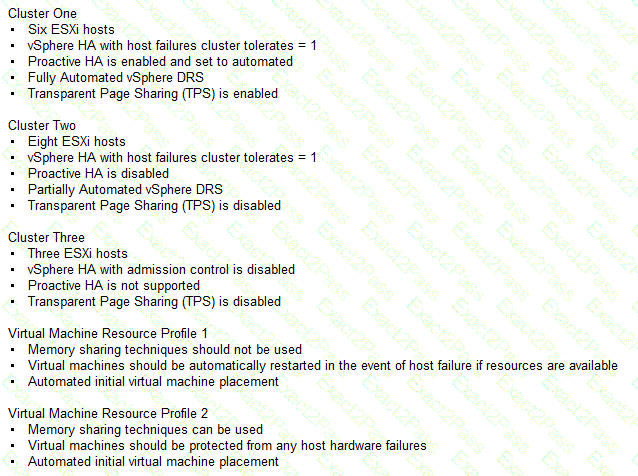
Which two recommendations should the architect make for placement of the virtual machines to meet resource profile requirements? (Choose two.)
Which two of the listed requirements would be classified as performance non-functional requirements? (Choose two.)
An architect is tasked with planning the design of a new vSphere environment. When commissioned, this environment will be used to migrate an existing set of virtual machines.
An inventory of the existing infrastructure, including configured vCPU, RAM and storage sizes has been provided.
In order for each virtual machine to be migrated, which two data sources with peak and average utilization data are required for sizing? (Choose two.)
Refer to the exhibit.
During a requirements gathering workshop, the customer shares the following diagram regarding their availability service-level agreements (SLAs):
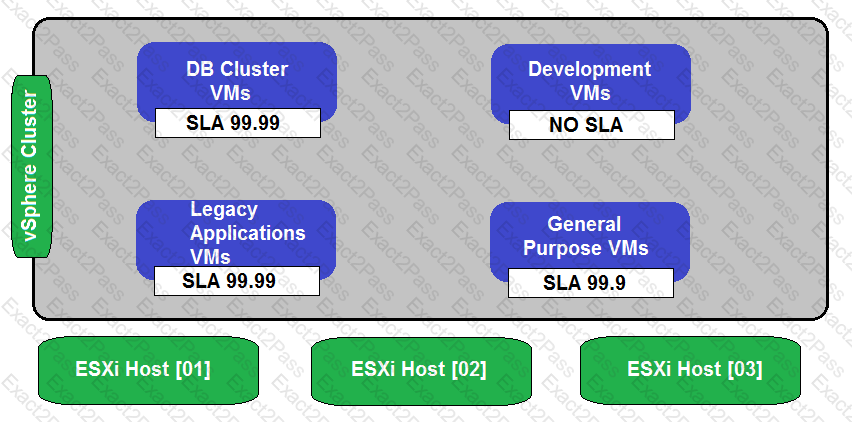
The customer wants database application level availability to always take precedence. What should the architect recommend to meet the customer’s requirement?
An architect is tasked with designing a greenfield VMware software-defined data center (SDDC) solution that will be used to deliver a private cloud service for a customer.
During the initial meeting with the service owner and business sponsor, the customer has provided the following information to help inform the design:
The solution must initially support the concurrent running of 300 production and 600 development virtual machines.
The production environment should be delivered across two geographically dispersed data centers. The development environment must be vSphere-based but does not have to be deployed on-premises.
The two data centers are connected to each other through multiple diversely routed, high bandwidth and low latency links.
The customer’s server hardware standard document states that all virtual infrastructure hosts must be based on blade architecture only.
The service owner has said that is important to ensure that neither the availability target of 99.5% nor the resource capacity is affected when the operations team completes maintenance activities, such as the monthly software patching and ad-hoc hardware break/fix.
All virtual machine backups must be completed using the existing backup service. The recovery time objective (RTO) for the service is four hours.
The recovery point objective (RPO) of the service is 24 hours.
Given the information from the customer, which two would be classified as assumptions within the design? (Choose two.)
An architect is tasked with expanding an existing VMware software-defined data center (SDDC) solution so that it can be used to deliver a virtual desktop infrastructure (VDI) service off-shore development activities.
The production environment is currently delivered across two geographically dispersed data centers. The two data centers are currently connected to each other through multiple diversely routed, high bandwidth and low latency links. The current operations management components are deployed to a dedicated management cluster that is configured with N+1 redundancy. The current VMware software-defined data center (SDDC) has a monthly availability target of 99.5%, which includes all management components.
The customer requires that the new solution scale to support the concurrent running of 500 persistent virtual desktops. The virtual desktops must not share the same virtual infrastructure as existing virtual machines, but can be managed using the same VMware operations management components. Any new VDI service management components must be installed into the management cluster. There is no requirement to back up the virtual desktops because all relevant user data is stored centrally. The VDI service is providing business critical services and must have an availability target of 99.9%.
Given the information from the customer, which two assumptions would the architect include in the design? (Choose two.)

