Exact2Pass

Last Update 16 hours ago Total Questions : 88
The Advanced Design VMware vSphere 7.x content is now fully updated, with all current exam questions added 16 hours ago. Deciding to include 3V0-21.21 practice exam questions in your study plan goes far beyond basic test preparation.
You'll find that our 3V0-21.21 exam questions frequently feature detailed scenarios and practical problem-solving exercises that directly mirror industry challenges. Engaging with these 3V0-21.21 sample sets allows you to effectively manage your time and pace yourself, giving you the ability to finish any Advanced Design VMware vSphere 7.x practice test comfortably within the allotted time.
Refer to the exhibit.
During a requirements gathering workshop, a customer shares the following diagram regarding their availability service-level agreements (SLAs):
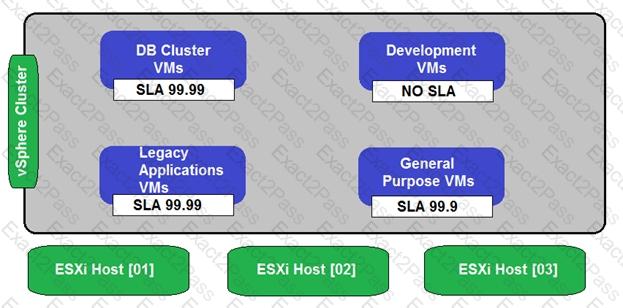
The customer states that there is no application level availability for legacy applications.
Which recommendation could the architect make to meet the customer’s high availability requirements for the legacy applications virtual machines?
During a requirements gathering workshop to design a physical to virtual migration, the customer provides the following information:
There is no physical firewall in the data center with no anticipated plans for a future network refresh.
Leveraging the virtual infrastructure to mitigate the lack of network security must be addressed in the design.
All physical servers to be migrated exist on the same VLAN.
Which recommendation should the architect make to address the customer requirement with regard to virtual networking?
A customer requests a review of its current vSphere platform design.
The following information is noted:
There are three different workload profiles for the virtual machines:
Tier-1 virtual machines operate resource-intensive applications and require dedicated allocations for CPU and RAM.
Tier-2 virtual machines operate internet-facing applications and require access to externally facing networks.
Tier-3 virtual machines operate platform management tools such as vCenter Server and have different lifecycle management requirements.
Tier-1, Tier-2 and Tier-3 virtual machines are all hosted on a single large vSphere cluster.
The Chief Information Security Officer (CISO) has raised concerns that hosting externally facing applications alongside management tools does not meet internal compliance standards.
The Operations team has raised concerns about Tier-1 virtual machines negatively impacting the performance of vCenter Server.
The Operations lead has stated that management changes have consistently been rejected by application teams.
As a result of the review, which recommendation should the architect make regarding the design of this platform?
A customer defines a requirement to minimize the vMotion migration time during a maintenance period. The servers being used are equipped with eight 1 GbE network adapters.
Per the defined logical network configuration, there are two network adapters each used for:
Management traffic
vMotion traffic
iSCSI traffic
Virtual machine traffic
Which design decision should the architect make to meet the customer requirement?
An architect decides to separate virtual desktops and application servers into separate vSphere clusters to meet security and management requirements.
What are two implications of this design decision? (Choose two.)
An architect is tasked with designing a greenfield VMware software-defined data center (SDDC) solution that will be used to deliver a private cloud service for a customer.
During the initial meeting with the service owner and business sponsor, the customer has provided the following information to help inform the design:
The solution must support the concurrent running of 1,000 virtual machines
The production environment must be delivered across two geographically dispersed data centers All virtual machines must be capable of running in either data center.
The two data centers are currently connected to each other through a single but diversely routed, high bandwidth and low latency link.
The link between the two data centers is capable of supporting a round-trip time (RTT) of 150 ms The existing server hardware standard document states that all virtual infrastructure hosts must be deployed using vSAN ReadyNodes
The service owner has stated that it is critical to ensure the availability target of 99.9% All virtual machine backups must be completed using the existing backup service
The recovery time objective (RTO) for the service is five minutes
The recovery point objective (RPO) of the service is four hours
Which two elements represent risks to the successful delivery of this solution? (Choose two.)

