Month End Special - 75% Discount Offer - Ends in 0d 00h 00m 00s - Coupon code: 75epass

Exact2Pass Menu

Advanced VMware Cloud Foundation 9.0 Automation

Last Update 11 hours ago Total Questions : 72

The Advanced VMware Cloud Foundation 9.0 Automation content is now fully updated, with all current exam questions added 11 hours ago. Deciding to include 3V0-21.25 practice exam questions in your study plan goes far beyond basic test preparation.

You'll find that our 3V0-21.25 exam questions frequently feature detailed scenarios and practical problem-solving exercises that directly mirror industry challenges. Engaging with these 3V0-21.25 sample sets allows you to effectively manage your time and pace yourself, giving you the ability to finish any Advanced VMware Cloud Foundation 9.0 Automation practice test comfortably within the allotted time.

Question # 11

Which statement correctly describes the relationship between a Project and an Organization in VCF 9.0?

A.

An Organization can belong to multiple Projects to share resources.

B.

A Project is a sub-construct of an Organization used to group users and entitle them to specific resources.

C.

Projects are managed in SDDC Manager, while Organizations are managed in the vSphere Client.

D.

There is no relationship; they are independent management silos.

Question # 12

An organization is experiencing rapid growth, and the VMware Cloud Foundation (VCF) administrator needs to ensure that the " Development " organization does not consume all available physical resources in the " West " region, which is shared with the " Production " organization.

What should the administrator configure to limit the total CPU and Memory consumption for the Development organization?

A.

Create a Resource Pool in vCenter and move all Development VMs into it.

B.

Configure a Region Quota for the Development organization within the Provider Management Portal.

C.

Apply a vSphere Limit on the Supervisor clusters.

D.

Modify the Project constraints within the Development organization to include hard limits.

Question # 13

A VMware Cloud Foundation (VCF) Automation administrator is creating a new organization for the Product Development team. The developers require self-service networking that allows them to:

• Provision workloads with virtual machines (VMs) and Kubernetes services.

• Attach these workloads to VPCs.

• Customize how ingress and egress traffic is handled.

Which configuration meets the requirement?

A.

Create an AllApps Organization and use the default VPC with VPC connectivity profiles.

B.

Create a VMApps Organization and assign multiple vSphere-backed networks for consumers to select as needed.

C.

Create an AllApps Organization and assign multiple vSphere-backed networks for consumers to select as needed.

D.

Create a VMApps Organization and use the default VPC with VPC connectivity profiles.

Question # 14

Which statement describes Virtual Private Clouds (VPCs)?

A.

Enables the provider administrator to create nested VCF instances with a private cloud.

B.

Enables multiple organizations to share the same physical Supervisor cluster while consuming logically isolated networks.

C.

Enables multiple organizations to share virtualized GPUs.

D.

Enables the provider administrator to create multiple VCF instances nested within public clouds (e.g., Amazon AWS, Microsoft Azure, Google GCP, etc.).

Question # 15

An administrator has been tasked with creating one organization with the following characteristics:

    Connect directly to one or more vSphere clusters.

    Do not use the Supervisor.

    No sharing of infrastructure resources with other organizations.

How can the administrator meet these requirements through the Provider Management Portal?

A.

Create a new Region.

B.

Create a VMApps organization.

C.

Enable the Provider Consumption Organization.

D.

Create an AllApps organization.

Question # 16

An administrator has been tasked with deploying an AllApps Organization within VMware Cloud Foundation (VCF) Automation.

During the regional networking creation step, which three NSX constructs will automatically be configured? (Choose three.)

A.

A Default Virtual Private Cloud (VPC).

B.

A Virtual Distributed Switch (VDS).

C.

A Provider Tier-0 Gateway.

D.

A Virtual Private Cloud (VPC) connectivity profile.

E.

An NSX Transit Gateway.

Question # 17

What should an Organization Administrator configure to ensure that three environments—staging, development, and production—are isolated from each other?

A.

Create a VPC for each environment and ensure no connectivity profiles are selected.

B.

Create a single VPC for both staging and development with a connectivity profile supporting multiple private CIDRs.

C.

Create a VPC for each environment with a connectivity profile that has only a “Private – TGW” IPv4 block.

D.

Create a Namespace class for each environment, ensuring limits are configured.

Question # 18

An Organization Administrator notices that their public assigned IPs are being used for non-production workloads.

What should the administrator do to prevent further public IP addresses consumption?

A.

Create an IP Quota and associate it with the non-production VPC.

B.

Create an IP Quota and associate it with the non-production namespace.

C.

Modify the default IP Quota that was shared by the provider.

D.

Modify the existing VPC and remove the " External IPv4 blocks " .

Question # 19

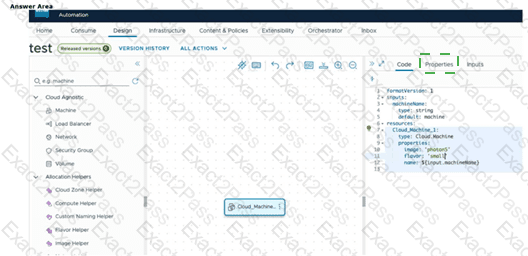
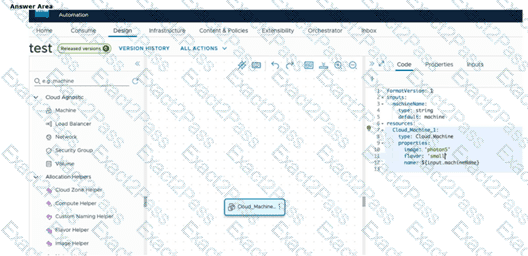
Click on the area to find syntax assistance to include a cloudConfig stanza to the blueprint.
Question # 20

An administrator has been tasked with creating a region to provide resources to an Organization in VMware Cloud Foundation (VCF) Automation.

The following information has been provided to the administrator for this task:

• Two workload domains are configured and will integrate with the region.

• All workload domains are configured to share a VMware NSX Manager.

• All workload domains are configured with VMware vSAN storage.

• All workload domain VMware vCenter instances have a Supervisor enabled.

Before creating the region, what two additional configurations should the administrator validate? (Choose two.)


A.

An AllApps Organization has been created.

B.

All Supervisors are configured with the same services across all vCenter instances.

C.

All required virtual machine (VM) classes are present and have the same names across all vCenter instances.

D.

A Region Quota has been created and associated with the Organization.

E.

All required storage classes are present and have the same names across all vCenter instances.

Go to page: