Summer Sale Special Limited Time 70% Discount Offer - Ends in 0d 00h 00m 00s - Coupon code: buysanta

Exact2Pass Menu

Alcatel-Lucent Interior Routing Protocols and High Availability

Last Update 11 hours ago Total Questions : 315

The Alcatel-Lucent Interior Routing Protocols and High Availability content is now fully updated, with all current exam questions added 11 hours ago. Deciding to include 4A0-101 practice exam questions in your study plan goes far beyond basic test preparation.

You'll find that our 4A0-101 exam questions frequently feature detailed scenarios and practical problem-solving exercises that directly mirror industry challenges. Engaging with these 4A0-101 sample sets allows you to effectively manage your time and pace yourself, giving you the ability to finish any Alcatel-Lucent Interior Routing Protocols and High Availability practice test comfortably within the allotted time.

Question # 11

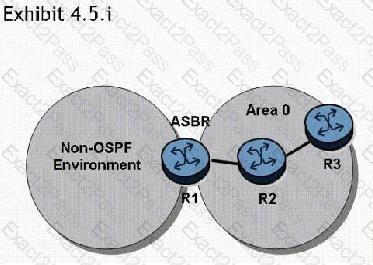
Click the exhibit button.

In the topology shown, router R1 is an ASBR configured to export external routes to OSPF. How many type 4 LSAs will be present in the network?

A.

One.

B.

One for each of the routers in area 0

C.

One for each of the external routes exported by router R1.

D.

Type 4 LSAs are not generated in this network topology.

Question # 12

Which of the following statements regarding distance vectors protocols are true?

(Choose two answers).

A.

RIPv1, RIPv2, and BGP are distance vector protocols.

B.

OSPF and IS-IS are distance vector protocols.

C.

Routing tables are exchanged between neighbors; however, no routing table is transmitted beyond the immediate neighbor.

D.

Distance vector protocols use the Dijkstra SPF algorithm.

E.

Routers that participate in distance vector routing protocols maintain full knowledge of distant routers and how they interconnect

Question # 13

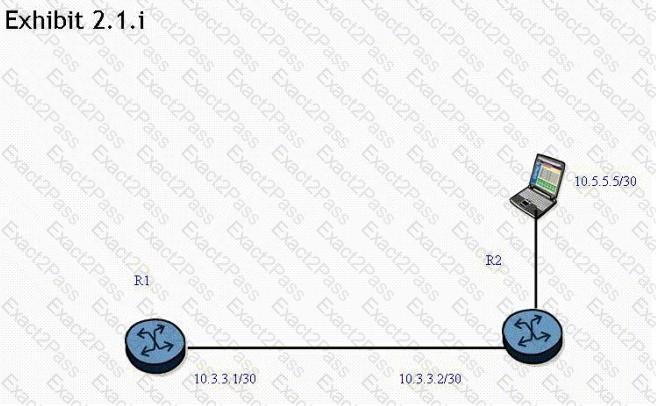
Click the exhibit button.

A static route is created on router R1 " using the " static-route 0.0.0.0/0 next-hop 10.3.3.2 " command. What command can be used to test the static route on an Alcatel-Lucent 7750 SR?

A.

ping static 10.5.5.5

B.

ping static 0.0.0.0/0

C.

ping 10.5.5.5

D.

ping 0.0.0.0

Question # 14

Which of the following features are supported by IS-IS? Choose three answers.

A.

PDU authentication.

B.

The ability to customize the link cost metric.

C.

Use of Bellman-Ford routing algorithm.

D.

Classless routing.

E.

Updates sent as layer 3 multicast.

Question # 15

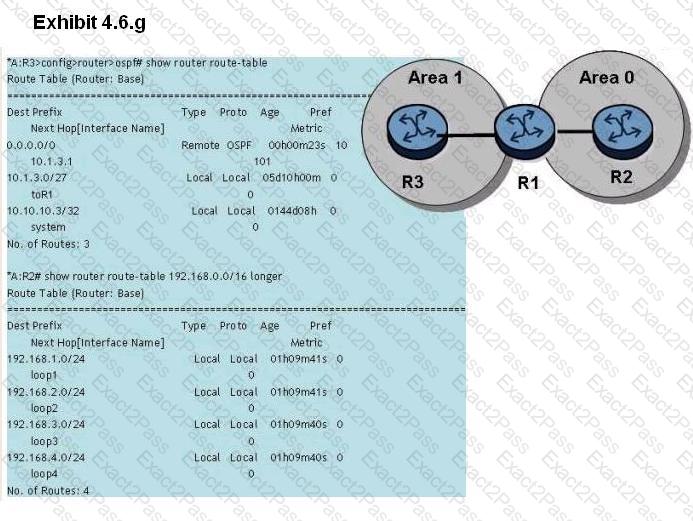
Click the exhibit button.

Given the topology and the show commands, and assuming that router R2 advertises all of its loopbacks into OSPF, what is the correct router R1 configuration?
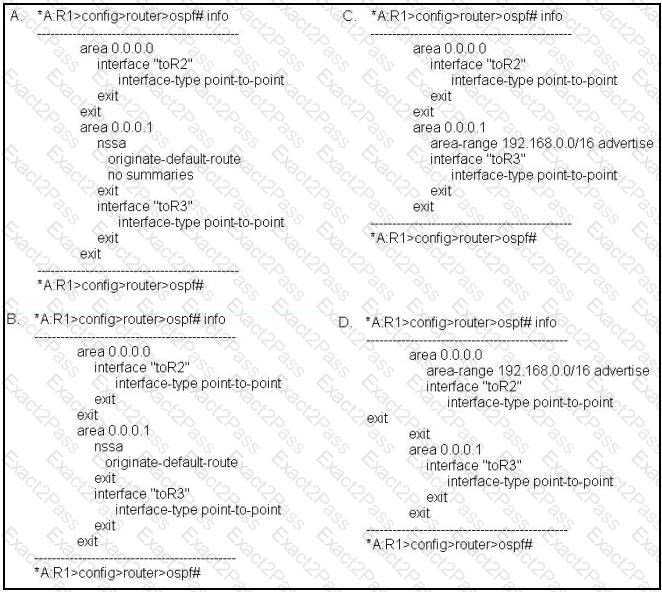
A.

Option A

B.

Option B

C.

Option C

D.

Option D

Question # 16

Click the exhibit button.

If router R2 redistributes the IS-IS route to 192.168.3.0/24 into OSPF, router R3 preference of these two routes? Choose two answers.

A.

The OSPF internal preference

B.

The IS-IS Level 1 internal preference

C.

The IS-IS Level 2 internal preference

D.

The OSPF external preference

E.

The IS-IS Level 2 external preference

F.

The IS-IS Level 1 external preference

Question # 17

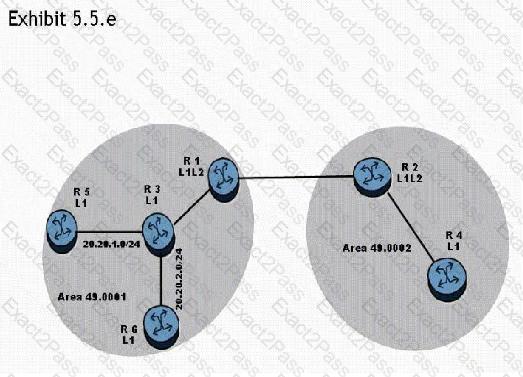
Click the exhibit button.

In the IS-IS network shown, router R1 has been configured to summarize network 20.20.1.0/24 and 20.20.2.0/24 as 20.20.0.0/16. Which router ' s routing table will be reduced compared to the routing table before the summarization?

A.

Router R1

B.

Router R2

C.

Routers R1 and R2

D.

Router R4

Question # 18

Which of the following correctly lists the 5 OSPF packet types?

A.

Hello, link state update, link state packet, link State acknowledgement, database description.

B.

Link state update, link state refresh, link state acknowledgement, database description, notification.

C.

Hello, link state refresh, link state update, link state acknowledgement, link state authentication.

D.

Hello, link state update, link state request, link state acknowledgement, database description.

Question # 19

Which of the following are similarities between OSPF and IS-IS? Choose two answers.

A.

Metric is based on hop count.

B.

Slow convergence after link failures.

C.

Support hierarchy through the use of areas.

D.

Support for CIDR.

E.

Link state updates sent using layer 3 multicast.

Question # 20

Which of the following statements regarding the election of the designated router (DR) by OSPF routers are true? (Choose two)


A.

The router with the lowest priority is the DR.

B.

The router with the highest priority is the DR.

C.

If priorities are the same, the DR is chosen based on the lowest RID.

D.

If priorities are the same, the DR is chosen based on the highest RID.

Go to page: