Summer Sale Special Limited Time 70% Discount Offer - Ends in 0d 00h 00m 00s - Coupon code: buysanta

Exact2Pass Menu

Alcatel-Lucent Interior Routing Protocols and High Availability

Last Update 11 hours ago Total Questions : 315

The Alcatel-Lucent Interior Routing Protocols and High Availability content is now fully updated, with all current exam questions added 11 hours ago. Deciding to include 4A0-101 practice exam questions in your study plan goes far beyond basic test preparation.

You'll find that our 4A0-101 exam questions frequently feature detailed scenarios and practical problem-solving exercises that directly mirror industry challenges. Engaging with these 4A0-101 sample sets allows you to effectively manage your time and pace yourself, giving you the ability to finish any Alcatel-Lucent Interior Routing Protocols and High Availability practice test comfortably within the allotted time.

Question # 61

Which type of LSA packets describe external routes originated within an NSSA area, and to what type are they converted to at the ABR?

A.

They are Type 7 within the area and are not modified at the ABR.

B.

They are Type 5 within the area and converted to Type 3 at the ABR.

C.

They are Type 5 within the area and are not modified at the ABR.

D.

They are Type 7 within the area and converted to Type 5 at the ABR.

Question # 62

Click on the exhibit.

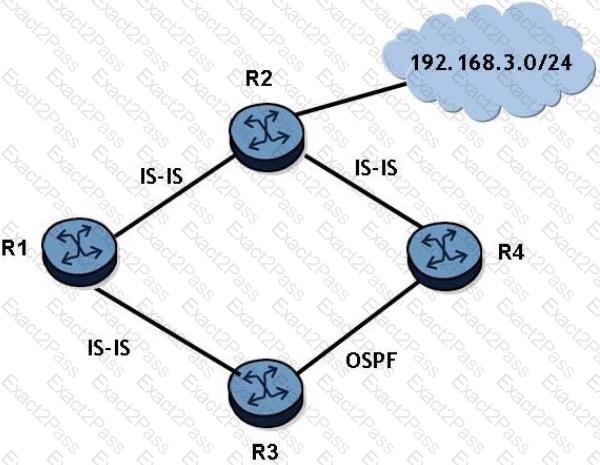
Router R2 has a directly connected interface to network 192.168.3.0/24 that is included in IS-IS.

If router R4 redistributes the IS-IS route to 192.168.3.0/24 into OSPF, router R3 will receive two routes to 192.168.3.0/24. Assume that all IS-IS routers are L1/L2 capable and are in the same area.

Which of the following is TRUE?

A.

Router R3 will install the IS-IS route in it ' s routing table.

B.

Router R3 will install the OSPF route in it ' s routing table.

C.

Router R3 will install an OSPF route and an IS-IS route in it ' s route table.

D.

There is not enough information to answer the question.

Question # 63

In an IS-IS network, why does the DIS create a pseudo-node?

A.

It represents a group of routers on the same non-broadcast network.

B.

It represents the topological database of the backbone network in an IS-IS network.

C.

It represents a broadcast sub-network.

D.

It represents the complete topology of an IS-IS area.

Question # 64

Which of the following route types must be manually configured and will not re-route traffic when a link failure occurs in its path?

A.

A route from IS-IS.

B.

A route from OSPF.

C.

A floating static route.

D.

A static route.

Question # 65

Which OSPFv3 LSA type is similar in function to the OSPFv2 Type 3 LSA?

A.

Link

B.

Intra-Area Prefix

C.

Inter-Area Prefix

D.

Inter-Area Router

Question # 66

Click on the exhibit.

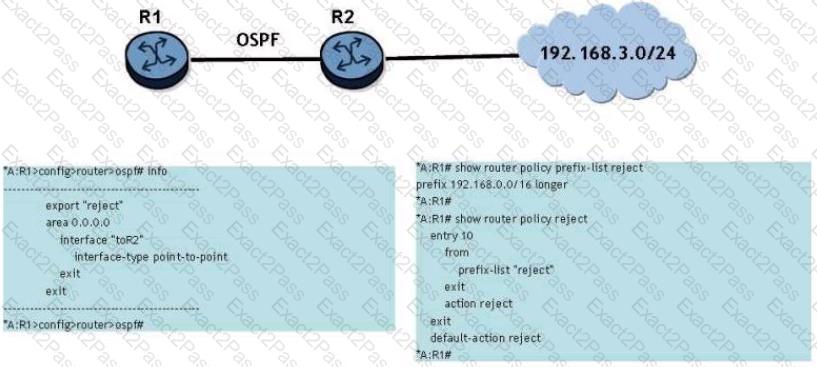
Router R2 uses OSPF to advertise the network 192.168.3.0/24 to router R1. A route policy has been configured to reject the route on router R1.

Why doesn ' t the route policy work?

A.

The prefix list " reject " should be " 192.168.3.0/16 exact " .

B.

Router R1 should be configured as an OSPF " asbr " .

C.

The policy was not " committed " after creation.

D.

Router R1 cannot reject the route because OSPF does not support import policies

Question # 67

Click on the exhibit.

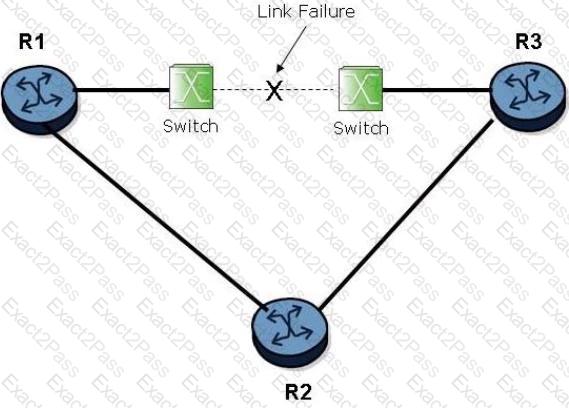
Before the link failure, all routers have operational OSPF adjacencies between them and there is a BFD session between routers R1 and R3.

After the link failure, which of the following affects the IGP convergence time?

A.

The convergence time depends on the value of the OSPF hello timers on routers R1 andR3.

B.

The convergence time depends on the value of the OSPF hello timers and Dead interval on routers R1 and R3.

C.

The convergence time depends on the value of the BFD interval and multiplier settings on routers R1 andR3.

D.

The convergence time depends on the time taken by the switches to detect the link failure.

Question # 68

In OSPFv3, which of the following LSA types carries prefixes and is only flooded in the area where it is generated?

A.

Link

B.

AS External

C.

Router

D.

Intra-Area Prefix

Question # 69

Which of the following statements regarding the IS-IS CSNP is false?

A.

CSNPs are used to maintain consistency in the link state database.

B.

CSNPs are advertised before an adjacency is formed with another router.

C.

There are two types of CSNPs: Level 1 and Level 2.

D.

CSNPs are advertised after an adjacency is formed with another router.

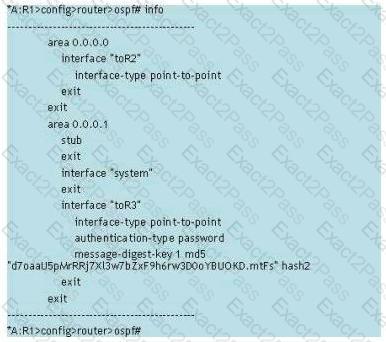
Question # 70

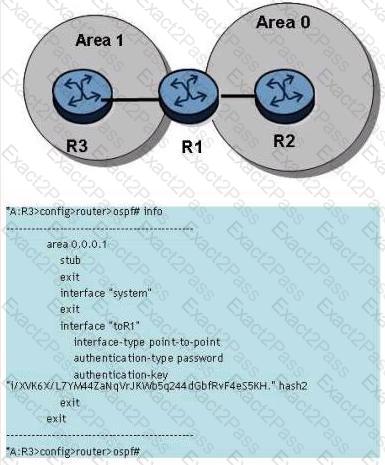
Click the exhibit button.

The OSPF adjacency between routers R3 and R1 is down. What is the problem?

A.

Area 1 of router R1 should not be configured as a stub.

B.

Router R3 has the incorrect authentication key type.

C.

Router R1 has the incorrect authentication key type.

D.

There is not enough information to tell.

Go to page: