Summer Sale Special Limited Time 70% Discount Offer - Ends in 0d 00h 00m 00s - Coupon code: buysanta

Exact2Pass Menu

Alcatel-Lucent Interior Routing Protocols and High Availability

Last Update 11 hours ago Total Questions : 315

The Alcatel-Lucent Interior Routing Protocols and High Availability content is now fully updated, with all current exam questions added 11 hours ago. Deciding to include 4A0-101 practice exam questions in your study plan goes far beyond basic test preparation.

You'll find that our 4A0-101 exam questions frequently feature detailed scenarios and practical problem-solving exercises that directly mirror industry challenges. Engaging with these 4A0-101 sample sets allows you to effectively manage your time and pace yourself, giving you the ability to finish any Alcatel-Lucent Interior Routing Protocols and High Availability practice test comfortably within the allotted time.

Question # 81

Which three IS-IS PDU types are used for database synchronization?

A.

Hellos, CSNPs, PSNPs

B.

LSPs. Hellos, CSNPs

C.

LSPs, PSNPs, Hellos

D.

LSPs, CSNPs, PSNPs

Question # 82

When multiple routing protocols offer a route for the same prefix, what part of the router is in charge of deciding which route to make active?

A.

The routing information base (RIB).

B.

The routing table manager (RTM).

C.

The equal cost multipath configuration (ECMP).

D.

The forwarding information base (FIB).

E.

The link state database (LSDB).

Question # 83

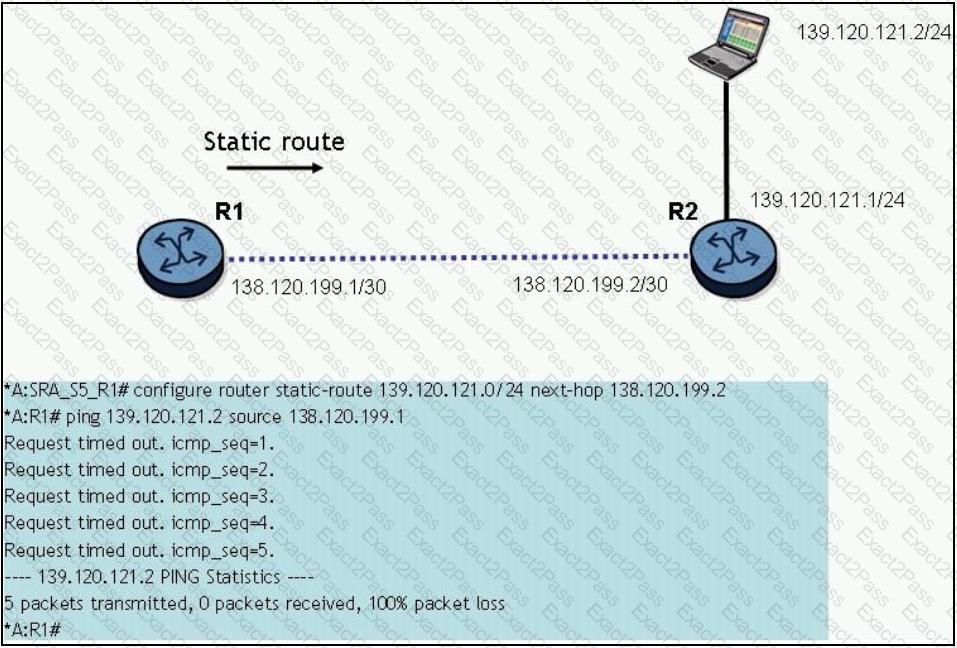
Click the exhibit button.

A static route has been configured on router R1 to reach the PC at 139.120.121.2. However, as shown in the exhibit, the ping fails. What is the most likely cause of the problem?

A.

Router R2 does not have a route to the system address of router R1 and therefore cannot respond to the ping.

B.

There is no default route configured on the PC.

C.

Router R2 does not have a route configured to the PC.

D.

Router R1 needs to be configured with a default route.

Question # 84

Click the exhibit button. Assuming point-to-point links, which of the following statements is true?

A.

Routers R1 and R2 are L2 routers. Routers R3 and R4 are L1/L2 routers

B.

Routers R1, R2, and R4 are L1/L2 routers. Router R3 is an L1 router,

C.

Routers R1, R2, and R3 are L2 routers. Router R4 is an L1 router,

D.

Routers R1 and R2 are L1/L2 routers. Routers R3 and R4 are L1 routers

Question # 85

A router sets the E bit in the flags of its Type 1 LSA. What does this indicate?

A.

The router is an ABR.

B.

The router is an ASBR.

C.

The router is at the end of a virtual link.

D.

The router ' s interface is in a stub area.

Question # 86

Which part of the NSAP address is used to indicate to the end system that a packet is to be processed by the router itself?

A.

AFI

B.

IDI

C.

HO-DSP

D.

NSEL

Question # 87

An interface has a MAC address of 24-16-4d-16-b5-3d. What link-local address will be assigned to this interface?

A.

fe80::2416:4dff:fe16:b53d

B.

fe80::2616:4dff:fe16:b53d

C.

ff80::2416:4dff:fe 16:b53d

D.

ff80::2616:4dff:fe 16:b53d

E.

fd80::2416:4dff:fe16:b53d

Question # 88

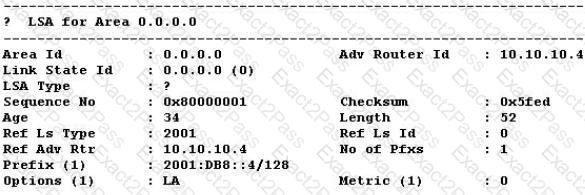
Click on the exhibit.

What type of OSPFv3 LSA is shown?

A.

Router LSA

B.

Network LSA

C.

Intra-Area Prefix LSA

D.

Link LSA

Question # 89

Which of the following best describes the forwarding of a IPv6 packet that has a destination anycast address?

A.

It is sent to all nodes on the local link.

B.

It is sent to all nodes on the local network.

C.

It is sent to all nodes that have joined the anycast group.

D.

It is sent to the nearest node that is assigned the anycast address

E.

It is sent to all nodes that are assigned the anycast address.

Question # 90

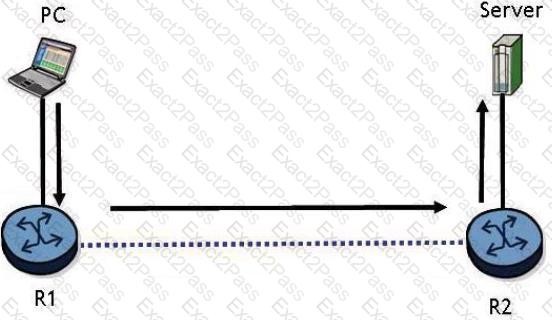
Click on the exhibit.

Which of the following best describes the format of data traffic sent to the server as it exits from the PC?


A.

The destination IP address will be the system IP address of router R1 and the destination MAC address will be the MAC address of the router R1 port connected to the PC.

B.

The destination IP address will be the IP address of the router R1 port connected to the PC and the destination MAC address will be the MAC address of the router R1 port connected to the PC.

C.

The destination IP address will be the IP address of the server and the destination MAC address will be the MAC address of the server.

D.

The destination IP address will be the IP address of the server and the destination MAC address will be the MAC address of the router R1 port connected to the PC.

Go to page: