Exact2Pass

Last Update 23 hours ago Total Questions : 328
The Credit and Counterparty Manager (CCRM) Certificate Exam content is now fully updated, with all current exam questions added 23 hours ago. Deciding to include 8011 practice exam questions in your study plan goes far beyond basic test preparation.
You'll find that our 8011 exam questions frequently feature detailed scenarios and practical problem-solving exercises that directly mirror industry challenges. Engaging with these 8011 sample sets allows you to effectively manage your time and pace yourself, giving you the ability to finish any Credit and Counterparty Manager (CCRM) Certificate Exam practice test comfortably within the allotted time.
Under the actuarial (or CreditRisk+) based modeling of defaults, what is the probability of 4 defaults in a retail portfolio where the number of expected defaults is 2?
For an investor with a long position in market index futures, which of the following is a primary risk:
The unexpected loss for a credit portfolio at a given VaR estimate is defined as:
Company A issues bonds with a face value of $100m, sold at $98. Bank B holds $10m in face of these bonds acquired at a price of $70. Company A then defaults, and the recovery rate is expected to be 30%. What is Bank B's loss?
Which of the following event types is hacking damage classified under Basel II operational risk classifications?
Which of the following cannot be used as an internal credit rating model to assess an individual borrower:
The generalized Pareto distribution, when used in the context of operational risk, is used to model:
An asset has a volatility of 10% per year. An investment manager chooses to hedge it with another asset that has a volatility of 9% per year and a correlation of 0.9. Calculate the hedge ratio.
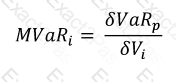
Which of the following best describes the concept of marginal VaR of an asset in a portfolio:
Which of the following statements is true in respect of a non financial manufacturing firm?
I. Market risk is not relevant to the manufacturing firm as it does not take proprietary positions
II. The firm faces market risks as an externality which it must bear and has no control over
III. Market risks can make a comparative assessment of profitability over time difficult
IV. Market risks for a manufacturing firm are not directionally biased and do not increase the overall risk of the firm as they net to zero over a long term time horizon


 A mathematical equation with numbers and symbols
Description automatically generated
A mathematical equation with numbers and symbols
Description automatically generated