Exact2Pass

Last Update 16 hours ago Total Questions : 187
The Operationalizing Machine Learning and Generative AI Solutions content is now fully updated, with all current exam questions added 16 hours ago. Deciding to include AI-300 practice exam questions in your study plan goes far beyond basic test preparation.
You'll find that our AI-300 exam questions frequently feature detailed scenarios and practical problem-solving exercises that directly mirror industry challenges. Engaging with these AI-300 sample sets allows you to effectively manage your time and pace yourself, giving you the ability to finish any Operationalizing Machine Learning and Generative AI Solutions practice test comfortably within the allotted time.
You manage an Azure Machine Learning workspace. You have an environment for training jobs which uses an existing Docker image.
A new version of the Docker image is available.
You need to use the latest version of the Docker image for the environment configuration by using the Azure Machine Learning SDK v2.
What should you do?
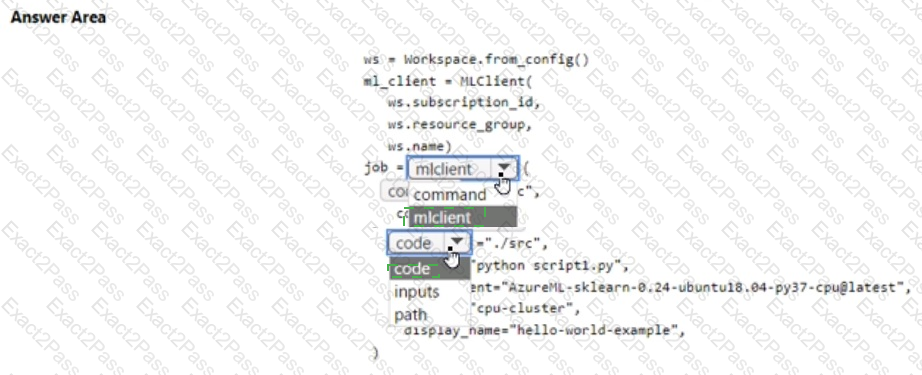
You create an Azure Machine learning workspace. The workspace contains a folder named src. The folder contains a Python script named script 1 .py.
You use the Azure Machine Learning Python SDK v2 to create a control script. You must use the control script to run script l.py as part of a training job.
You need to complete the section of script that defines the job parameters.
How should you complete the script? To answer, select the appropriate options in the answer area.
NOTE: Each correct selection is worth one point.
Note: This question is part of a series of questions that present the same scenario. Each question in the series contains a unique solution that might meet the stated goals. Some question sets might have more than one correct solution, while others might not have a correct solution.
After you answer a question in this section, you will NOT be able to return to it. As a result, these questions will not appear on the review screen.
You work in Microsoft Foundry with a prompt flow.
You must manually evaluate prompts and compare results across prompt variants.
You need to capture the inputs, outputs, token usage, and latencies for each flow run for the evaluation.
Solution: Use the prompt flow SDK to enable tracing for the flow before executing runs. Then run the flow to generate traceable results.
Does the solution meet the goal?
You manage an Azure Machine Learning workspace.
You must create and configure a compute cluster for a training job by using Python SDK v2.
You need to create a persistent Azure Machine Learning compute resource, specifying the fewest possible properties.
Which two properties should you define? Each correct answer presents part of the solution.
NOTE: Each correct selection is worth one point.
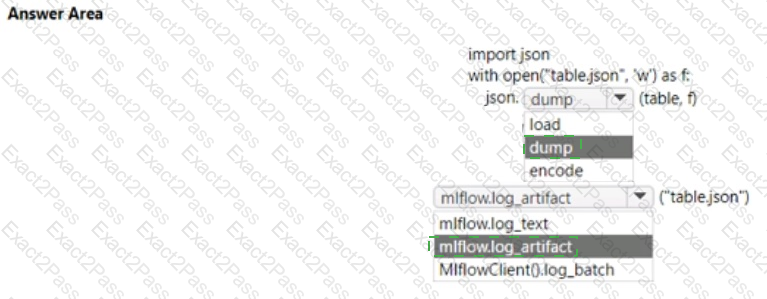
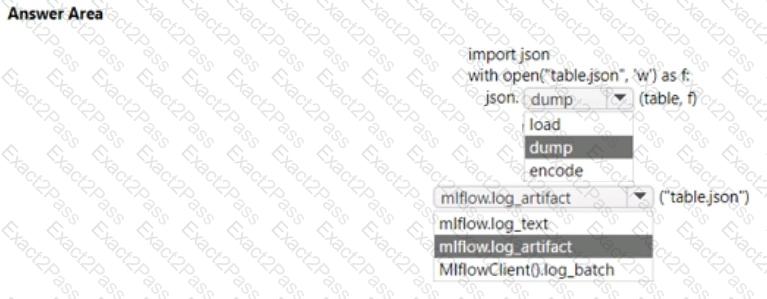
You create an Azure Machine Learning workspace.
You must use the Python SDK v2 to implement an experiment from a Jupyter notebook in the workspace. The experiment must log a table in the following format:
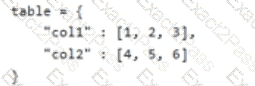
You need to complete the Python code to log the table.
How should you complete the code? To answer, select the appropriate options in the answer area.
NOTE: Each correct selection is worth one point.
You have an Azure subscription named Sub1 that contains an Azure
• a registered MLflow model named Model1
• an online endpoint named Endpoint1
Outbound network connectivity from Endpointl is blocked. You need to deploy ModeM to Endpointl. What should you do first?
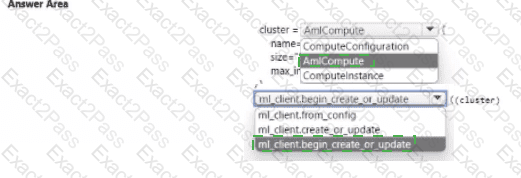
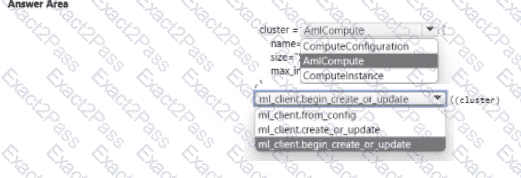
You create a new Azure Machine Learning workspace with a compute cluster.
You need to create the compute cluster asynchronously by using the Azure Machine Learning Python SDK v2.
How should you complete the code segment? To answer, select the appropriate options in the answer area.
NOTE: Each correct selection is worth one point
Note: This question is part of a series of questions that present the same scenario. Each question in the series contains a unique solution that might meet the stated goals. Some question sets might have more than one correct solution, while others might not have a correct solution.
After you answer a question in this section, you will NOT be able to return to it. As a result, these questions will not appear on the review screen.
You work in Microsoft Foundry with a prompt flow.
You must manually evaluate prompts and compare results across prompt variants.
You need to capture the inputs, outputs, token usage, and latencies for each flow run for the evaluation.
Solution: In Microsoft Foundry, turn on Tracing for the prompt flow of the project and execute test runs to produce trace data.
Does the solution meet the goal?
You need to standardize how Fabrikam Inc. manages machine learning assets.
Which action should you perform first?
You need to isolate training workloads while remaining cost-aware to address Fabrikam Inc.’s issues, constraints, and technical requirements.
What should you implement?