Exact2Pass

Last Update 16 hours ago Total Questions : 187
The Operationalizing Machine Learning and Generative AI Solutions content is now fully updated, with all current exam questions added 16 hours ago. Deciding to include AI-300 practice exam questions in your study plan goes far beyond basic test preparation.
You'll find that our AI-300 exam questions frequently feature detailed scenarios and practical problem-solving exercises that directly mirror industry challenges. Engaging with these AI-300 sample sets allows you to effectively manage your time and pace yourself, giving you the ability to finish any Operationalizing Machine Learning and Generative AI Solutions practice test comfortably within the allotted time.
Fabrikam Inc. must improve its deployment process because traditional machine learning models are deployed manually and the organization has limited rollback capability .
You need to recommend a deployment approach that supports staged rollout and rollback while minimizing operational overhead.
Which deployment approach should you recommend?
You create an Azure Machine Learning workspace named woricspace1. The workspace contains a Python SDK v2 notebook that uses MLflow to collect model training metrics and artifacts from your local computer.
You must reuse the notebook to run on Azure Machine Learning compute instance in workspace1.
You need to continue to log metrics and artifacts from your data science code.
What should you do?
You manage an Azure Machine Learning workspace by using the Azure CLI ml extension v2. You need to define a YAML schema to create a compute cluster. Which schema should you use?
When comparing prompt variants, the team plans to assess whether the generated responses are grammatically correct.
You need to evaluate the quality of the language from the generated responses.
Which evaluator should you use?
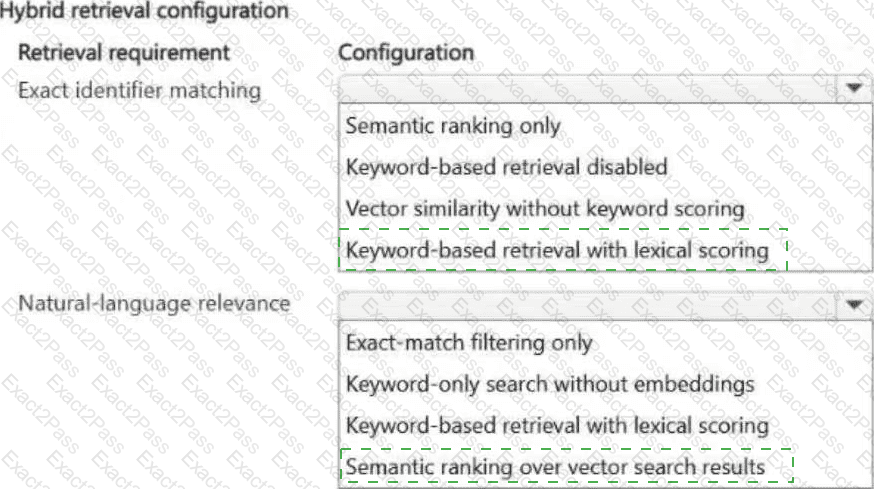
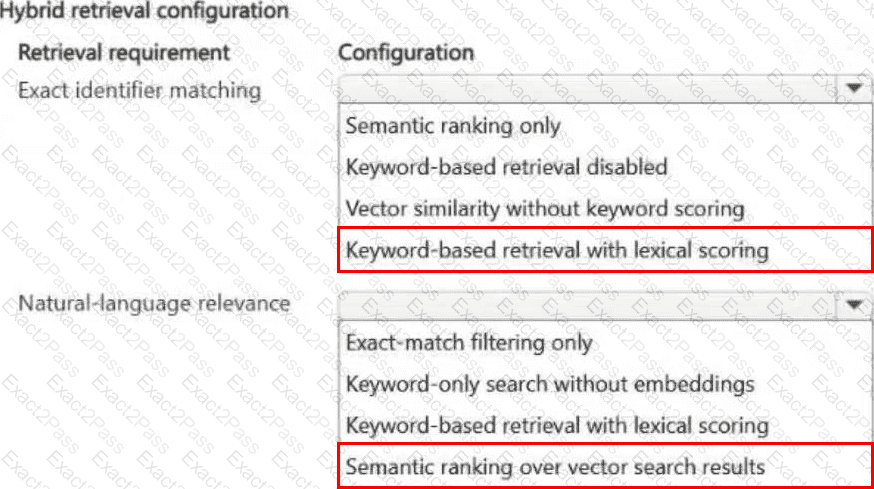
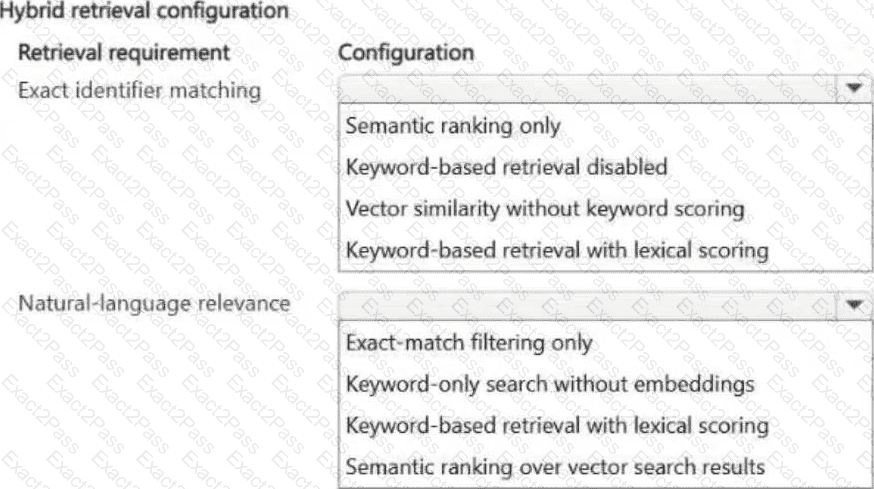
You manage a Retrieval-Augmented Generation (RAG) system that uses Azure AI Search to retrieve documents from an indexed knowledge base.
The system must support the following retrieval requirements:
Queries that include exact policy identifiers must return matching documents even when semantic similarity is low.
Natural-language questions must prioritize semantically relevant documents even when keywords are not an exact match.
You need to configure the retrieval approach to meet the requirements.
How should you configure the retrieval behavior for each requirement? To answer, select the appropriate options in the answer area. NOTE: Each correct selection is worth one point.
A team is building a Retrieval-Augmented Generation (RAG) system.
The team observes that the retrieved documents are often irrelevant or incomplete.
You need to improve retrieval accuracy.
What should you adjust?
A team manages prompts that are used by a generative AI application built on Microsoft Foundry. Multiple developers contribute prompt updates, and changes must be reviewed and tracked over time.
The team requires that:
Prompt changes are reviewed before being applied to the version in production.
Previous prompt versions can be restored if issues occur.
Prompt updates follow the same governance practices as the application code.
You need to implement a controlled process for managing and updating prompts in production.
How should you manage prompt updates to meet the requirements? To answer, move the appropriate actions to the correct requirements. You may use each action once, more than once, or not at all. You may need to move the split bar between panes or scroll to view content. NOTE: Each correct selection is worth one point.

You create an Azure Machine Learning workspace.
You plan to write an Azure Machine Learning SDK for Python v2 script that logs an image for an experiment. The logged image must be available from the images tab in Azure Machine Learning Studio.
You need to complete the script.
Which code segments should you use? To answer, select the appropriate options in the answer area.
NOTE: Each correct selection is worth one point.

You manage an Azure Machine learning workspace. You develop a machine learning model.
You must deploy the model to use a low-priority VM with a pricing discount.
You need to deploy the model.
Which compute target should you use?
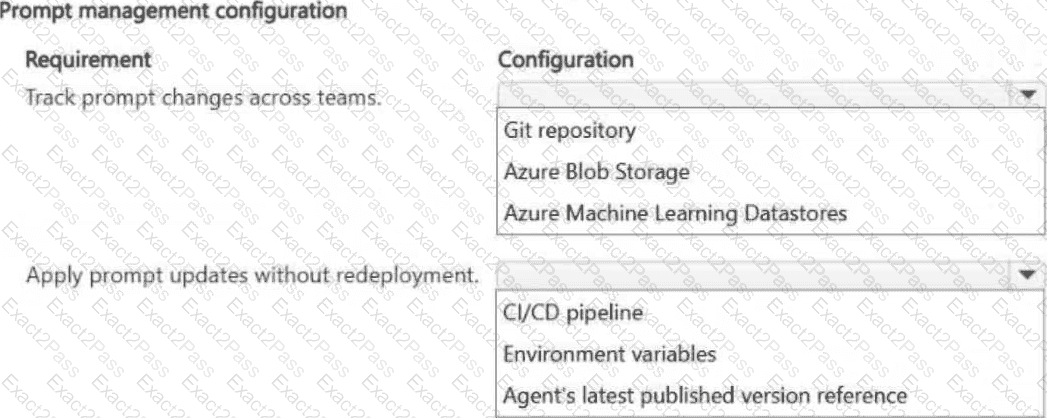
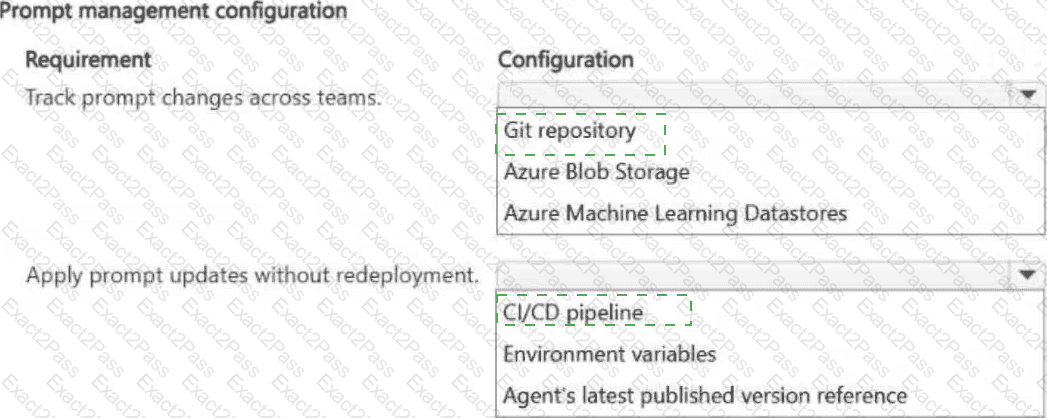
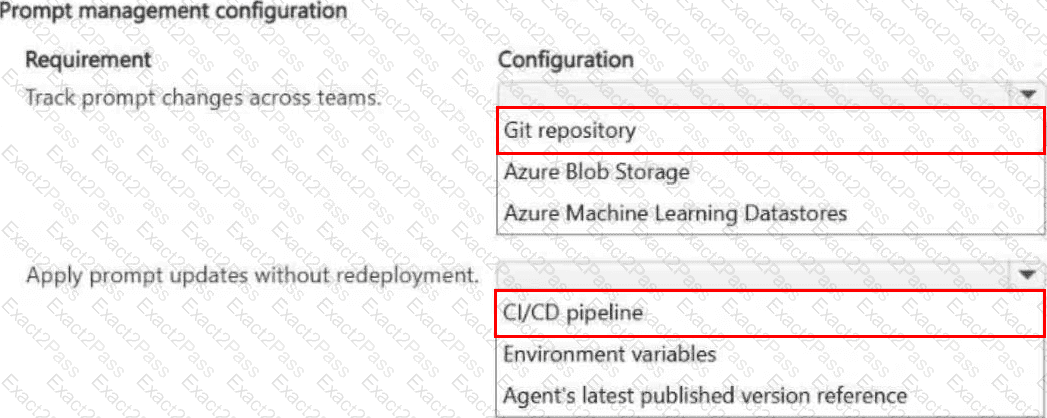
A team is building a generative AI agent by using Retrieval-Augmented Generation (RAG) in Microsoft Foundry.
The team frequently updates prompt content. The team must be able to track changes across contributors while avoiding full application redeployments.
You need to enable rapid prompt iteration with traceability. Applications consuming the agent must be able to use updated prompts without requiring redeployment.
What should you configure for each requirement? To answer, select the appropriate options in the answer area. NOTE: Each correct selection is worth one point.