Exact2Pass

Last Update 17 hours ago Total Questions : 328
The Designing and Implementing Microsoft Azure Networking Solutions content is now fully updated, with all current exam questions added 17 hours ago. Deciding to include AZ-700 practice exam questions in your study plan goes far beyond basic test preparation.
You'll find that our AZ-700 exam questions frequently feature detailed scenarios and practical problem-solving exercises that directly mirror industry challenges. Engaging with these AZ-700 sample sets allows you to effectively manage your time and pace yourself, giving you the ability to finish any Designing and Implementing Microsoft Azure Networking Solutions practice test comfortably within the allotted time.
You have an Azure virtual network that contains two subnets named Subnet1 and Subnet2. Subnet1 contains a virtual machine named VM1. Subnet2 contains a virtual machine named VM2.
You have two network security groups (NSGs) named NSG1 and NSG2. NSG1 has 100 inbound security rules and is associated to VM1. NSG2 has 200 inbound security rules and is associated to Subnet1.
VM2 cannot connect to VM1.
You suspect that an NSG rule blocks connectivity.
You need to identify which rule blocks the connection. The issue must be resolved as quickly as possible.
Which Azure Network Watcher feature should you use?
Note: This question is part of a series of questions that present the same scenario. Each question in the series contains a unique solution that might meet the stated goals. Some question sets might have more than one correct solution, while others might not have a correct solution.
After you answer a question in this section, you will NOT be able to return to it. As a result, these questions will not appear in the review screen.
You have an Azure application gateway that has Azure Web Application Firewall (WAF) enabled.
You configure the application gateway to direct traffic to the URL of the application gateway.
You attempt to access the URL and receive an HTTP 403 error. You view the diagnostics log and discover the following error.
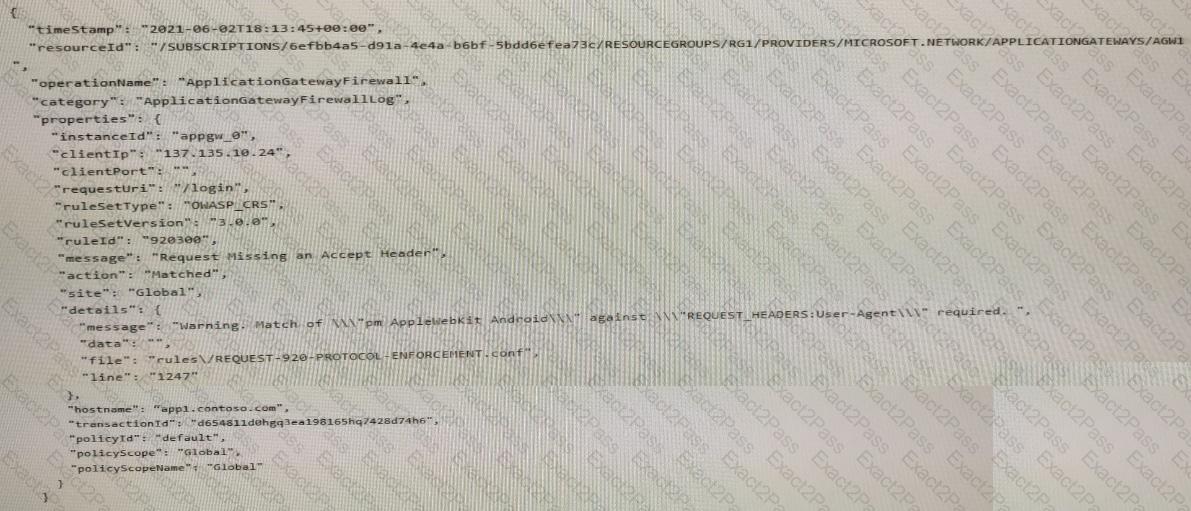
You need to ensure that the URL is accessible through the application gateway.
Solution: You disable the WAF rule that has a ruleld of 920300.
Does this meet the goal?
Note: Th is question is part of a series of questions that present the same scenario. Each question in the series contains a unique solution that might meet the stated goals. Some question sets might have more than one correct solution, while others might not have a correct solution.
After you answer a question in this section, you will NOT be able to return to it. As a result, these questions will not appear in the review screen.
You have two Azure virtual networks named Vnet1 and Vnet2.
You have a Windows 10 de vice named Client1 that connects to Vnet1 by using a Point-to-Site (P2S) IKEv2 VPN.
You implement virtual network peering between Vnet1 and Vnet2. Vnet1 allows gateway transit. Vnet2 can use the remote gateway.
You discover that Client1 cannot communicate with Vnet2.
You need to ensure that Client1 can communicate with Vnet2.
Solution: You reset the gateway of Vnet1.
Does this meet the goal?
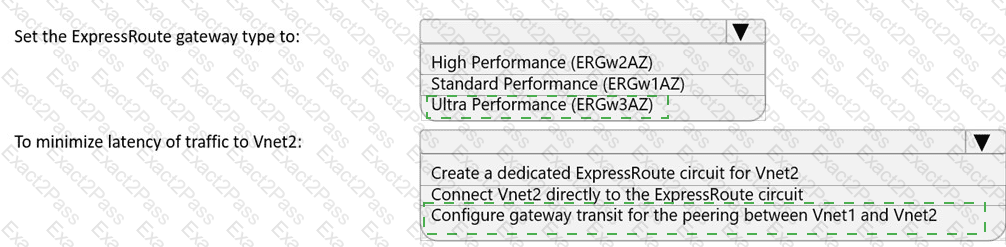
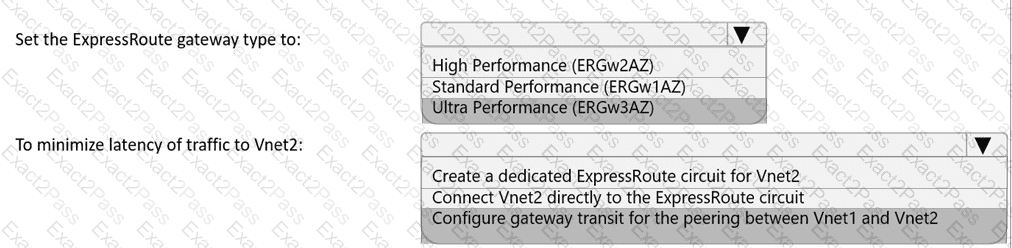
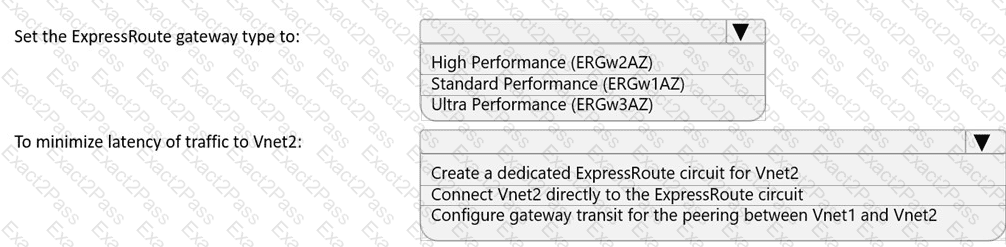
You need to recommend a configuration for the ExpressRoute connection from the Boston datacenter. The solution must meet the hybrid networking requirements and business requirements.
What should you recommend? To answer, select the appropriate options in the answer area.
NOTE: Each correct selection is worth one point.
Task 2
You need to create an Azure Firewall instance named FW1 that meets the following requirements:
• Has an IP address from the address range of 10.1.255.0/24
• Uses a new Premium firewall policy named FW-pohcy1
• Routes traffic directly to the internet
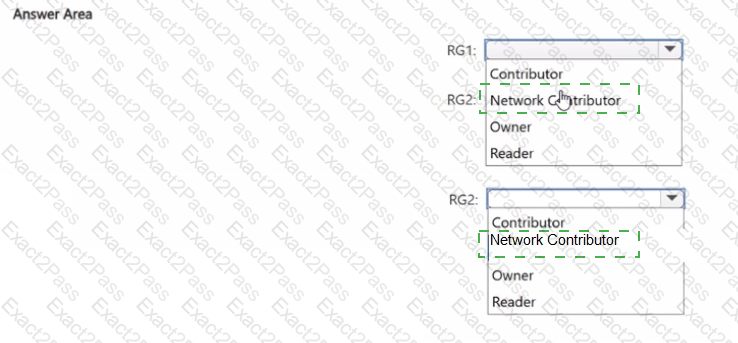
You have an Azure subscription that contains a user named User1 and the resources shown in the following table.
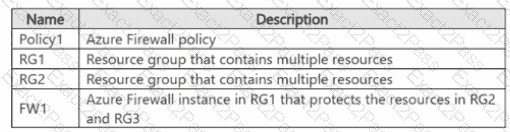
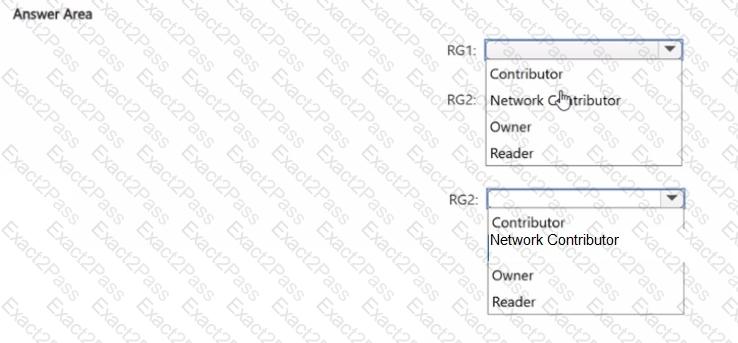
You need to ensure that User1 can associate Policy1 to FW1 by using Azure Firewall Manager. The solution must follow the principle of least privilege.
Which role should you assign to User1 for each resource group? To answer, select the appropriate options in the answer area.
NOTE: Each correct selection is worth one point.
You have an Azure subscription that contains a virtual network named VNet1. VNet1 has a subnet mask of /24. You plan to implement an Azure application gateway that will have the following configurations:
• Public endpoints: 1
• Private endpoints: 1
• Minimum instances: 1
• Maximum instances: 10
You need to configure the address space for the subnet of the application gateway. The solution must minimize the number of IP addresses allocated to the application gateway subnet.
What is the minimum number of assignable IP addresses required?
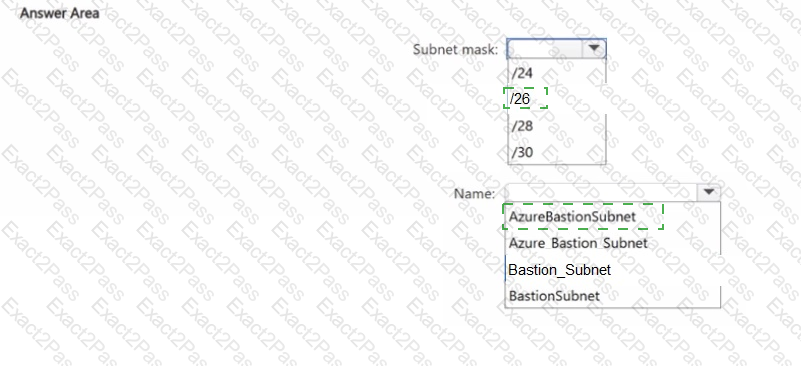
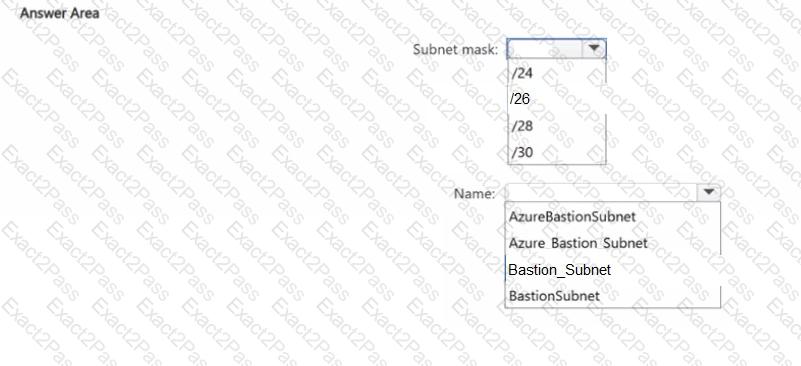
You have an Azure subscription that contains 20 virtual machines and a virtual network named VNetl.
You plan to provide access to the virtual machines by using Azure Bastion.
You need to configure a subnet for Azure Bastion. The solution must minimize the number of IP addresses required for the subnet
How should you configure the subnet? To answer, select the appropriate options in the answer area.
NOTE: Each correct selection is worth one point.
You have an Azure subscription.
You need to deploy an App Service web app named App1 that will use an Azure application gateway. The estimated usage for App1 is 250,000 persistent connections.
What is the minimum number of app instances you should configure?
Task 5
You need to ensure that requests for wwwjelecloud.com from any of your Azure virtual networks resolve to frontdoor1.azurefd.net.