Exact2Pass

Last Update 22 hours ago Total Questions : 510
The Administering Windows Server content is now fully updated, with all current exam questions added 22 hours ago. Deciding to include AZ-802 practice exam questions in your study plan goes far beyond basic test preparation.
You'll find that our AZ-802 exam questions frequently feature detailed scenarios and practical problem-solving exercises that directly mirror industry challenges. Engaging with these AZ-802 sample sets allows you to effectively manage your time and pace yourself, giving you the ability to finish any Administering Windows Server practice test comfortably within the allotted time.
Technical requirements: Promote a new server named DC4 that runs Windows Server 2022 to a domain controller. Replicate the virtual machines from Cluster2 to an Azure Recovery Services vault. Centrally manage performance alerts in Azure for all the domain controllers. Ensure that User1 can recover objects from the Active Directory Recycle Bin. Migrate Share1 to Server2, including all the share and folder permissions. Back up Server4 and all data to an Azure Recovery Services vault. Use Hyper-V Replica to protect the virtual machines in Cluster3. Implement BitLocker Drive Encryption (BitLocker) on Server4. Whenever possible, use the principle of least privilege. You need to meet the technical requirements for Cluster3. What should you include in the solution?
Technical requirements: Promote a new server named DC4 that runs Windows Server 2022 to a domain controller. Replicate the virtual machines from Cluster2 to an Azure Recovery Services vault. Centrally manage performance alerts in Azure for all the domain controllers. Ensure that User1 can recover objects from the Active Directory Recycle Bin. Migrate Share1 to Server2, including all the share and folder permissions. Back up Server4 and all data to an Azure Recovery Services vault. Use Hyper-V Replica to protect the virtual machines in Cluster3. Implement BitLocker Drive Encryption (BitLocker) on Server4. Whenever possible, use the principle of least privilege. You need to meet the technical requirements for User1. To which group in contoso.com should you add User1?
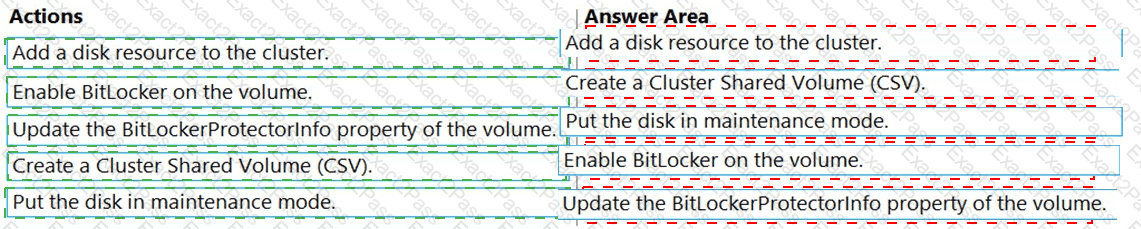
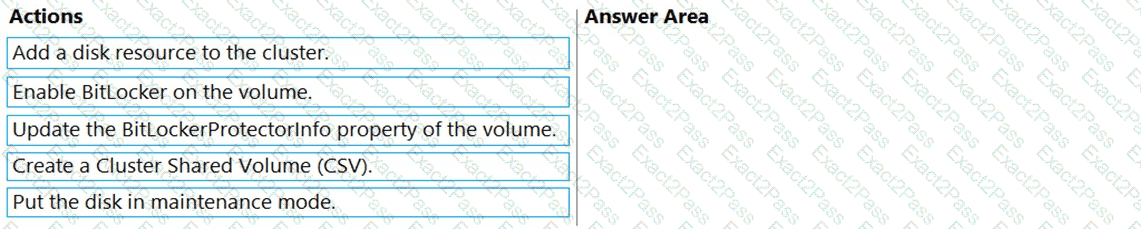
You are planning the implementation of Cluster2 to support the on-premises migration plan. You need to ensure that the disks on Cluster2 meet the security requirements. In which order should you perform the actions? To answer, move all actions from the list of actions to the answer area and arrange them in the correct order.
You are planning the migration of Archive1 to support the on-premises migration plan. What is the minimum number of IP addresses required for the node and cluster roles on Cluster3?
You are planning the deployment of Microsoft Sentinel. Which type of Microsoft Sentinel data connector should you use to meet the security requirements?
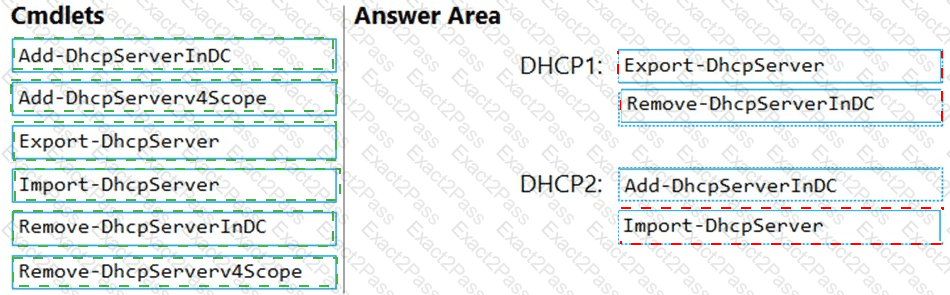
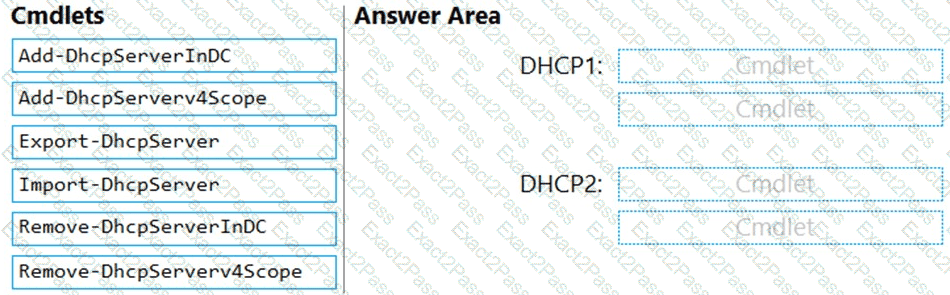
You are planning the DHCP1 migration to support the DHCP migration plan. Which two PowerShell cmdlets should you run on DHCP1, and which two PowerShell cmdlets should you run on DHCP2? To answer, drag the appropriate cmdlets to the correct servers. Each cmdlet may be used once, more than once, or not at all. You may need to drag the split bar between panes or scroll to view content. NOTE: Each correct selection is worth one point.
You have an Azure subscription. The subscription contains a virtual machine named VM1 that runs Windows Server and uses Azure Disk Encryption. You need to identify which Azure key vault stores the encryption keys for VM1. The solution must minimize administrative effort. Which PowerShell cmdlet should you run?
Note: This question is part of a series of questions that present the same scenario. Each question in the series contains a unique solution that might meet the stated goals. Your network contains an Active Directory Domain Services (AD DS) domain. The domain contains servers that run Windows Server and store BitLocker recovery keys in AD DS. A server named Server1 starts in BitLocker recovery mode. You need to identify the BitLocker recovery key for Server1. Solution: You run repair-bde.exe by using a BitLocker key package exported from AD DS. Does this meet the goal?
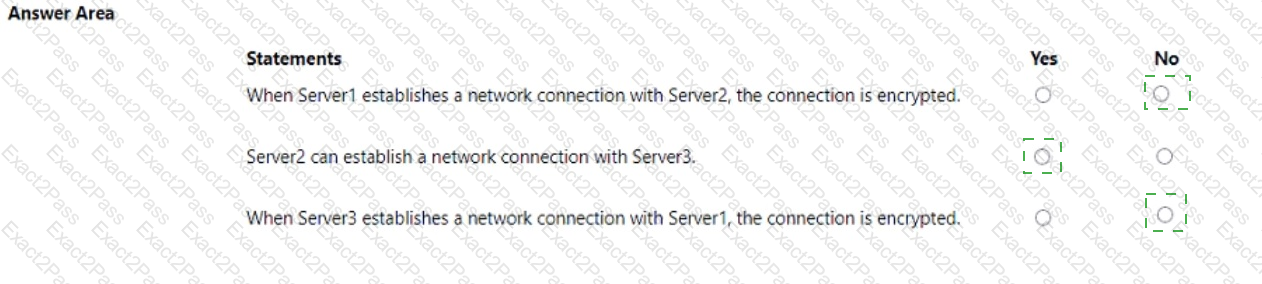
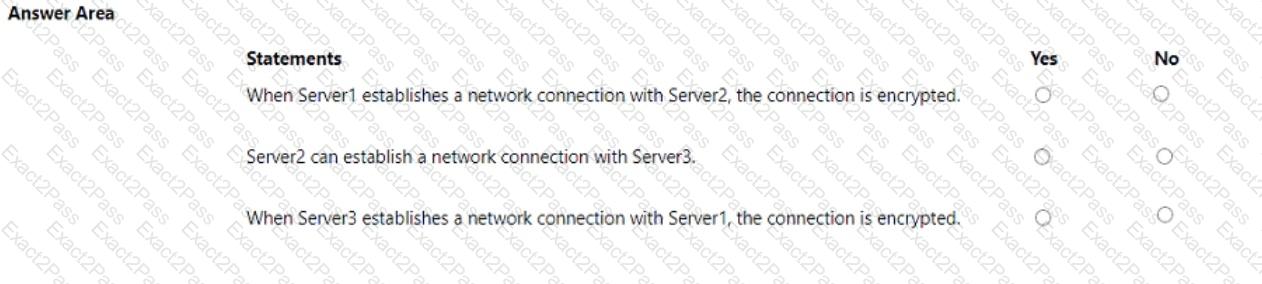
Your network contains an Active Directory Domain Services (AD DS) domain. The domain contains three servers named Server1, Server2, and Server3 that run Windows Server. All the servers are on the same network and have network connectivity.
On Server1, Windows Defender Firewall has a connection security rule that has the following settings:
• Rule Type: Server-to-server
• Endpoint 1: Any IP address
• Endpoint 2: Any IP address
• Requirements: Require authentication for inbound connections and request authentication for outbound connections
• Authentication Method: Computer (Kerberos V5)
• Profile: Domain, Private, Public
• Name: Rule1
For each of the following statements, select Yes if the statement is true. Otherwise, select No. NOTE: Each correct selection is worth one point.
Your network contains an on-premises Active Directory Domain Services (AD DS) domain named contoso.com. You have an Azure virtual network named VNet1 that is connected to the on-premises network by using a Site-to-Site (S2S) VPN. VNet1 contains a domain-joined virtual machine named VM1 that hosts an application named App1. App1 uses Kerberos authentication and updates objects in AD DS. An Azure Firewall filters communication from VM1 to the domain controllers in contoso.com. You need to deploy domain controllers to VNet1. The solution must support the requirements of VM1 and provide domain controller redundancy in Azure. What should you deploy?