Exact2Pass

Last Update 12 hours ago Total Questions : 497
The Certified Business Analysis Professional content is now fully updated, with all current exam questions added 12 hours ago. Deciding to include CBAP practice exam questions in your study plan goes far beyond basic test preparation.
You'll find that our CBAP exam questions frequently feature detailed scenarios and practical problem-solving exercises that directly mirror industry challenges. Engaging with these CBAP sample sets allows you to effectively manage your time and pace yourself, giving you the ability to finish any Certified Business Analysis Professional practice test comfortably within the allotted time.
An insurance company wants to increase sales by 15% and customer retention by 10% within 1 calendar year.
Various strategies to achieve this were considered and a restructure to the existing pricing model is selected to help achieve these goals.
A business analyst (BA) works with stakeholders such as actuaries, product specialists, sales staff, risk managers, and underwriters who agree to applying varying levels of discounts to customers based on:
• Total annual premium the customer has with the company (Financial worth)
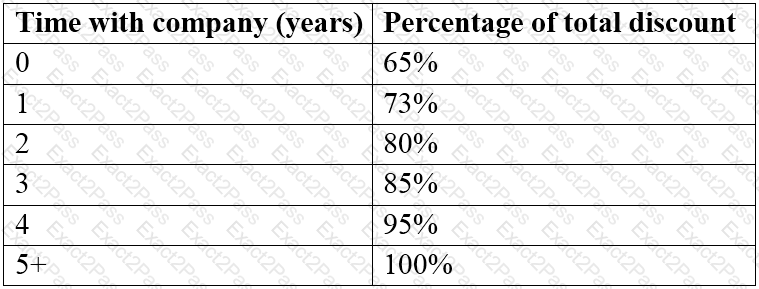
• Time with the insurance company (Loyalty)
Various financial models are considered but the stakeholders agree that an initial applicable discount is determined based on the customer ' s overall premium:
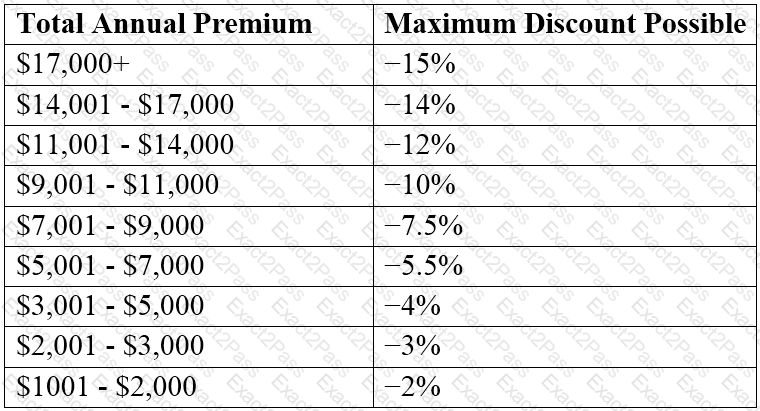
The percentage of the maximum possible discount available to the customer is adjusted based on time with the company:
What did the BA create to ensure that everyone who needed to be included had been?
After the new report " Customer Sales by Date " was deployed last week, the sales team is now unable to generate the previously existing report " Consolidated Sales by Customer, " which is causing customer dissatisfaction.
What could the business analyst (BA) have assessed to prevent this situation?
The technology team at a financial institution has successfully constructed a software application to be deployed as part of a digital banking strategy. A business analyst (BA) has completed a review of the current state description and now needs to evaluate the solution and determine limiting factors for value realization.
What additional input is required to perform the assessment of enterprise limitations?
An organization is trying to streamline its current processes to improve performance and reduce costs. A business analyst (BA) conducted a process improvement workshop and identified the following issues as the top three items to be addressed:
1: There are multiple teams to define systems, functionality, and content, in many instances, multiple teams are defining the same Functionalities while other functionalities are not being defined at all. leading to unclear understanding of business requirements
2: Product specification forms are published each year. A comparison tool is used to evaluate specification differences between yearly releases; but does not adequately identify changes between versions and needs to be improved.
3: Training consists of a new team member shadowing a seasoned team member. There are no written training materials or formal training sources therefore training is inconsistent and not meeting the needs of the organization.
The BA learns that formal training programs are not often devised for teams as small and diverse as this team, but still believes it is a viable solution to the training need. What type of analysis would help the BA gain approval to proceed with creating this type of training program for this team?
Which one of the following is an example of a non-negotiable demand by a stakeholder during the requirements prioritization session?
After releasing its beta version of a travel assistance mobile application, a travel company has received feedback from a public survey proposing new features. The company is struggling with the large number of ideas and would like to make a decision on which to consider in the next implementation cycle.
Which of the following considerations should be used first for filtering ideas?
A software development company is in the process of creating a new product for their customer base. It has been several years since such a project has been initiated and the organization has created a new team to own and develop the product. The project team will be evaluated by the successful adoption of the product, which will be developed over the next 12 months.
The team ' s business analyst (BA) has analyzed the current state in partnership with the product owner and has been meeting with senior management to identify the goals that need to be attained. A broad view of the business has been analyzed in order to have an understanding of how the company is currently providing value to its customer base.
What has the BA evaluated to help determine value of the project?
Company A is a nation-wide leader in commercial demolition. Having just celebrated its 100th year of operations, the company decided to begin doing work internationally. The current system used for reporting company finances is unable to keep pace with the potential demands of doing work in geographically dispersed locations. Therefore, the company decided to replace its client-based Profit & Loss (P & L) reporting system with a more robust, web-based system. This will ensure transparency across the organization and enable better decision making.
The business analyst (BA) at Company A has recently completed several rounds of elicitation to determine the requirements for the new, web-based system. Over 1250 requirements were elicited. An initial Requirements Traceability Matrix (RTM) has been drafted, and a subset of the RTM can be seen below:
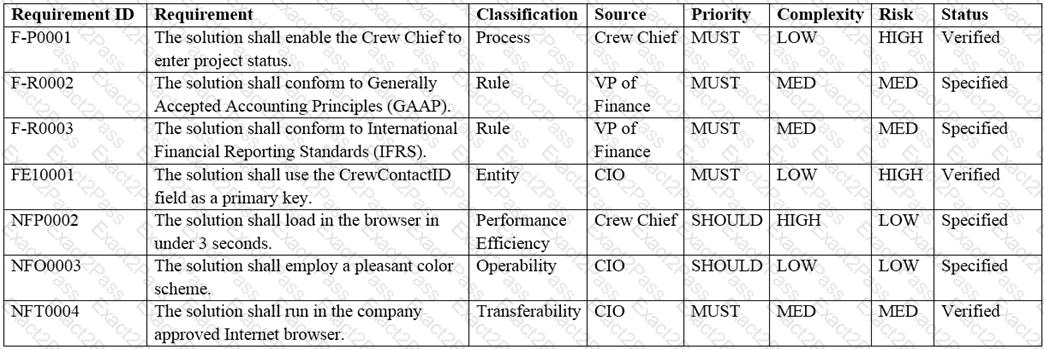
While verifying the requirements, the BA notices that Requirement ID NFO0003 does not meet the " unambiguous " or the " testable " characteristics of requirements quality. The BA plans to re-write the requirement.
Which of the following requirements is both unambiguous and testable?
A large insurance company wants to buy a new claims processing system or upgrade one of its two existing system. Each year the claims department is given a $3.5 million budget to spend. Time is of the essence since there are tome regulatory charges that will be coming the following year that will require several features that currently neither one of the two claims System currently support.
There are eight stakeholders involved in this initiative. There are local to where the claim system are managed, while five are located across the country. The business analyst (BA) struggled to get all stakeholders to agree on the desired features but ultimately got agreement on ten identified key features for the new claims system. The BA was able to build a current state and future state process model which included all ten key features.
System a process 75% of the company ' s claims. It is 5 years old and the claim processors love it because it is easy to use. However, it must go offline for two hours each day. The code is very module so it does have flexibility to be modified. To upgrade system A to have all ten features it would cost $5 million. System A would be at capacity if it were to process all of the company ' s claims.
System B process 25% of the company ' s claims. It is an older mainframe system, but rarely goes offline. It could easily handle double the number of claims that system A processes. However, it has a lot of legacy code and would cost $6 million to upgrade.
Both systems have some of the desired key features. But neither system has all ten. The cost to buy a new system would be $7 million.
Below is the estimated cost for each feature in priority order.

If System A is unanimously selected to be the system for upgrade but the technical lead says that System A will have to be taken offline for 3 months, what kind of strategy should the project team develop while system A is offline?
Before investing further in the project, a customer and the stakeholder of the project wants to be able to visualize the final product. Which elicitation technique should the business analyst (BA) select?

