Exact2Pass

Last Update 12 hours ago Total Questions : 497
The Certified Business Analysis Professional content is now fully updated, with all current exam questions added 12 hours ago. Deciding to include CBAP practice exam questions in your study plan goes far beyond basic test preparation.
You'll find that our CBAP exam questions frequently feature detailed scenarios and practical problem-solving exercises that directly mirror industry challenges. Engaging with these CBAP sample sets allows you to effectively manage your time and pace yourself, giving you the ability to finish any Certified Business Analysis Professional practice test comfortably within the allotted time.
In a risk assessment exercise of a software implementation program, the business analyst (BA) has successfully computed the probability of occurrence (POC) and the cost of impact for each of the identified risks as follows:
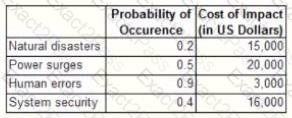
Which of the following will have the highest negative impact to value?
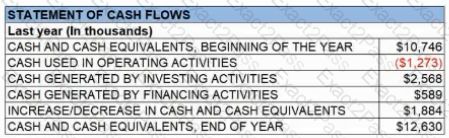
The table illustrate the statement of cash flower for a courier company for the last fiscal year:
Due to aggressive market competition the management of the company performed a strategy review and based on their0-findings and the current market conditions, they came up with strategic and tactical changes in order to keep a competitive market position.
In order to strength customer retention strategies through a new competitive advantage, the company is considering implementing a live parcel tracking system. The added value will be that the customers may determine the exact location on of the parcel whether it is in a warehouse, crossing the ocean through an overseas the exact location of th parcel whether it is in a warehouse, crossing the ocean through an overseas the ship, or travelling in a delivery truck at any time. The system tracks the location of the parcel by tracking the vehicle in which it is contained. However, for a group of old delivery trucks, it was noticed that the engine sound and vibration disturbed the tracking signal and caused of management would like to sell these vehicles and replace them with newer ones, the Chief Financial Officer (CFO) was strongly against that approach. The CFO argoad that instead of hanging tracking devices on the trucks body they can have the truck drivers manually send the truck send the truck location from a hand held mobile device every 20 minutes.
The CFO ' s resistance to replacing the older vehicles represents which type of cost?
A conservative company with rigorous risk control plans and internal audit rules has a recurrent problem with a core Business application. As a result access to this application must be restricted and controlled and maintenance must be on-site. However, the company feels that the application must have an emergency service team. The routine maintenance of this solution is provided by an external vendor and the vendor requested 24 hours remote access to quality and production data. In this context what is the company ' s response to the vendor ' s request?
A business analyst (BA) is preparing a governance approach. The BA is trying to define the approval process. Which factors should the BA consider?
After determining mat the enterprise culture was the driving force behind recent solution change decisions a business analyst (BA) has decided to conduct an enterprise-wide cultural assessment. What information can the 8A expect to learn from the results?
A large insurance company wants to buy a new claims processing system or upgrade one of its two existing system. Each year the claims department is given a $3.5 million budget to spend. Time is of the essence since there are tome regulatory charges that will be coming the following year that will require several features that currently neither one of the two claims System currently support.
There are eight stakeholders involved in this initiative. There are local to where the claim system is managed, while five are located across the country. The business analyst (BA) struggled to get all stakeholders to agree on the desired features but ultimately got agreement on ten identified key features for the new claims system. The BA was able to build a current state and future state process model which included all ten key features.
System a processes 75% of the company ' s claims. It is 5 years old and the claim processors love it because it is easy to use. However, it must go offline for two hours each day. The code is very module so it does have flexibility to be modified. To upgrade system A to have all ten features it would cost $5 million. System A would be at capacity if it were to process all of the company ' s claims.
System B process 25% of the company ' s claims. It is an older mainframe system, but rarely goes offline. It could easily handle double the number of claims that system A processes. However, it has a lot of legacy code and would cost $6 million to upgrade.
Both systems have some of the desired key features. But neither system has all ten. The cost to buy a new system would be $7 million.
Below is the estimated cost for each feature in priority order.

During elicitation the BA must understand the non-functional requirements. What nonfunctional requirement does System B support over System A?
A bank moves currency from the mam office to the tranches daily for operational use. To avoid paying overnight interest, the branch** return the currency at the end of the business day. The Bank requires a new inventory management system to account for the whereabouts of the cash at all times A software provider has proposed a heavily customized version of their standard inventory management software. As the project progresses, the business analyst (BA) identifies a number of subtleties that would suggest a fully made to order solution may be a better option for the bank. What inputs does the BA need to perform the analysis?
A business analyst (BA) is compiling a communication plan by reviewing stakeholders and identifying the needs of the stakeholders. The BA organizes the stakeholders based on their needs and decides that all communication Mil be handled through e-mail so that information can be disseminated quickly and easily while maintaining a record. What has the BA missed in the stakeholder analysts?
A national branch of a global company is struggling to improve business processes of its Public and Government Affairs (PGA) department. To work with external stakeholders effectively, PGA employees need to collect, manage, and exchange a vast amount of information. Complex cases involve collaboration of many employees from different departments. The ability to share information and to coordinate corresponding activities is crucial for the company ' s growth plans. Their current tools and practices do not serve the purpose well. The existing system, which was deployed a couple of years ago, has only a few active users. The majority of PGA employees avoid using it because the system is hard to use and lacks needed functionality. Consequently, available information is mostly unstructured and stored either locally or on a shared network drive. Some of the information exists only in a paper form.
The branch ' s PGA head, who sponsors the project, wants to implement a configurable solution that two other branches successfully deployed several months ago. Both deployments were done by three solution consultants, who will be available to assist in the project. They will be responsible for tailoring the solution to PGA needs, as well as for training the PGA staff. With their help, the sponsor plans to complete the project in approximately three months.
The solution consultants reside in another country 7 hours ahead of the rest of the project team. They will be available part-time, but are planning two one-week long trips to the PGA central office to conduct initial training and to participate in the final deployment of the system into production. The consultants, in turn, expect a business analyst (BA) to assist in collecting necessary data and defining customization requirements.
The solution consultants have composed a spreadsheet with all requirements that are already implemented in the solution. The requirements in the catalog are organized partially by user tasks and partially by system features. The branch has distinct definitions of PGA user roles and uses a different approach to structuring requirements specifications.
How should the BA organize the customization requirements?
A business analyst (BA) was presenting requirements to all stakeholders, after having reviewed, structured and organized the requirements. The requirements were being presented in the form of multi layered business process models, using standard notations with proper sequencing of tasks. During the presentation, the project manager points out a few of the missing, inconsistent, and contradictory requirements.
What did the BA fail to perform?

