
Summer Sale Special Limited Time 70% Discount Offer - Ends in 0d 00h 00m 00s - Coupon code: buysanta

Exact2Pass Menu

ISTQB Certified Tester Foundation Level CTFL 4.0 Exam

Last Update 11 hours ago Total Questions : 188

The ISTQB Certified Tester Foundation Level CTFL 4.0 Exam content is now fully updated, with all current exam questions added 11 hours ago. Deciding to include CTFL4 practice exam questions in your study plan goes far beyond basic test preparation.

You'll find that our CTFL4 exam questions frequently feature detailed scenarios and practical problem-solving exercises that directly mirror industry challenges. Engaging with these CTFL4 sample sets allows you to effectively manage your time and pace yourself, giving you the ability to finish any ISTQB Certified Tester Foundation Level CTFL 4.0 Exam practice test comfortably within the allotted time.

Question # 21

Which ONE of the following options BEST describes a key characteristic of non-functional testing?

A.

Performing non-functional testing starting at the system test level.

B.

Conducting non-functional testing exclusively at the acceptance test level.

C.

Limiting non-functional testing to security testing and performance testing only.

D.

Ensuring non-functional testing focuses only on user experience and usability.

Question # 22

Consider the following list of activities (I to V):

I. Test design

II. Test planning

III. Review test basis

IV. Be a facilitator of a peer review

V. Test monitoring and control

Which ONE of the following options identifies the activities that the test management role is MAINLY focused on?

A.

Activities III, IV, and V

B.

Activities II and V

C.

Activities I and V

D.

Activities I, III, and IV

Question # 23

Which of the following is not an example of a typical generic skill required for testing?

A.

Be able to apply test-driven development

B.

Be able to use test management tools and defect tracking tools

C.

Be able to communicate defects and failures to developers as objectively as possible

D.

Possess the necessary social skills that support effective teamwork

Question # 24

Which ONE of the following options MOST ACCURATELY describes branch testing ?

A.

In branch testing, the coverage items are executable statements. The aim is to design test cases that exercise statements in the code until an acceptable level of coverage is achieved, expressed as a percentage.

B.

In branch testing, the coverage items are control flow transfers between decisions, and the aim is to design test cases to exercise flow transfers in the code until an acceptable level of coverage is achieved. Coverage is measured as the number of branches exercised by the test cases divided by the total number of branches expressed as a percentage.

C.

In branch testing, the coverage items are branches, and the aim is to design test cases to exercise branches in the code until an acceptable level of coverage is achieved. Coverage is measured as the number of branches exercised by the test cases divided by the total number of branches expressed as a percentage.

D.

In branch testing, the coverage items are executable decisions. The aim is to design test cases that exercise statements in the code until an acceptable level of coverage is achieved. Coverage is expressed as a percentage.

Question # 25

The following state transition diagram describes the functionality involved in a system using fingerprint and password authentication to log onto a system.
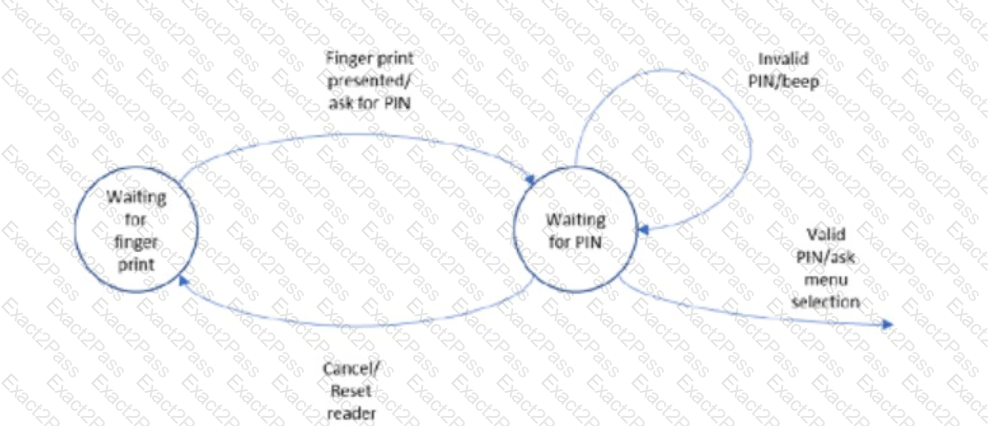
How many distinct states of the system are visible in the above diagram?

A.

1

B.

2

C.

3

D.

4

Question # 26

Which of the following is a factor that contributes to a successful review?

A.

All participants in the review are aware they will be evaluated based on the defects they will find

B.

The author of the work product to be reviewed leads the review meeting.

C.

All participants in the review are trained to deal with the review type and its objectives.

D.

Review metrics must be collected to improve the review process

Question # 27

Which ONE of the following options is NOT a benefit of test automation ?

A.

Reduced test execution times

B.

More objective assessment

C.

Prevention of simple human errors

D.

Eliminating completely the need for manual testing

Question # 28

Which of the following statements about exploratory testing is true?

A.

Exploratory testing is an experience-based test technique in which testers explore the requirements specification to detect non testable requirements

B.

When exploratory testing is conducted following a session-based approach, the issues detected by the testers can be documented in session sheets

C.

Exploratory testing is an experience-based test technique used by testers during informal code reviews to find defects by exploring the source code

D.

In exploratory testing, testers usually produce scripted tests and establish bidirectional traceability between these tests and the items of the test basis

Question # 29

Which one of the following statements IS NOT a valid objective of testing?

A.

To build confidence in the level of quality of the test object.

B.

To find all defects in a product, ensuring the product is defect free.

C.

To find failures and defects

D.

To evaluate work products such as requirements, user stories, design, and code.

Question # 30

A state transition diagram describes a control system’s behavior in different operational modes. The initial state is “NORMAL MODE” .

Which ONE of the following test cases covers an INVALID sequence ?

A.

NORMAL MODE → DIAGNOSTIC MODE → DEGRADED MODE → EMERGENCY MODE → DIAGNOSTIC MODE → NORMAL MODE → DIAGNOSTIC MODE

B.

NORMAL MODE → DEGRADED MODE → NORMAL MODE → DIAGNOSTIC MODE → DEGRADED MODE → EMERGENCY MODE → DIAGNOSTIC MODE

C.

NORMAL MODE → DIAGNOSTIC MODE → DEGRADED MODE → EMERGENCY MODE → DIAGNOSTIC MODE → NORMAL MODE → DEGRADED MODE

D.

NORMAL MODE → DIAGNOSTIC MODE → NORMAL MODE → DIAGNOSTIC MODE → EMERGENCY MODE → DIAGNOSTIC MODE → NORMAL MODE

Go to page:
