Exact2Pass

Last Update 13 hours ago Total Questions : 188
The ISTQB Certified Tester Foundation Level CTFL 4.0 Exam content is now fully updated, with all current exam questions added 13 hours ago. Deciding to include CTFL4 practice exam questions in your study plan goes far beyond basic test preparation.
You'll find that our CTFL4 exam questions frequently feature detailed scenarios and practical problem-solving exercises that directly mirror industry challenges. Engaging with these CTFL4 sample sets allows you to effectively manage your time and pace yourself, giving you the ability to finish any ISTQB Certified Tester Foundation Level CTFL 4.0 Exam practice test comfortably within the allotted time.
Which ONE of the following options CORRECTLY describes one of the seven principles of the testing process?
Match each objective to the correct test level
Objective:
A) Verifying whether the functional and non-functlonal behaviors of the system are as designed and specified.
B) Verifying whether the functional and non-functlonal behaviors of the interfaces are as designed.
C) Verifying whether the functional and non-functional behaviors of the components are as designed and specified.
D) Establishing confidence in the quality of the system as a whole.
Test Level:
1. Component testing.
2. Integration testing.
3. System testing.
4. Acceptance testing.
Which of the following is an advantage of the whole team approach?
Which two of the following statements describe the advantages provided by good traceability between the test basis and test work products?
I. Analyzing the impact of changes.
ii. A measure of code quality.
iii. Accurate test estimation.
iv. Making testing auditable.
Select the correct answer:
Which sequence of stated in the answer choices is correct in accordance with the following figure depicting the life-cycle of a defect?

A program is used to control a manufacturing line (turn machines on and off. start and stop conveyer belts, add raw materials to the flow. etc.). Not all actions are possible at all times. For example, there are certain manufacturing stages that cannot be stopped - unless there is an emergency. A tester attempts to evaluate if all such cases (where a specific action is not allowed) are covered by the tests.
Which coverage metric will provide the needed information for this analysis?
Select the roles required in a formal review:
Which of the following best describes the way in which statement coverage is measured?
The following diagram displays the logical dependencies between requirements and the individual requirement priorities. For example, "R2- > R3" means that R3 is dependent on R2. Priority is indicated by the number next to the letter ”P" i.e. P1 has a higher priority than P2.
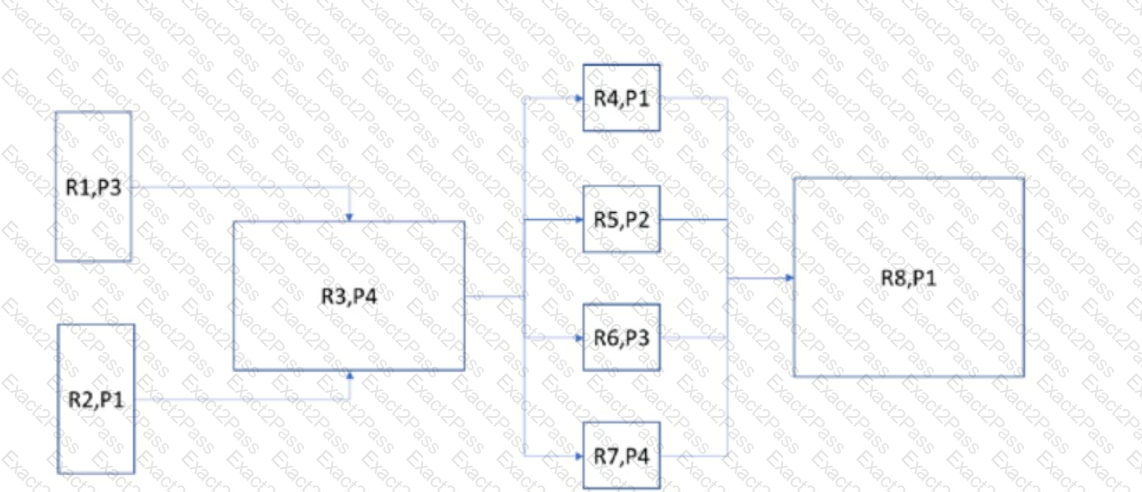
Which one of the following options best describes the test execution sequence using both requirement dependency and priority
Which ONE of the following elements is TYPICALLY part of a test plan ?

