
Summer Sale Special Limited Time 70% Discount Offer - Ends in 0d 00h 00m 00s - Coupon code: buysanta

Exact2Pass Menu

ISTQB Certified Tester Foundation Level CTFL 4.0 Exam

Last Update 11 hours ago Total Questions : 188

The ISTQB Certified Tester Foundation Level CTFL 4.0 Exam content is now fully updated, with all current exam questions added 11 hours ago. Deciding to include CTFL4 practice exam questions in your study plan goes far beyond basic test preparation.

You'll find that our CTFL4 exam questions frequently feature detailed scenarios and practical problem-solving exercises that directly mirror industry challenges. Engaging with these CTFL4 sample sets allows you to effectively manage your time and pace yourself, giving you the ability to finish any ISTQB Certified Tester Foundation Level CTFL 4.0 Exam practice test comfortably within the allotted time.

Question # 31

Which of the following s the most correct statement about state testing techniques?

A.

Static techniques can be used before all code is ready for execution

B.

Static techniques find more detects then dynamic techniques.

C.

Static techniques can be used by inexperienced users.

D.

Static techniques are always cheaper than dynamic techniques.

Question # 32

For each test case to be executed, the following table specifies its dependencies and the required configuration of the test environment for running such test case:
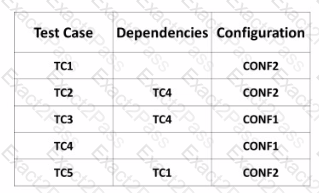
Assume that C0NF1 is the initial configuration of the test environment Based on this assumption, which of the following is a test execution schedule that is compatible with the specified dependencies and allows minimising the number of switches between the different configurations of the test environment^

A.

TC4, TC3, TC2, TC1, TC5.

B.

TCI, TC5, TC4, TC3, TC2

C.

TC4, TC3, TC2, TC5, TC1.

D.

TC4, TC1, TC5, TC2, TC3

Question # 33

A company runs a pilot project for evaluation of a test automation tool. Which of the following is NOT a valid object of this pilot project?

A.

Get familiar with the functionality and options of the tool

B.

Check haw the tool fits to the existing test processes

C.

Train all testers on using the tool

D.

Decide upon standards for tool implementation

Question # 34

Which TWO of the following are benefits of continuous integration?

I. Allows earlier detection and easier root cause analysis of integration problems and conflicting changes.

II. Removes the need for manual test analysis, design and execution.

Hi. Removes the dependency on automated regression packs when integrating larger systems, or components.

iv. Gives the development team regular feedback on whether the code is working.

Select the correct answer:

A.

i and iv

B.

i and ii

C.

i and iii

D.

iii and iv

Question # 35

Which of the following statements is true?

A.

Experience-based test techniques rely on the experience of testers to identify the root causes of defects found by black-box test techniques

B.

Some of the most common test basis used by white-box test techniques include user stories, use cases and business processes

C.

Experience-based test techniques are often useful to detect hidden defects that have not been targeted by black-box test techniques

D.

The primary goal of experience-based test techniques is to design test cases that can be easily automated using a GUI-based test automation tool

Question # 36

The fact that defects are usually not evenly distributed among the various modules that make up a software application, but rather their distribution tend to reflect the Pareto principle:

A.

is a false myth

B.

is expressed by the testing principle referred to as Tests wear out'

C.

is expressed by the testing principle referred to as 'Defects cluster together'

D.

is expressed by the testing principle referred to as 'Bug prediction'

Question # 37

Which ONE of the following options BEST describes the third test quadrant (Q3) ?

A.

This test quadrant contains smoke tests and non-functional tests (except usability tests). These tests are often automated.

B.

This test quadrant is business-facing and criticizes the system. It contains exploratory testing, usability testing, and user acceptance testing.

C.

This test quadrant contains functional tests, examples, user story tests, user experience prototypes, API testing, and simulations. These tests check the acceptance criteria and can be manual or automated.

D.

This test quadrant is technology-facing and supports the team. These tests should be automated and included in the continuous integration (CI) process.

Question # 38

In which one of the following test techniques are test cases derived from the analysis of the software architecture?

A.

Black-box test techniques.

B.

Experience-based test techniques.

C.

Checklist-based test techniques.

D.

White-box test techniques.

Question # 39

Who of the following has the best knowledge to decide what tests in a test project should be automated?

A.

The developer

B.

The customer

C.

The development manager

D.

The test leader

Question # 40

A document descnbes the test procedures that have been derived for the identified test sets Among other things, the order in which the test cases in the corresponding test set are to be executed according to the dependencies described by preconditions and postconditions is specified This document is a typical work product produced as part of:


A.

Test design.

B.

Test analysis

C.

Test Implementation.

D.

Test monitoring and control

Go to page: