Exact2Pass

Last Update 4 hours ago Total Questions : 194
The Designing and Implementing Cloud-Native Applications Using Microsoft Azure Cosmos DB content is now fully updated, with all current exam questions added 4 hours ago. Deciding to include DP-420 practice exam questions in your study plan goes far beyond basic test preparation.
You'll find that our DP-420 exam questions frequently feature detailed scenarios and practical problem-solving exercises that directly mirror industry challenges. Engaging with these DP-420 sample sets allows you to effectively manage your time and pace yourself, giving you the ability to finish any Designing and Implementing Cloud-Native Applications Using Microsoft Azure Cosmos DB practice test comfortably within the allotted time.
Your company develops an application named App1 that uses the Azure Cosmos DB SDK and the Eventual consistency level.
App1 queries an Azure Cosmos DB for NoSQL account named account!
You need to identify which consistency level to assign to App1 to meet the following requirements:
• Maximize the throughput of the queries generated by App1 without increasing the number of request units currently used by the queries.
• Provide the highest consistency guarantees.
Which consistency level should you identify?
You have a container named container1 in an Azure Cosmos DB for NoSQL account named account1 that is set to the session default consistency level. The average size of an item in container1 is 20 KB.
You have an application named App1 that uses the Azure Cosmos DB SDK and performs a point read on the same set of items in container1 every minute.
You need to minimize the consumption of the request units (RUs) associated to the reads by App1. What should you do?
You need to create a data store for a directory of small and medium-sized businesses (SMBs). The data store must meet the following requirements:
* Store companies and the users employed by them. Each company will have less than 1,000 users.
* Some users have data that is greater than 2 KB.
* Associate each user to only one company.
* Provide the ability to browse by company.
* Provide the ability to browse the users by company.
* Whenever a company or user profile is selected, show a details page for the company and all the related users.
* Be optimized for reading data.
Which design should you implement to optimize the data store for reading data?
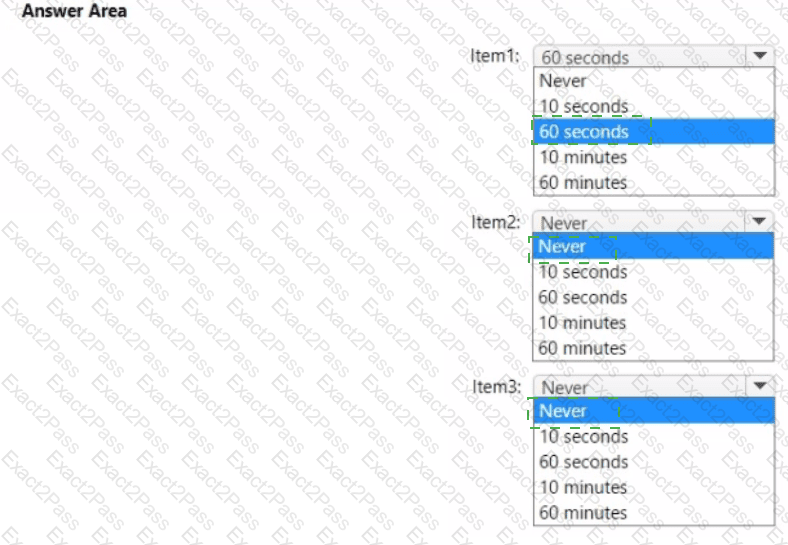
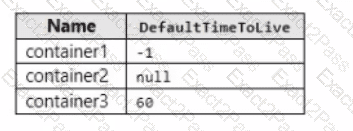
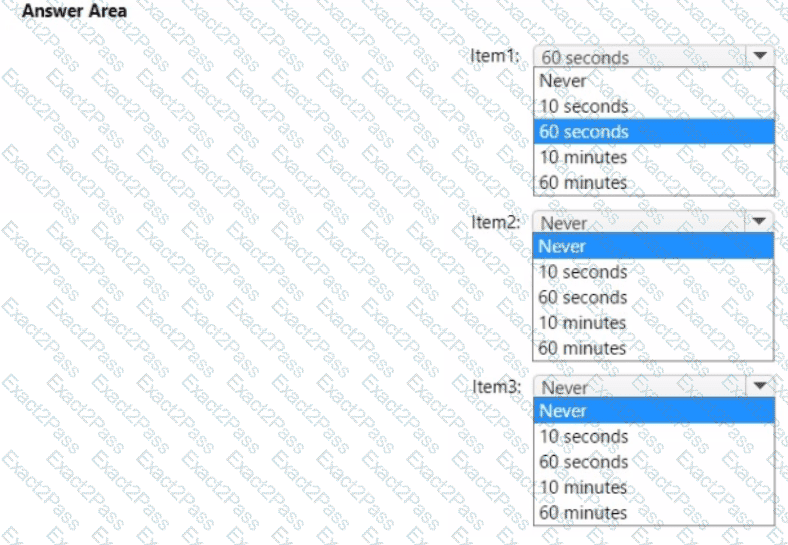
You have the Azure Cosmos DB for NoSQL containers shown in the following table.
You have the items shown in the following table.
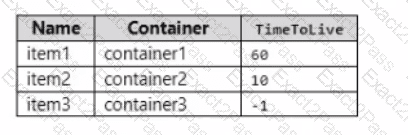
When will each item expire? To answer, select the appropriate options in the answer area.
NOTE: Each correct selection is worth one point.
You have an Azure Cosmos DB for NoSQL account that has multiple write regions.
You need to receive an alert when requests that target the database exceed the available request units per second (RU/s).
Which Azure Monitor signal should you use?
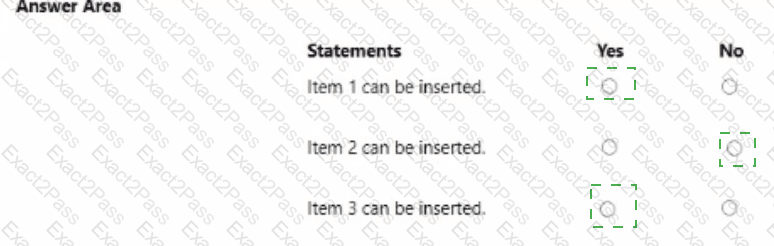
You have an Azure Cosmos DB for NoSQL container named Contacts that is configured as shown in the following exhibit.
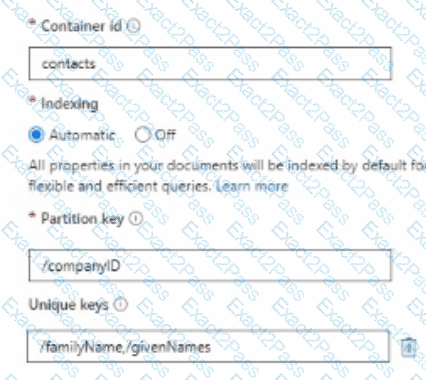
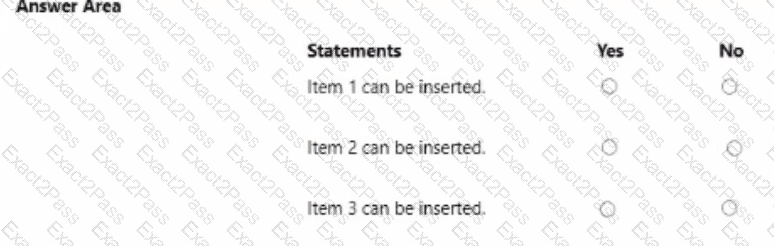
Contacts contains the items shown in the following table.

To Contacts, you plan to insert the items shown in the following table.

For each of the following statements select Yes if the statement is true. Otherwise, select No.
NOTE: Each correct selection is worth one point.
You have an Azure Cosmos DB for NoSQL account named account1.
In account 1, you plan to create a container named container1 that will contain data continuously collected from sell-driving cars. The items in container! will be accessed mostly by using queries that target data collected from a specific car during a given day. Each car is identifiable by using a property named Vehicle-Identification-Number.
You need to identify a partition strategy for container1. The strategy must meet the following requirements:
• Maximize read and write performance.
• Minimize the costs of data reads and writes.
What should you identify?
You plan to store order data in Azure Cosmos DB for NoSQL account. The data contains information about orders and their associated items.
You need to develop a model that supports order read operations. The solution must minimize the number or requests.
The settings for a container in an Azure Cosmos DB Core (SQL) API account are configured as shown in the following exhibit.
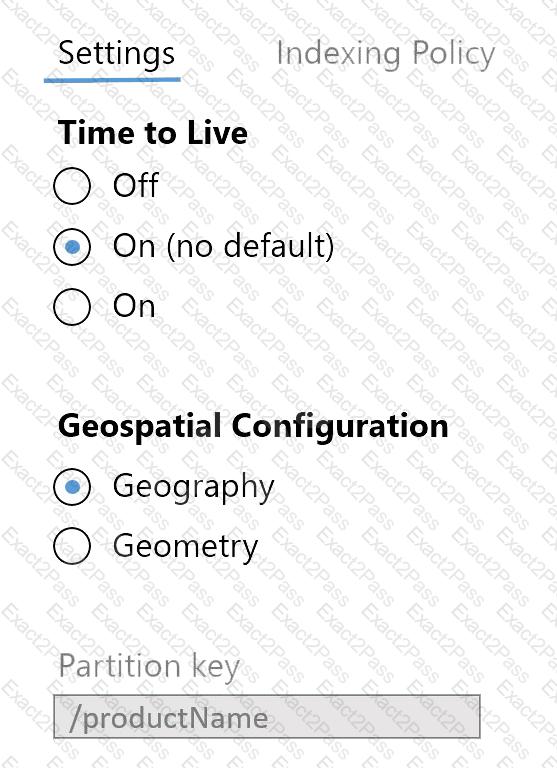
Which statement describes the configuration of the container?
You have an Azure Cosmos DB account that hosts a single container named Container1. Container1 contains items that include two properties named Tenantld and Userld. Container1 has logical partitions based on the Tenantld property.
You need to configure subpartitioning for Container1 based on the Userld property. The solution must maximize data availability.
What should you do first?