Exact2Pass

Last Update 4 hours ago Total Questions : 194
The Designing and Implementing Cloud-Native Applications Using Microsoft Azure Cosmos DB content is now fully updated, with all current exam questions added 4 hours ago. Deciding to include DP-420 practice exam questions in your study plan goes far beyond basic test preparation.
You'll find that our DP-420 exam questions frequently feature detailed scenarios and practical problem-solving exercises that directly mirror industry challenges. Engaging with these DP-420 sample sets allows you to effectively manage your time and pace yourself, giving you the ability to finish any Designing and Implementing Cloud-Native Applications Using Microsoft Azure Cosmos DB practice test comfortably within the allotted time.
You have an Azure subscription. The subscription contains an Azure Cosmos DB for NoSQL account named account! that hosts a container named Container 1. Container! has a provisioned throughput of 100 request units per second (RU/s) and uses a single physical partition.
Vou are evaluating the available throughput for Container1.
What is the maximum burst capacity that Container1 can accumulate?
Note: This question is part of a series of questions that present the same scenario. Each question in the series contains a unique solution that might meet the stated goals. Some question sett might have more than one correct solution, while others might not have a correct solution.
After you answer a question in this section, you will NOT be able to return to it. As a result, these questions will not appear in the review screen.
You have a container named conlainer1 in an Azure Cosmos DB for NoSQL account.
You need to make the contents of container1 available as reference data for an Azure Stream Analytics job.
Solution: You create an Azure function to copy data to another Azure Cosmos DB for NoSQL container.
Does this meet the goal?
You have the following query.
SELECT * FROM с
WHERE c.sensor = " TEMP1 "
AND c.value < 22
AND c.timestamp > = 1619146031231
You need to recommend a composite index strategy that will minimize the request units (RUs) consumed by the query.
What should you recommend?
You have an Azure Cosmos DB database named databaset contains a container named container1. The container1 container store product data and has the following indexing policy.
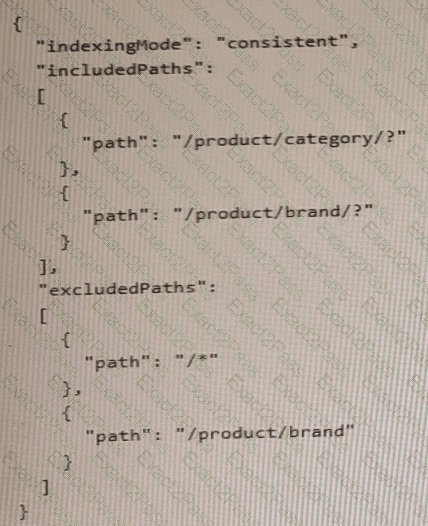
Which path will be indexed?
You have a container m an Azure Cosmos DB for NoSQL account. The container stores data about families. Data about parents, children, and pets are stored as separate documents.
Each document contains the address of each family. Members of the same family share the same partition key named family Id
You need to update the address for each member of the same family that share the same address. The solution must meet the following requirements:
• Be atomic consistent isolated, and durable (ACID).
• Provide the lowest latency.
What should you do?
Note: This question is part of a series of questions that present the same scenario. Each question in the series contains a unique solution that might meet the stated goals. Some question sets might have more than one correct solution, while others might not have a correct solution.
After you answer a question in this section, you will NOT be able to return to it. As a result, these questions will not appear in the review screen.
You have an Azure Cosmos DB Core (SQL) API account named account 1 that uses autoscale throughput.
You need to run an Azure function when the normalized request units per second for a container in account1 exceeds a specific value.
Solution: You configure an Azure Monitor alert to trigger the function.
Does this meet the goal?
You need to create a database in an Azure Cosmos DB for NoSQL account. The database will contain three containers named coll1, coll2 and coll3. The coll1 container will have unpredictable read and write volumes. The col!2 and coll3 containers will have predictable read and write volumes. The expected maximum throughput for coll1 and coll2 is 50,000 request units per second (RU/s) each.
How should you provision the collection while minimizing costs?

