Exact2Pass

Last Update 12 hours ago Total Questions : 1057
The Chartered Wealth Manager (CWM) Global Examination content is now fully updated, with all current exam questions added 12 hours ago. Deciding to include GLO_CWM_LVL_1 practice exam questions in your study plan goes far beyond basic test preparation.
You'll find that our GLO_CWM_LVL_1 exam questions frequently feature detailed scenarios and practical problem-solving exercises that directly mirror industry challenges. Engaging with these GLO_CWM_LVL_1 sample sets allows you to effectively manage your time and pace yourself, giving you the ability to finish any Chartered Wealth Manager (CWM) Global Examination practice test comfortably within the allotted time.
The difference between aggregate disbursements net of debt repayments and recovery of loans and revenue receipts and non debt capital receipts is called:
As a CWM® you recommended Mr. Raj Malhotra to put his money in Asset A offering 15% annual return with a standard deviation of 10%, and balance funds in asset B offering a 9% annual return with a standard deviation of 8%. Assume the coefficient of correlation between the returns on assets A and B is 0.50. Calculate the expected return after 1 year and standard deviation of Mr. Raj Malhotra’s portfolio
Sujoy has purchased shares of Rs.12500 of common stock in Hindustan Unilever . He has recently sold investment to the tune of Rs.15000 & received Rs 2500 as cash dividends during the holding period of 4 years. He paid a total of Rs 250 in commissions. What is CAGR on the investment?
You are considering investing Rs 1,500 at an interest rate of 5% compounded annually for 2 years or investing the Rs1,500 at 7% per year simple interest rate for 2 years. Which option is better?
Mr.Tiwari is the sole income earner in the family. Mrs. Tiwari is a homemaker. They are aged 40 and 36 respectively. Life expectancy for both of them is another 40 years. They have no children. Other information you have is:
Current investment portfolio Rs. 20 lakh, Estimated final expenses – Rs. 1 lakh, present annual expenses- Rs 4 lakhs (including 1 lakh MrTiwari’s personal expenses), Mr. Tiwari’s post tax income in hand is Rs 3.5 lakhs. Assume a post tax; and post inflation rate, the discounting factor is 4%. Calculate the insurance requirement under the Needs Based Method.
If, C=Rs.240 million, I = Rs.20 million, G = Rs.90 million, X = Rs.50 million M = Rs.80 million Calculate the value of GDP?
From the following information:
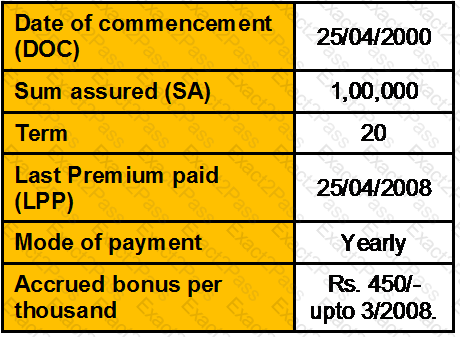
The Surrender value is 43% of the paid up value and loan is available at 85% of surrender value.
Calculate paid up value, surrender value, and loan value
You buy a new computer for your business costing approximately Rs. 5,000. You expect a salvage value of Rs. 1000 selling parts when you dispose of it. Your business has upgraded its hardware every four years, so you think this is a more realistic estimate of useful life, since you are apt to dispose of the computer at that time. Calculate the amount of depreciation using straight line method?
A Treasury bill pays a 6% rate of return. A risk averse investor __________ invest in a risky portfolio that pays 12% with a probability of 40% or 2% with a probability of 60% because __________.
What is the minimum paid up capital needed to form a Pvt. Company?
In Islamic Banking, Anything permitted by Shariah is called:
“Income rule” in Insurance advocates
The Society Registration Act of 1860 come into effect on
If the proposer does not disclose fully all the material facts at the time of Proposal the principle violated
If the slope of the Security Market Line is zero, which of the following is/are true?

Minimum number of members in case of private company is
The quantum of deduction allowed u/s 80U is:
A will that is not valid in India except in the case of privileged wills or in the case of Mahomedans
Which is not the condition for getting superannuation fund approved?
Which of the following is not true?

