
Spring Sale Special Limited Time 70% Discount Offer - Ends in 0d 00h 00m 00s - Coupon code: buysanta

Exact2Pass Menu

Chartered Wealth Manager (CWM) Global Examination

Last Update 19 hours ago Total Questions : 1057

The Chartered Wealth Manager (CWM) Global Examination content is now fully updated, with all current exam questions added 19 hours ago. Deciding to include GLO_CWM_LVL_1 practice exam questions in your study plan goes far beyond basic test preparation.

You'll find that our GLO_CWM_LVL_1 exam questions frequently feature detailed scenarios and practical problem-solving exercises that directly mirror industry challenges. Engaging with these GLO_CWM_LVL_1 sample sets allows you to effectively manage your time and pace yourself, giving you the ability to finish any Chartered Wealth Manager (CWM) Global Examination practice test comfortably within the allotted time.

Question # 121

Which of the following is false with respect to internal rate of return?

A.

The internal rate of return (IRR) is a capital budgeting method used by firms to decide whether they should make long-term investments.

B.

The IRR is the annualized effective compounded return rate which can be earned on the invested capital, i.e. the yield on the investment.

C.

IRR is defined as any discount rate that results in a positive net present value (present value of cash flows- initial investment) of zero of a series of cash flows.

D.

In general, if the IRR is greater than the project’s cost of capital or hurdle rate, the project will not be accepted at any cost.

Question # 122

Cheque truncation refers to the process by which:

A.

Cheques are returned to customers after payment

B.

Entry of stopped cheques into the computer system

C.

Cheques payable at different cities / branches

D.

Physical movement of cheques is curtailed, being replaced by electronic records of their content

Question # 123

Money Laundering:

A.

is itself a crime and it is built upon another crime

B.

is not itself a crime but is built upon a crime

Question # 124

Which of the following is a self funded retirement security?

A.

Old age pension scheme

B.

Public provident fund

C.

Joint family system

D.

Provident Fund

Question # 125

Income received in India in previous year is taxable in the hands of:

A.

Resident;

B.

Not-resident;

C.

Non ordinarily resident;

D.

All above.

Question # 126

If an investment has a correlation coefficient of 0.80 with the market, which of the following performance measures is the best measure of risks?

A.

Jensen.

B.

Sharpe & Jensen.

C.

Sharpe.

D.

Treynor.

Question # 127

Banking Ombudsman Scheme is:

A.

Bank’s own scheme

B.

IBA Scheme

C.

Under Banking Regulation Act

D.

None of the above

Question # 128

Mr. Munjal has got her daughters son admitted to a dental college today, where he has to pay a fee of Rs. 1.5 Lac today i.e. at the time of admission. Then Rs. 1.75 lacs after 1 year, Rs. 2.5 lacs after 2 years and Rs. 3.25 lacs after 3 years. He wants to set aside the amount required today itself in the form of a Bank FDR.So how much he needs to put aside today if ROI is 8% for 1 year, 8.5% for 2 years and 9% for 3 years, all compounded Quarterly?

A.

Rs. 7,71,807.05

B.

Rs. 7,81,911.05

C.

Rs. 8,93,541.07

D.

Rs. 8,51,657.10

Question # 129

Urban land means land situated within the jurisdiction of local authority which has a population of not less than …………………. as per last ensure

A.

500

B.

1000

C.

5000

D.

10000

Question # 130

A rate of interest of 10% semi-annual compounded quarterly would be equal to -------------------- % per annum compounded annually.

A.

20% per Annum Compounded Annually

B.

21.55% per Annum Compounded Annually

C.

20.50% per Annum Compounded Annually

D.

21% per Annum Compounded Annually

Question # 131

Mr. Rajesh Rawat deposits Rs. 15,000 per month at the end of the month for 6.50 years in an account that pays a ROI of 8.80% per annum compounded quarterly. What will be the amount in the account after 6.50 years.?

A.

1571140

B.

1567650

C.

91666

D.

91654

Question # 132

Azhar aged 30 is a disciplined investor. He has started depositing Rs. 25,000 every year in an account that pays a return of 9% every year. He plans to increase his contribution by Rs. 5000 every year till his age 50. Calculate the amount he would be having in his account at this age.?

A.

1731111

B.

1279000

C.

30101111

D.

29101111

Question # 133

From the following information of assets assets and liabilities, the taxable wealth for:
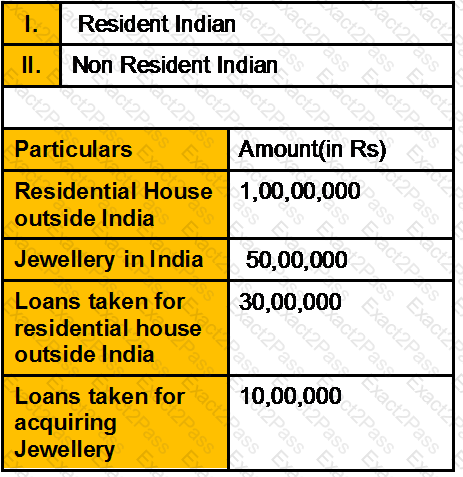
A.

Rs 1,10,00,000 & Rs 40,00,000 respectively

B.

Rs 1,00,00,000 & Rs 40,00,000 respectively

C.

Rs 1,10,00,000 & Rs 50,00,000 respectively

D.

Rs 70,00,000 & Rs 40,00,000 respectively

Question # 134

Which of the following statements is/are false?

A.

Only II

B.

I andIV

C.

Only III

D.

None of the above

Question # 135

Premium under endowment plans equals

A.

risk premium+ savings element +expenses

B.

risk premium +expenses

C.

risk premium +saving element

D.

none of these

Question # 136

A “Family Office” segment client has investible assets worth of

A.

$20,000,000

B.

$50,000,000

C.

$75,000,000

D.

$100,000,000

Question # 137

Which of the following assets not included in calculating wealth tax?

A.

Commercial buildings

B.

Residential

C.

A farm situated 40 km far from local limits of any municipality or a cantonment Board

D.

Any guest house

Question # 138

Risk that can be eliminated through diversification is called ______ risk.

A.

Unique

B.

Firm-specific

C.

Diversifiable

D.

All of the above

Question # 139

In case where amount of wealth tax exceeds one hundred thousand rupees rigorous imprison-ment for a term not be less than …………

A.

One month which may extend to one year

B.

Only fine

C.

Six months which may extend to 7 years

D.

On year to 10 years

Question # 140

NSSO stands for ____________

A.

National Security Space Office

B.

National Shared Services Organization

C.

National Sample Survey Organization

D.

None of the above

Go to page:

