Spring Sale Special Limited Time 70% Discount Offer - Ends in 0d 00h 00m 00s - Coupon code: buysanta

Exact2Pass Menu

Aruba Certified Network Security Associate Exam

Last Update 10 hours ago Total Questions : 167

The Aruba Certified Network Security Associate Exam content is now fully updated, with all current exam questions added 10 hours ago. Deciding to include HPE6-A78 practice exam questions in your study plan goes far beyond basic test preparation.

You'll find that our HPE6-A78 exam questions frequently feature detailed scenarios and practical problem-solving exercises that directly mirror industry challenges. Engaging with these HPE6-A78 sample sets allows you to effectively manage your time and pace yourself, giving you the ability to finish any Aruba Certified Network Security Associate Exam practice test comfortably within the allotted time.

Question # 41

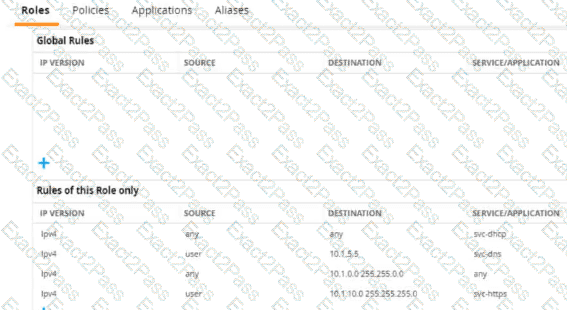
Refer to the exhibit.

A diem is connected to an ArubaOS Mobility Controller. The exhibit snows all Tour firewall rules that apply to this diem

What correctly describes how the controller treats HTTPS packets to these two IP addresses, both of which are on the other side of the firewall

10.1 10.10

203.0.13.5

A.

It drops both of the packets

B.

It permits the packet to 10.1.10.10 and drops the packet to 203 0.13.5

C.

it permits both of the packets

D.

It drops the packet to 10.1.10.10 and permits the packet to 203.0.13.5.

Question # 42

What is a benefit of Protected Management Frames (PMF). sometimes called Management Frame Protection (MFP)?

A.

PMF helps to protect APs and MCs from unauthorized management access by hackers.

B.

PMF ensures trial traffic between APs and Mobility Controllers (MCs) is encrypted.

C.

PMF prevents hackers from capturing the traffic between APs and Mobility Controllers.

D.

PMF protects clients from DoS attacks based on forged de-authentication frames

Question # 43

You are managing an Aruba Mobility Controller (MC). What is a reason for adding a " Log Settings " definition in the ArubaOS Diagnostics > System > Log Settings page?

A.

Configuring the Syslog server settings for the server to which the MC forwards logs for a particular category and level

B.

Configuring the MC to generate logs for a particular event category and level, but only for a specific user or AP.

C.

Configuring a filter that you can apply to a defined Syslog server in order to filter events by subcategory

D.

Configuring the log facility and log format that the MC will use for forwarding logs to all Syslog servers

Question # 44

You have configured a WLAN to use Enterprise security with the WPA3 version.

How does the WLAN handle encryption?

A.

Traffic is encrypted with TKIP and keys derived from a PMK shared by all clients on the WLAN.

B.

Traffic is encrypted with TKIP and keys derived from a unique PMK per client.

C.

Traffic is encrypted with AES and keys derived from a PMK shared by all clients on the WLAN.

D.

Traffic is encrypted with AES and keys derived from a unique PMK per client.

Question # 45

How can hackers implement a man-in-the-middle (MITM) attack against a wireless client?

A.

The hacker uses a combination of software and hardware to jam the RF band and prevent the client from connecting to any wireless networks.

B.

The hacker runs an NMap scan on the wireless client to find its MAC and IP address. The hacker then connects to another network and spoofs those addresses.

C.

The hacker uses spear-phishing to probe for the IP addresses that the client is attempting to reach. The hacker device then spoofs those IP addresses.

D.

The hacker connects a device to the same wireless network as the client and responds to the client ' s ARP requests with the hacker device ' s MAC address.

Question # 46

What is a use case for Transport Layer Security (TLS)?

A.

to establish a framework for devices to determine when to trust other devices ' certificates

B.

to enable a client and a server to establish secure communications for another protocol

C.

to enable two parties to asymmetrically encrypt and authenticate all data that passes be-tween them

D.

to provide a secure alternative to certificate authentication that is easier to implement

Question # 47

A company is deploying AOS-CX switches to support 114 employees, which will tunnel client traffic to an HPE Aruba Networking Mobility Controller (MC) for the MC to apply firewall policies and deep packet inspection (DPI). This MC will be dedicated to receiving traffic from the AOS-CX switches.

What are the licensing requirements for the MC?

A.

One PEF license per switch

B.

One PEF license per switch, and one WCC license per switch

C.

One AP license per switch

D.

One AP license per switch, and one PEF license per switch

Question # 48

A company with 465 employees wants to deploy an open WLAN for guests. The company wants the experience to be as follows:

    Guests select the WLAN and connect without having to enter a password.

    Guests are redirected to a welcome web page and log in. The company also wants to provide encryption for the network for devices that are capable. Which security options should you implement for the WLAN?

A.

Opportunistic Wireless Encryption (OWE) and WPA3-Personal

B.

Captive portal and WPA3-Personal

C.

WPA3-Personal and MAC-Auth

D.

Captive portal and Opportunistic Wireless Encryption (OWE) in transition mode

Question # 49

You have been asked to send RADIUS debug messages from an AOS-CX switch to a central SIEM server at 10.5.15.6. The server is already defined on the switch with this command:

logging 10.5.15.6

You enter this command:

debug radius all

What is the correct debug destination?

A.

file

B.

console

C.

buffer

D.

syslog

Question # 50

What distinguishes a Distributed Denial of Service (DDoS) attack from a traditional Denial of Service (DoS) attack?


A.

A DDoS attack originates from external devices, while a DoS attack originates from internal devices.

B.

A DoS attack targets one server; a DDoS attack targets all the clients that use a server.

C.

A DDoS attack targets multiple devices, while a DoS is designed to incapacitate only one device.

D.

A DDoS attack is launched from multiple devices, while a DoS attack is launched from a single device.

Go to page: