Exact2Pass

The contemporary enterprise wired networking and campus fabric design landscape in 2026 demands resilient high-availability topologies, automated provisioning pipelines, and granular traffic inspection controls. As modern organizations transition to distributed multi-site campus networks, edge branches, and cloud-managed data centers, network engineers must master the deployment of ArubaOS-CX switches and centralized management systems. Achieving the HPE Aruba Networking Certified Professional - Switching qualification through the HPE7-A08 evaluation validates your technical capacity to design, configure, troubleshoot, and optimize enterprise switching solutions. However, many network administrators, system architects, and technical support specialists struggle on this intensive, 2-hour proctored assessment by relying on passive review methods. Trusting flat answer repositories or context-stripped question files found on unverified public forums cannot prepare you for the intricate situational logic of configuring Virtual Switching Framework (VSF) stacking, managing Virtual Switching Extension (VSX) split-brain scenarios, or resolving Dynamic Segmentation issues under active production loads.
True success on this 75-question proctored milestone requires a comprehensive, multi-dimensional command of both command-line interface (CLI) configurations and HPE Aruba Networking Central cloud orchestration. Network professionals must demonstrate sharp diagnostic judgment when configuring Layer 2 VLANs, validating Layer 3 routing protocols, implementing Quality of Service (QoS) parameters, and tuning Network Analytics Engine (NAE) scripts. Candidates frequently spend several months searching for high-yield hpe7-a08 exam questions online, hoping to locate an updated hpe7-a08 study guide to measure their readiness, or reviewing CLI syntax outputs to verify their OSPF and BGP routing parameters. Without interactive workspace software, a structured enterprise switching course, or targeted practical simulator practice that can provide actual help in exam preparation, passive reading fails to build the diagnostic capabilities needed to handle IP mismatches, VLAN configuration errors, or transceiver port speed incompatibilities within the network fabric.
At Exact2Pass, we replace passive reading with active, scenario-driven structural engineering exercises designed to build true platform confidence. Our premium preparation workspace simulates the functional operational layers, Aruba Central management dashboards, and CLI diagnostic consoles of the active ArubaOS-CX switching ecosystem. We guide you through executing gap analyses on legacy campus topologies, configuring VSX high-availability pairs, deploying CX 6300 and CX 8325 switches, and establishing automated health monitoring baselines. This targeted practice builds the exact network deployment strategy and system execution skills demanded by leading enterprise consultation teams, ensuring you pass your official Pearson VUE proctored assessment on your very first attempt.
The HPE7-A08 certification exam is engineered to evaluate your end-to-end switching solution design, device provisioning, and network troubleshooting capabilities across modern enterprise environments. Our realistic simulation platform replicates active HPE Aruba Networking Central management screens, command-line interface diagnostic tools, and real-time NAE monitoring dashboards instead of serving up generic multiple-choice questionnaires. You will master the underlying network interface relationships, operator-driven data ingestion fields, and protocol-level dependencies of the active Aruba ecosystem, preparing you to tackle any scenario-based switching question with ease.
Refer to the exhibit from an HPE Aruba Networking CX6000:

Two CX 6000 switches are configured with the same configuration for LAG 1. What needs to be done to remove the LACP block state?
An HPE Aruba Networking Central switch is managed in HPE Aruba Networking Central. If you need to validate configuration changes in the switch’s Global view, what information can you get using the Audit trail?
You have configured 802.1X and MAC authentication in an office environment. During testing, you noticed that devices that don’t support 802.1X take a few minutes to receive an IP address. What can you do to improve the connection time for these devices while maintaining a secure configuration?
An Aruba CX8100 VSX has the following state for LACP:
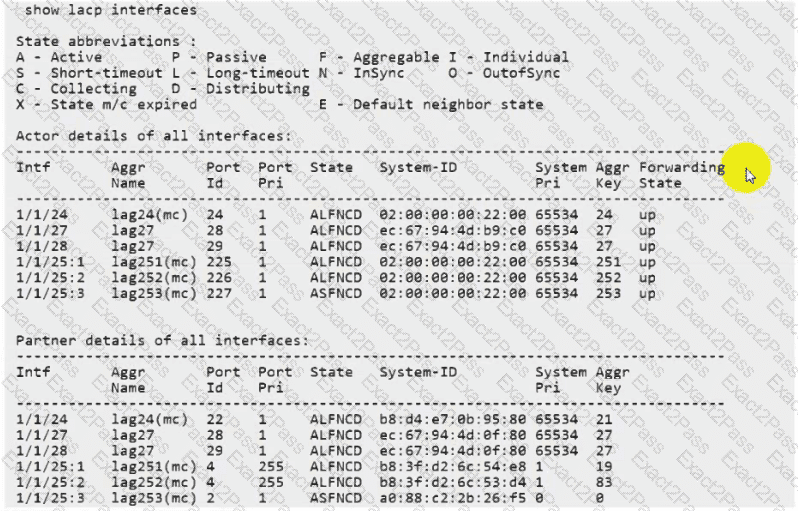
What can be observed based on the output?
What is true when describing HPE Aruba Networking VSX ISL to a new customer?
How would you explain the functionality of an HPE Aruba Networking VSX inter-switch link protocol (ISLP)?
Which switch configuration is required to implement Dynamic User Roles (DUR)?
You have added a switch with existing configuration to an existing group in HPE Aruba Networking Central but the configuration is not synchronizing. What could cause this?
You have added a switch with existing configuration to an existing group in HPE Aruba Networking Central but the configuration is not synchronizing. What could cause this?
Refer to the exhibit:
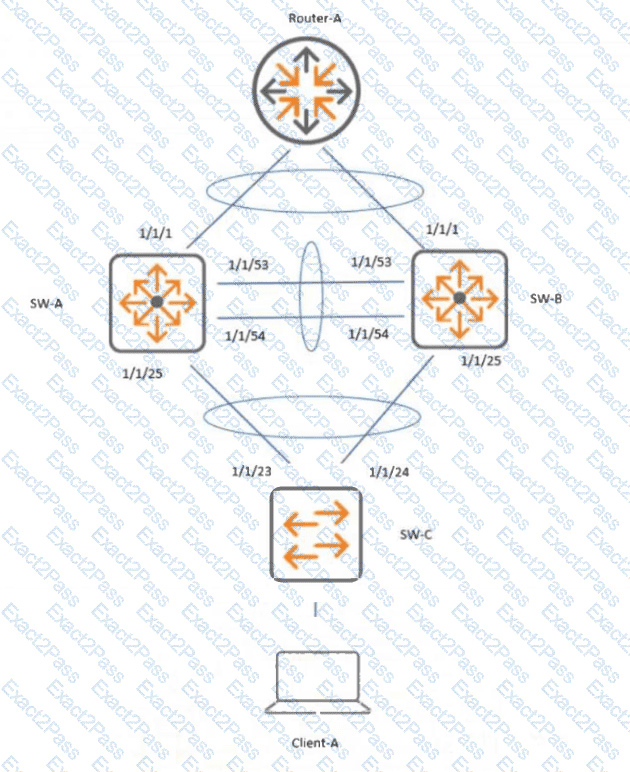
Interfaces 1/1/53 and 1/1/54 were accidentally disconnected from Switch-A, the primary VSX member. Client A is experiencing network disruptions with network
connections to Router-A.
What needs to be done to prevent user traffic disruption in this scenario?