Exact2Pass

Last Update 5 hours ago Total Questions : 96
The PECB Certified EMS ISO 14001 Lead Auditor Exam content is now fully updated, with all current exam questions added 5 hours ago. Deciding to include ISO-14001-Lead-Auditor practice exam questions in your study plan goes far beyond basic test preparation.
You'll find that our ISO-14001-Lead-Auditor exam questions frequently feature detailed scenarios and practical problem-solving exercises that directly mirror industry challenges. Engaging with these ISO-14001-Lead-Auditor sample sets allows you to effectively manage your time and pace yourself, giving you the ability to finish any PECB Certified EMS ISO 14001 Lead Auditor Exam practice test comfortably within the allotted time.
A huge public library established an EMS following the requirements of ISO 14001, which was third-party certified 10 years ago. You are performing the second surveillance audit of the third certification cycle. The audit plan included an audit to the Director as the last interview before the closing meeting.
During the interview with the Director, you audit clause 6.2 (Objectives and planning to achieve them). The dialogue is as follows:
You: Could you please tell me which were the environmental objectives defined for last year and show evidence of their achievement?
Director: Yes. We had defined three objectives. As you can see from our Annual Plan, one of them was to separate our waste in four categories: paper, plastics, metals, food — before, we had only three (plastic and paper were disposed together). We developed an Action Plan to achieve this objective.
Which six of the questions would you ask related to the Action Plan?
You are leading a recertification audit of XM, a manufacturer of cosmetics products. After the initial certification, XM moved to another site.
After the opening meeting, you are visiting the new site with the production manager (PM). The dialogue is as follows:
You: It seems that you are doing some work in the right-hand corner of the site.
PM: Yes, when we moved to this site, there was a very old, three-stories high building; it was almost empty, and we decided to demolish it and to build a new office for the administrative personnel. DEMO services are doing the job, which is almost over.
You: Do you know what the old building was used for?
PM: I was told that it was a warehouse for chemical storage, including a laboratory and toilets for the personnel. It had also a chimney, I do not know what for.
You: Did you consider it necessary to refer to some parts of the EMS for this work?
PM: No, we were busy moving all equipment and materials to the new site, we did not have time to care about something that was going to disappear.
Which four audit trail issues would you follow?
XM, a chain of 25 petrol stations, established an EMS following the requirements of ISO 14001, which was third-party certified 10 years ago. You are performing an internal audit before the fourth certification cycle.
During the audit to the EMS Manager (EM), the following dialogue takes place:
You: Could you please give me some details on the inspection of underground tanks in each station?
EM: It ' s very simple. There is a regulation that requires an annual leak inspection.
You: Who performs these inspections?
EM: I personally contract the inspectors and submit the results to the local authority. These are the certificates submitted last year.
You: I see only 22 certificates. There are three missing.
EM: The tanks of those three stations will be removed next year and replaced by new ones. I phoned the local authority and they told me that I do not need to send any report of the tanks that will be changed.
Which one of the following would be your next question?
Whistlekleen is a national dry cleaning and laundry organisation with 50 shops. You are conducting an EMS surveillance audit of Head Office and are sampling environmental performance measurement. You find that 80 per cent of failures to meet performance criteria originate from five shops in the same region. Most of these failures relate to the release of volatile organic compounds (VOCs) that exceeded regulations. The Environmental Manager tells you that these are the oldest shops in the organisation. The cleaning equipment needs replacing but the organisation cannot afford it at the moment.
On raising the matter with senior management, you are told that there are plans to replace the equipment in these shops over the next five years.
When reviewing the nonconformity report files, you find that the organisation is facing a legal dispute with the environmental authority over multiple breaches of environmental legislation.
Select the three best options for how this dispute should be handled by the organisation through its EMS.
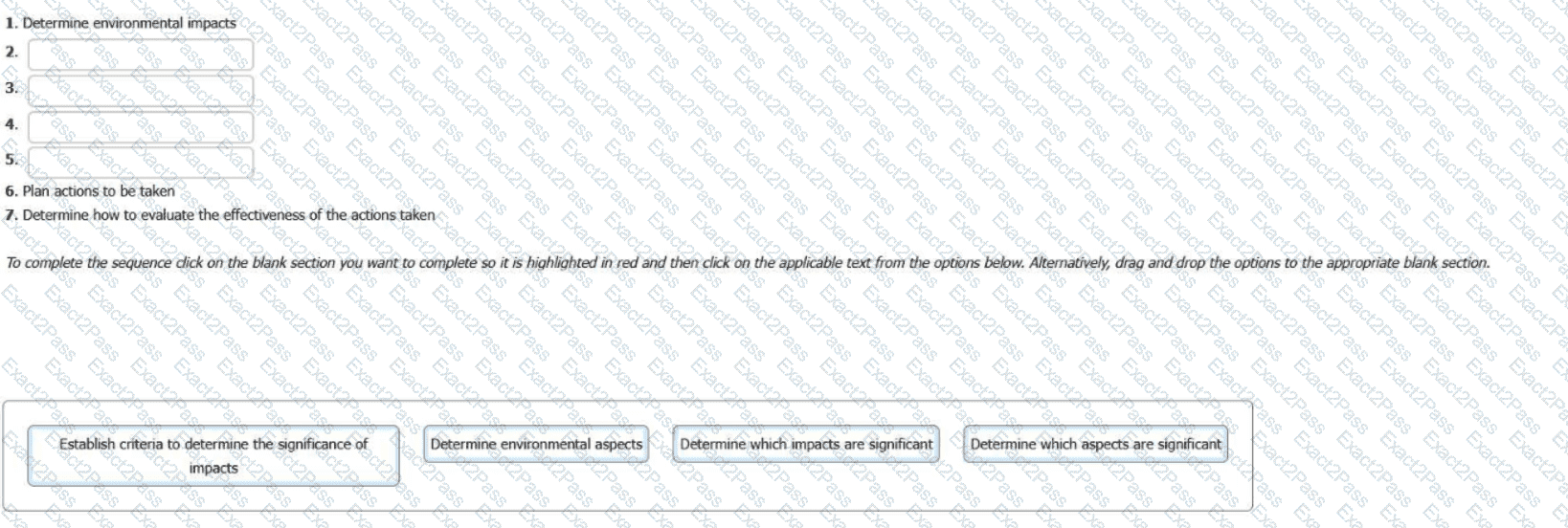
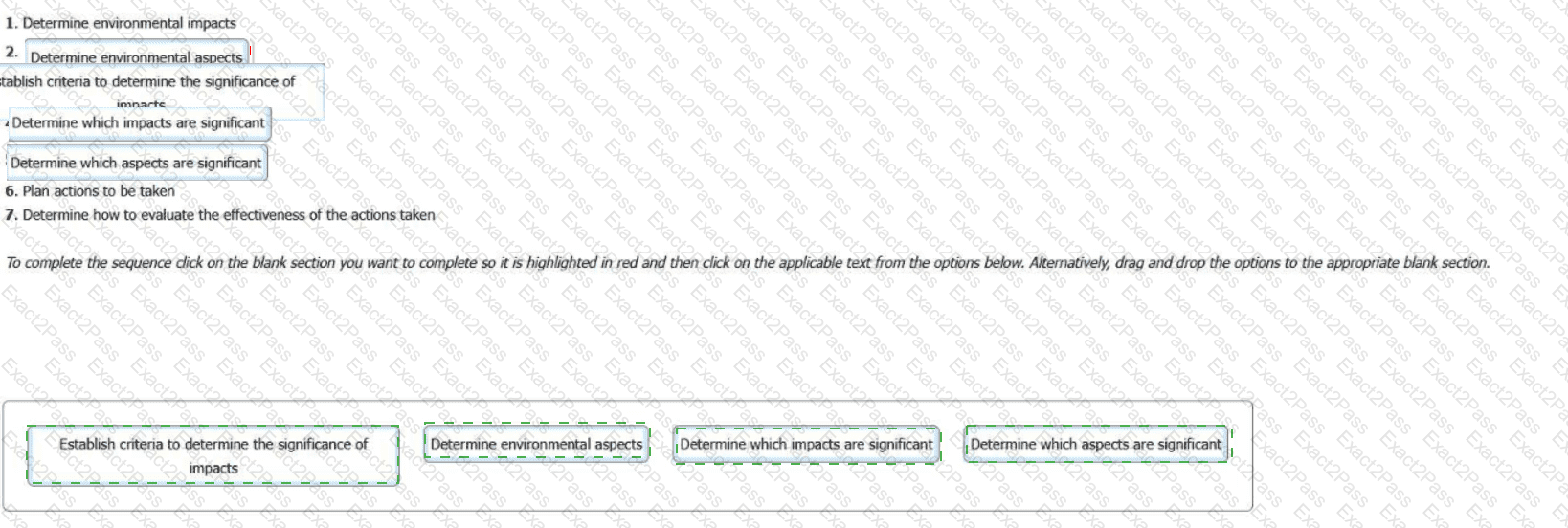
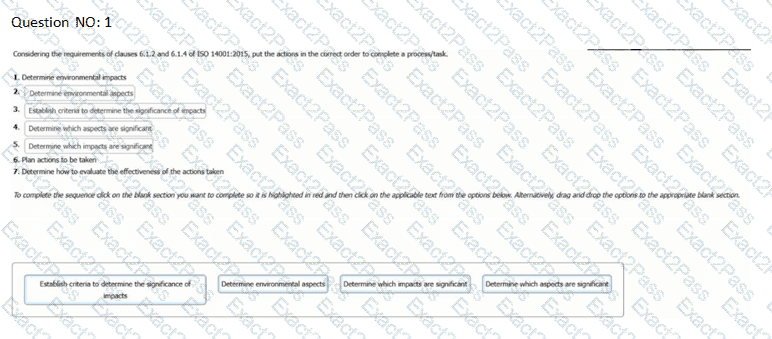
Considering the requirements of clauses 6.1.2 and 6.1.4 of ISO 14001:2015, put the actions in the correct order to complete a process/task.
You are a third-party auditor of XM, a logistics organisation located in a European country, that distributes a wide range of products to local customers but also to customers in several neighbouring countries. Close to the distribution warehouse, you see many trucks loading and unloading goods. Almost 50 per cent of the trucks are owned by XM, the remainder are subcontracted from other organisations.
You have the following dialogue with the Warehouse Manager:
You: I see that not all trucks belong to XM.
WM: Sometimes we need additional trucks from other organisations nearby. Obviously, we cannot control their energy consumption since they come with the trucks half full of their own goods.
You: How did you inform them of the EMS?
WM: You know, they are not used to the complicated words in our policy. I have just told them: “Save energy”.
You: What about your trucks?
WM: We measure the fuel they used on each trip, the distance they drove and the weight of goods they distributed. They know the roads and we ask them to choose the shortest route — we rely on them.
You: Did you fix any indicators and objectives related to energy consumption?
WM: No, we know they are careful people, they do their best. We would not be able to improve consumption.
This dialogue is related to several clauses of ISO 14001. Identify which three clauses below are related to this dialogue.
You are the audit team leader of a third-party initial certification audit to ISO 14001 for two days of audit. This is the first time you lead an audit, and a second member of the team is a qualified audit team leader who will evaluate your performance as the audit team leader.
During lunch on the second day, you are informed that the second member of the audit team will have to leave the audit due to personal problems but could return the following day.
What would you do? Select the best two options.
A chain of 10 paint shops in a city has established an EMS following the requirements of ISO 14001, which was third-party certified 10 years ago. You are performing a second-party audit. The audit plan included an interview with the General Manager.
The dialogue was as follows:
You: Hi, good evening. I have seen well-developed environmental risk assessment processes. However, I did not find the identification of emergency situations included in the results of this process. The Environmental Manager could not provide me with an acceptable answer to this question.
GM: The EM joined us two months ago, and he may not know some decisions we made some time ago, when we first certified our EMS. During those days, I met with all 10 supervisors and asked them what the emergencies were that they feared most. They unanimously said: fire. That was it. This is the only emergency we care of. As far as I remember we do not test the plan very often because the supervisors of all our 10 shops know it very well. The auditors of our certification body accepted this. We did not have a fire in the last 10 years.
What evidence would you need to review to determine conformity with ISO 14001 in this scenario? Select six.
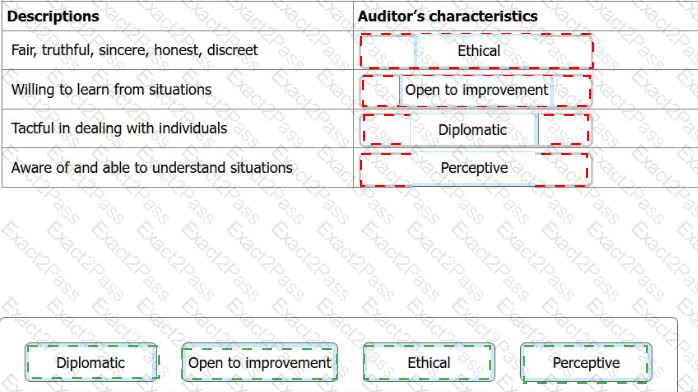
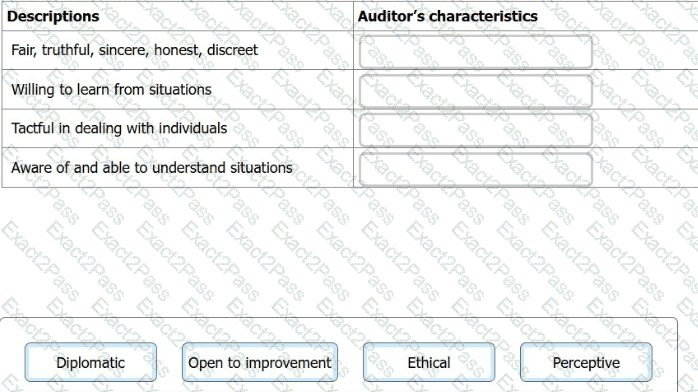
Auditors need to communicate effectively with auditees. Therefore, their personal behaviour is a key characteristic in ensuring a successful audit.
Below is a list of these characteristics and a brief related description. Match the characteristics to the descriptions.


 C:\Users\Intellectual Works\Pictures\Screenshots\Screenshot 2025-06-12 143525.png