Exact2Pass

Last Update 20 hours ago Total Questions : 40
The Global Commercial Strategy content is now fully updated, with all current exam questions added 20 hours ago. Deciding to include L6M2 practice exam questions in your study plan goes far beyond basic test preparation.
You'll find that our L6M2 exam questions frequently feature detailed scenarios and practical problem-solving exercises that directly mirror industry challenges. Engaging with these L6M2 sample sets allows you to effectively manage your time and pace yourself, giving you the ability to finish any Global Commercial Strategy practice test comfortably within the allotted time.
XYZ is a large and successful airline which is looking to expand into a new geographical market. It currently offers short haul flights in Europe and wishes to expand into the Asian market. In order to do this, the CFO is considering medium/ long term financing options. Describe 4 options that could be used.
See the complete answer below in Explanation.
Four Medium/Long-Term Financing Options for XYZ’s Expansion into Asia
Introduction
Expanding into a new geographical market requires significant capital investment for new aircraft, operational infrastructure, marketing, and regulatory approvals . As XYZ Airlines plans to enter the Asian market , the CFO must assess medium and long-term financing options to fund this expansion while managing risk and financial stability.
The following are four key financing options that XYZ can consider:
1. Bank Loans (Term Loans) ????
Definition
A bank term loan is a structured loan from a financial institution with a fixed repayment period (typically 5–20 years) , used for large-scale business investments.
✅ Advantages ✔ Predictable repayment structure – Fixed or floating interest rates over an agreed period. ✔ Retains company ownership – Unlike equity financing, no shares are sold. ✔ Can be secured or unsecured – Flexible terms depending on company creditworthiness.
❌ Disadvantages ✖ Requires collateral – Airlines often secure loans against aircraft or other assets. ✖ Fixed repayment obligations – Risky if revenue generation is slower than expected. ✖ Interest rate fluctuations – Increases costs if rates rise (for variable-rate loans).
???? Example:
British Airways secured bank loans to fund new aircraft purchases.
???? Best for: Large capital expenditures, such as purchasing aircraft for the new Asian routes.
2. Corporate Bonds ????
Definition
A corporate bond is a debt security issued to investors , where the company borrows capital and agrees to pay interest (coupon) over time before repaying the principal at maturity (typically 5–30 years).
✅ Advantages ✔ Large capital raise – Bonds can generate substantial long-term funding. ✔ Lower interest rates than bank loans – If the company has a strong credit rating. ✔ Flexibility in repayment – Interest payments (coupons) are pre-agreed, allowing financial planning.
❌ Disadvantages ✖ High creditworthiness required – Investors demand a solid credit rating. ✖ Fixed interest costs – Even in poor revenue periods, interest payments must be met. ✖ Long approval and issuance process – Complex regulatory and underwriting procedures.
???? Example:
Lufthansa issued corporate bonds to raise capital for fleet expansion .
???? Best for: Funding fleet expansion or infrastructure development without immediate repayment pressure.
3. Lease Financing (Aircraft Leasing) ✈️
Definition
Lease financing involves leasing aircraft instead of purchasing them outright , reducing initial capital expenditure while maintaining operational flexibility.
✅ Advantages ✔ Lower upfront costs – Avoids large capital outlays. ✔ More flexible than ownership – Can return or upgrade aircraft as market demand changes. ✔ Preserves cash flow – Payments are spread over time, aligning with revenue generation.
❌ Disadvantages ✖ Higher long-term costs – Leasing is more expensive over the aircraft’s lifespan compared to ownership. ✖ Limited asset control – XYZ would not own the aircraft and must follow leasing conditions. ✖ Dependent on lessors’ terms – Strict maintenance and usage clauses.
???? Example:
Ryanair and Emirates use operating leases to expand their fleets cost-effectively.
???? Best for: Entering new markets with minimal financial risk, allowing XYZ to test the Asian market before making major capital investments.
4. Equity Financing (Share Issuance) ????
Definition
Equity financing involves raising funds by issuing new company shares to investors , providing long-term capital without repayment obligations.
✅ Advantages ✔ No repayment burden – Unlike debt, there are no interest payments or fixed obligations. ✔ Enhances financial stability – Reduces leverage and improves balance sheet strength. ✔ Can attract strategic investors – Airlines may raise capital from partners or industry investors .
❌ Disadvantages ✖ Dilutes ownership – Existing shareholders lose some control. ✖ Time-consuming approval process – Requires regulatory compliance and investor confidence. ✖ Market dependence – Success depends on stock market conditions.
???? Example:
IAG (British Airways' parent company) raised capital via a share issuance to fund expansion.
???? Best for: Companies looking for long-term funding without increasing debt, especially if stock market conditions are favorable.
5. Comparison of Financing Options
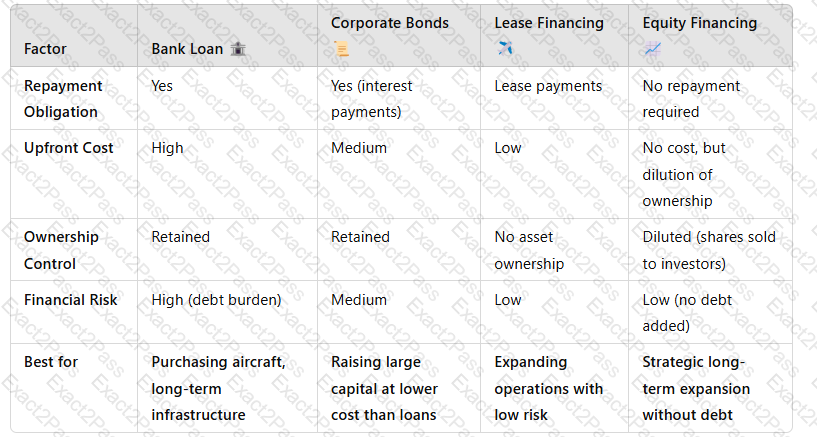
Key Takeaway: Each financing option suits different strategic needs, from ownership-based expansion to flexible leasing.
6. Recommendation: Best Financing Option for XYZ’s Expansion
✅ Best Option: Lease Financing (Aircraft Leasing) ✈️
Minimizes financial risk while expanding into Asia.
Avoids large upfront costs , preserving cash for operations.
Allows flexibility if the new market underperforms.
Alternative Approach: Hybrid Strategy
Lease aircraft initially → Test the Asian market.
Issue corporate bonds later → Secure long-term funding for growth.
Consider equity financing if a strategic investor is interested.
???? Final Takeaway: A combination of leasing for operational flexibility and corporate bonds or equity for long-term financial strength is the best approach for XYZ’s expansion into Asia.
XYZ is a large technology organisation which has used an aggressive growth strategy to become the market leader. It frequently buys out smaller firms to add to its increasing portfolio of businesses. How could XYZ use the Kachru Parenting Matrix to assist in decision making regarding future investments?
See the complete answer below in Explanation.
Using the Kachru Parenting Matrix for XYZ’s Investment Decisions
Introduction
The Kachru Parenting Matrix is a strategic decision-making tool that helps businesses evaluate how well a parent company can add value to its subsidiaries . For XYZ, a large technology firm that follows an aggressive acquisition strategy , the Kachru Parenting Matrix can guide investment decisions by assessing the synergy between the parent company (XYZ) and its acquired businesses .
By using this matrix, XYZ can determine which acquisitions will benefit from its expertise, resources, and management style , ensuring maximum strategic alignment and value creation.
1. Explanation of the Kachru Parenting Matrix
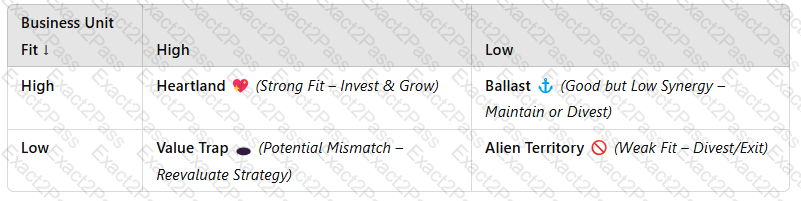
The Kachru Parenting Matrix evaluates business units based on:
Business Unit Fit – How well the subsidiary aligns with the parent company’s core capabilities and expertise .
Parenting Advantage – The ability of the parent company to add value to the subsidiary through strategic oversight, resources, and expertise.
It categorizes business units into four quadrants , influencing investment decisions:
| Parenting Advantage →
 A screenshot of a computer
Description automatically generated
A screenshot of a computer
Description automatically generated
2. How XYZ Can Use the Kachru Parenting Matrix for Investment Decisions
1. Identifying Core Growth Areas – Heartland Businesses ???? (Invest & Grow)
These businesses strongly align with XYZ’s expertise and benefit from its technology, resources, and leadership .
XYZ should prioritize investment, innovation, and expansion in these areas.
???? Example: If XYZ specializes in AI and cloud computing , acquiring smaller AI startups would fall into the Heartland category, ensuring seamless integration and value creation.
✅ Strategic Action: Invest in R & D, talent acquisition, and global expansion for these subsidiaries.
2. Maintaining Complementary Businesses – Ballast Businesses ⚓ (Maintain or Divest if Needed)
These businesses are profitable but do not directly fit XYZ’s core strategy .
XYZ can keep them for financial stability or sell them if they drain management resources .
???? Example: If XYZ acquires a hardware company but primarily operates in software , the hardware unit may not fully align with its expertise .
✅ Strategic Action: Maintain for profitability or sell if it becomes a burden .
3. Avoiding Value Draining Investments – Value Trap Businesses ???? ️ (Reevaluate or Divest)
These businesses seem promising but struggle under XYZ’s management approach .
They may require too much intervention , reducing overall profitability.
???? Example: If XYZ buys a social media company but lacks the right expertise to monetize it effectively, it becomes a value trap .
✅ Strategic Action: Reevaluate if restructuring is possible; otherwise, sell to avoid financial losses.
4. Exiting Poorly Aligned Businesses – Alien Territory ???? (Divest Immediately)
These businesses do not align at all with XYZ’s strategy or expertise.
Keeping them leads to resource misallocation and inefficiencies .
???? Example: If XYZ acquires a retail clothing company , it would be in Alien Territory , as it does not fit within the technology industry .
✅ Strategic Action: Divest or spin off these businesses to focus on core competencies.
3. Strategic Benefits of Using the Kachru Parenting Matrix
✅ Improves Investment Focus – Helps XYZ identify the most valuable acquisitions . ✅ Enhances Synergy & Value Creation – Ensures subsidiaries benefit from XYZ’s resources and leadership . ✅ Prevents Poor Acquisitions – Avoids wasting capital on unrelated businesses . ✅ Optimizes Portfolio Management – Balances high-growth and stable revenue businesses .
4. Conclusion
The Kachru Parenting Matrix is a critical tool for XYZ to assess future acquisitions , ensuring that each business unit contributes to long-term profitability and strategic alignment .
✅ Heartland businesses should receive maximum investment . ✅ Ballast businesses can be maintained for financial stability . ✅ Value Trap businesses should be reevaluated or restructured . ✅ Alien Territory businesses must be divested to avoid inefficiencies .
By using this framework, XYZ can ensure smarter, more strategic acquisitions , maintaining its market leadership while avoiding financial risks .
Discuss 5 tasks of strategic management
See the complete answer below in Explanation.
Five Key Tasks of Strategic Management
Introduction
Strategic management involves formulating, implementing, and evaluating a company's long-term goals to achieve competitive advantage. It ensures that an organization effectively aligns its resources, capabilities, and market position to meet its objectives.
The strategic management process can be broken down into five key tasks :
1. Setting Vision, Mission, and Objectives
Strategic management begins with defining the organization’s purpose and direction .
✅ Vision Statement: Describes the long-term aspirations of the business. ✅ Mission Statement: Outlines the core purpose and values . ✅ Objectives: Establish specific, measurable goals (e.g., market expansion, profitability targets).
???? Example:
Tesla’s vision is to accelerate the world’s transition to sustainable energy.
XYZ Construction might set a strategic objective to become the UK’s leading sustainable housing developer.
2. Environmental Scanning and Analysis
Organizations must assess internal and external environments to identify opportunities and threats .
✅ External Analysis – Uses PESTLE (Political, Economic, Social, Technological, Legal, Environmental) and Porter’s Five Forces to assess market conditions. ✅ Internal Analysis – Uses VRIO (Value, Rarity, Imitability, Organization) and SWOT (Strengths, Weaknesses, Opportunities, Threats) to evaluate internal capabilities.
???? Example:
A global beverage company may conduct PESTLE analysis to assess regulatory changes in sugar taxation .
XYZ Construction may analyze rising material costs and explore alternative suppliers .
3. Strategy Formulation
After analyzing the environment, the organization develops its strategic choices :
✅ Corporate-Level Strategy: Determines growth direction (e.g., diversification, mergers, acquisitions). ✅ Business-Level Strategy: Focuses on competitive advantage (e.g., cost leadership, differentiation, or niche market strategies ). ✅ Functional-Level Strategy: Aligns departments (procurement, HR, marketing) with the corporate strategy.
???? Example:
XYZ Construction could adopt a cost leadership strategy by sourcing materials more efficiently.
Apple follows a differentiation strategy by focusing on innovation and design.
4. Strategy Implementation
Once a strategy is formulated, it must be executed effectively .
✅ Organizational Structure: Ensures the right teams and leadership are in place. ✅ Change Management: Employees must accept and support the strategy (overcoming resistance to change). ✅ Resource Allocation: Financial, technological, and human resources must be assigned effectively.
???? Example:
XYZ Construction might invest in new project management software to improve efficiency.
Amazon continuously optimizes its logistics network to implement its cost leadership strategy.
5. Strategy Evaluation and Control
Organizations must monitor performance to ensure the strategy remains effective.
✅ Key Performance Indicators (KPIs): Measure progress (e.g., sales growth, cost reduction). ✅ Feedback & Adaptation: Adjust strategies based on market trends and competitor actions . ✅ Risk Management: Identify and mitigate risks (e.g., economic downturns, supply chain disruptions) .
???? Example:
XYZ Construction may review project completion times and adjust its approach for greater efficiency.
McDonald’s continuously adapts its menu based on regional preferences and customer feedback .
Conclusion
The five key tasks of strategic management— setting objectives, environmental scanning, strategy formulation, strategy implementation, and evaluation —help organizations achieve long-term success and competitive advantage . Effective strategic management ensures that companies stay agile in dynamic markets while making informed, data-driven decisions.
XYZ is a toilet paper manufacturer based in the UK. It has 2 large factories employing over 500 staff and a complex supply chain sourcing paper from different forests around the world. XYZ is making some strategic changes to the way it operates including changes to staffing structure and introducing more automation. Discuss 4 causes of resistance to change that staff at XYZ may experience and examine how the CEO of XYZ can successfully manage this resistance to change
See the complete answer below in Explanation.
Causes of Resistance to Change & Strategies to Manage It – XYZ Case Study
When XYZ, a UK-based toilet paper manufacturer, implements strategic changes such as staff restructuring and automation , employees may resist change due to uncertainty, fear, and disruption to their work environment. Below are four key causes of resistance and how the CEO can manage them effectively .
Causes of Resistance to Change
1. Fear of Job Loss
???? Cause: Employees may fear that automation will replace their jobs, leading to layoffs. Factory workers and administrative staff may feel particularly vulnerable.
???? Example: If machines take over manual processes like paper cutting and packaging, employees may see this as a direct threat to their roles.
2. Lack of Communication and Transparency
???? Cause: When management fails to communicate the reasons for change, employees may speculate and assume the worst. Unclear messages lead to distrust.
???? Example: If XYZ’s CEO announces restructuring without explaining why and how jobs will be affected, employees may feel insecure and disengaged.
3. Loss of Skills and Status
???? Cause: Some employees, especially long-serving workers , may feel their skills are becoming obsolete due to automation. Managers may resist change if they fear losing power in a new structure.
???? Example: A production line supervisor may oppose automation because it reduces the need for human oversight, making their role seem redundant.
4. Organizational Culture and Habit
???? Cause: Employees are accustomed to specific ways of working , and sudden changes disrupt routine . Resistance occurs when changes challenge existing work culture .
???? Example: XYZ’s employees may have always used manual processes , and shifting to AI-driven production feels unfamiliar and uncomfortable.
How the CEO Can Manage Resistance to Change
1. Effective Communication Strategy
✅ What to do?
Clearly explain why the changes are necessary (e.g., cost efficiency, competitiveness).
Use town hall meetings, emails, and team discussions to provide updates.
Address employee concerns directly to reduce uncertainty.
???? Example: The CEO can send monthly updates on automation, ensuring transparency and reducing fear.
2. Employee Involvement and Engagement
✅ What to do?
Involve staff in decision-making to give them a sense of control.
Create cross-functional teams to gather employee input.
Provide opportunities for feedback and discussion .
???? Example: XYZ can form a worker’s advisory panel to gather employee concerns and address them proactively.
3. Training and Upskilling Programs
✅ What to do?
Offer training programs to help employees adapt to new technologies.
Provide reskilling opportunities for employees whose jobs are affected.
Reassure staff that automation will create new roles , not just eliminate jobs.
???? Example: XYZ can introduce digital skills training for workers transitioning from manual processes to automated systems.
4. Change Champions & Support Systems
✅ What to do?
Appoint change champions (influential employees) to advocate for change.
Offer emotional and psychological support (e.g., HR consultations, career guidance).
Recognize and reward employees who embrace change .
???? Example: XYZ can offer bonuses or promotions to employees who successfully transition into new roles.
Conclusion
Resistance to change is natural, but the CEO of XYZ can minimize resistance through clear communication, employee involvement, training, and structured support . By managing resistance effectively, XYZ can ensure a smooth transition while maintaining employee morale and operational efficiency.
Discuss supply and demand factors in foreign exchange
See the complete answer below in Explanation.
Supply and Demand Factors in Foreign Exchange
Introduction
The foreign exchange (Forex) market operates on the fundamental principle of supply and demand , which determines currency values. When demand for a currency rises , its value appreciates, while an oversupply causes depreciation .
Several factors influence the supply and demand of foreign currencies, including interest rates, inflation, trade balances, investor sentiment, and geopolitical events .
This answer explores the key supply and demand factors in Forex markets and how they impact exchange rates.
1. Demand Factors in Foreign Exchange ???? ???? (What Increases Demand for a Currency?)
1.1 Interest Rate Differentials ???? (Higher Interest Rates Attract Capital Inflows)
✅ Why It Affects Demand?
Investors seek higher returns on savings and investments .
Higher interest rates increase demand for the country’s currency.
???? Example:
When the US Federal Reserve raises interest rates , the US dollar (USD) strengthens as global investors buy USD-denominated assets .
???? Key Takeaway: Countries with higher interest rates attract more investors , increasing currency demand.
1.2 Inflation Rates ???? (Low Inflation Strengthens Currency Demand)
✅ Why It Affects Demand?
Lower inflation preserves purchasing power , making the currency more attractive.
High inflation erodes currency value , reducing demand.
???? Example:
The Swiss Franc (CHF) remains strong due to Switzerland’s low inflation and economic stability .
In contrast, Turkey’s Lira (TRY) depreciated due to high inflation, reducing investor confidence.
???? Key Takeaway: Stable inflation rates encourage demand for a currency , while high inflation weakens it.
1.3 Trade Balance & Current Account Surplus ???? (Export-Led Demand for a Currency)
✅ Why It Affects Demand?
A trade surplus (exports > imports) increases demand for a country’s currency.
Foreign buyers need the country’s currency to pay for goods and services .
???? Example:
China’s trade surplus increases demand for the Chinese Yuan (CNY) as global buyers purchase Chinese goods.
Germany’s strong exports strengthen the Euro (EUR) due to high international trade.
???? Key Takeaway: Exporting nations experience higher currency demand , boosting value.
1.4 Investor Confidence & Speculation ???? (Market Sentiment Drives Demand)
✅ Why It Affects Demand?
If investors expect a currency to appreciate , they buy more of it.
Safe-haven currencies see increased demand during global uncertainty .
???? Example:
Gold and the US Dollar (USD) strengthen during economic crises , as investors seek stability.
Brexit uncertainty weakened the British Pound (GBP) as investors speculated on UK economic instability.
???? Key Takeaway: Market psychology and speculation can drive short-term demand for a currency.
2. Supply Factors in Foreign Exchange ???? ???? (What Increases the Supply of a Currency?)
2.1 Central Bank Monetary Policy ???? (Money Supply & Interest Rate Adjustments)
✅ Why It Affects Supply?
Central banks control currency supply through interest rates and money printing.
Loose monetary policy (low rates, quantitative easing) increases money supply, depreciating currency.
???? Example:
The European Central Bank (ECB) lowered interest rates and introduced stimulus packages, increasing the supply of Euros (EUR) .
The Bank of Japan’s low-interest rates increased the supply of Japanese Yen (JPY) , making it weaker.
???? Key Takeaway: More money supply weakens a currency, while tight monetary policy strengthens it.
2.2 Government Debt & Fiscal Policy ???? (Higher Debt Increases Currency Supply)
✅ Why It Affects Supply?
Countries with high national debt may increase money supply to cover obligations.
High debt reduces investor confidence, increasing supply as investors sell off the currency.
???? Example:
The US dollar saw increased supply during the 2008 financial crisis due to stimulus packages.
Argentina’s peso weakened as government debt rose, increasing peso supply in markets.
???? Key Takeaway: High government debt can lead to more currency supply and depreciation.
2.3 Foreign Exchange Reserves & Currency Intervention ???? (Central Banks Selling Currency to Manage Value)
✅ Why It Affects Supply?
Central banks buy/sell their currency to stabilize exchange rates .
Selling reserves increases currency supply , reducing its value.
???? Example:
China’s central bank occasionally sells Yuan (CNY) to keep it competitive in global markets.
Switzerland’s central bank has intervened to weaken the Swiss Franc (CHF) to support exports.
???? Key Takeaway: Governments manipulate currency supply to stabilize economic conditions.
2.4 Import Demand & Trade Deficits ???? (More Imports Increase Currency Supply)
✅ Why It Affects Supply?
A trade deficit (imports > exports) increases supply of local currency in global markets.
Importers exchange local currency for foreign currency, increasing supply.
???? Example:
The US has a persistent trade deficit , increasing the supply of US dollars in foreign exchange markets .
The UK’s reliance on imports has contributed to GBP fluctuations.
???? Key Takeaway: Countries with trade deficits see higher currency supply , leading to depreciation.
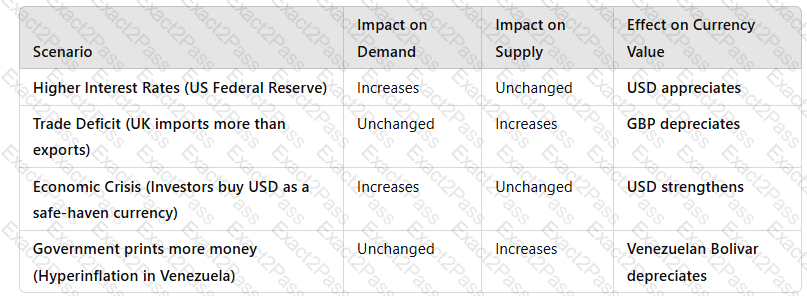
3. Interaction of Supply & Demand in Foreign Exchange Markets
 A white grid with black text
Description automatically generated
A white grid with black text
Description automatically generated
Key Takeaway: Exchange rates fluctuate based on the balance between supply and demand .
4. Conclusion
The foreign exchange market operates based on supply and demand dynamics , influenced by:
✅ Demand Factors:
Interest Rates & Inflation – Higher rates strengthen demand.
Trade Balances – Export-driven economies see strong demand.
Investor Sentiment – Economic stability attracts investors.
✅ Supply Factors:
Central Bank Policies – Money printing increases supply.
Government Debt – High debt increases supply, lowering value.
Trade Deficits – Import-heavy economies see currency depreciation.
Understanding these factors helps businesses and policymakers manage foreign exchange risks and optimize international trade strategies .
Using Porter’s 5 Forces, describe the business environment of a company of your choice
See the complete answer below in Explanation.
Porter’s Five Forces Analysis – Business Environment of Tesla
Introduction
Porter’s Five Forces Model , developed by Michael Porter , is a strategic framework used to analyze the competitive environment of an industry. It evaluates five key factors that influence a company’s profitability and strategic positioning.
For this analysis, we will examine Tesla Inc. , a leading electric vehicle (EV) and clean energy company , to assess its business environment using Porter’s Five Forces.
1. Competitive Rivalry (High) ???? ????
The automotive industry is highly competitive, with established brands and new entrants challenging Tesla’s market position.
✅ Key Factors:
Traditional automakers (Toyota, BMW, Mercedes, Ford, Volkswagen, GM) are expanding into EVs.
EV-only competitors (Rivian, Lucid, NIO, BYD, Polestar) are gaining market share.
Tesla’s technology (battery innovation, autonomous driving) gives it a temporary edge, but competitors are catching up.
???? Example: Tesla’s Supercharger network gives it an advantage, but competitors like Hyundai and Ford are forming EV charging alliances to reduce Tesla’s lead.
???? Impact: Tesla must continue innovation and brand differentiation to maintain market leadership.
2. Threat of New Entrants (Medium) ????
The barriers to entry in the automotive industry are high due to capital investment, brand recognition, and regulatory requirements .
✅ Key Factors:
High R & D costs for battery technology and autonomous driving deter new entrants.
Tesla’s strong brand recognition makes it difficult for new brands to compete.
Government incentives and EV market growth encourage startups like Rivian and Lucid .
Manufacturing expertise required —many new EV companies struggle with scaling production .
???? Example: Apple planned to enter the EV market but faced challenges in battery sourcing and technology.
???? Impact: While Tesla faces some risk from new startups , its established brand, patents, and economies of scale help protect its position.
3. Bargaining Power of Suppliers (Low to Medium) ???? ⚙️
Tesla relies on specialized components and raw materials (e.g., lithium, cobalt, semiconductors ) for battery production.
✅ Key Factors:
Tesla has vertically integrated its supply chain , producing in-house batteries (Gigafactories).
Raw material suppliers (e.g., lithium mining companies) hold some bargaining power due to limited global supply .
Semiconductor shortages have impacted Tesla and the auto industry as a whole.
Tesla has long-term contracts with key suppliers, reducing dependency risks.
???? Example: Tesla sources batteries from Panasonic, CATL, and LG Chem , but it is developing its own battery technology (4680 cells) to reduce reliance on third parties.
???? Impact: Tesla’s vertical integration strategy lowers supplier power, but raw material scarcity remains a challenge .
4. Bargaining Power of Buyers (Medium) ???? ️
Customers have more choices in the EV market , but Tesla’s brand loyalty and product differentiation give it an advantage.
✅ Key Factors:
Consumers compare Tesla against competitors based on price, range, and features.
Tesla's strong brand and innovation (Autopilot, long-range batteries, Supercharger network) reduce customer switching.
As more automakers enter the EV market, customers gain more bargaining power.
Price-sensitive buyers may opt for lower-cost EVs from brands like BYD and Nissan .
???? Example: Tesla’s Model 3 dominates the EV market , but new affordable EVs from Volkswagen and Hyundai give buyers alternatives .
???? Impact: Tesla must continuously innovate and expand its product range to retain market dominance.
5. Threat of Substitutes (Low to Medium) ???? ????
Substitutes for Tesla’s products include public transportation, hybrid vehicles, and alternative energy solutions .
✅ Key Factors:
Hybrid cars remain an option for customers who are not ready for full EV adoption.
Public transportation and ride-sharing services reduce the need for personal car ownership.
Fuel cell and hydrogen-powered vehicles could emerge as alternatives in the long term.
???? Example: Toyota is investing in hydrogen fuel cell vehicles (Mirai) , presenting an alternative to battery EVs.
???? Impact: While substitutes exist , Tesla’s unique market positioning and growing EV adoption reduce this threat .
Conclusion
Porter’s Five Forces analysis shows that Tesla operates in a highly competitive environment , facing challenges from rival EV makers, supplier dependencies, and increasing buyer power . However, its innovation, brand strength, and vertical integration strategy provide a strong competitive advantage .
To sustain growth, Tesla must: ✅ Continue investing in battery technology and AI-driven autonomous driving . ✅ Expand affordable EV options to compete with lower-cost brands. ✅ Strengthen supplier relationships to mitigate raw material shortages.
Assess benchmarking as an approach to analysing an organisations performance.
See the complete answer below in Explanation.
Benchmarking as an Approach to Analyzing Organizational Performance
Introduction
Benchmarking is a performance measurement tool used by organizations to compare their processes, products, or services against industry standards, competitors, or best practices. It helps organizations identify performance gaps, set improvement targets, and enhance competitive advantage .
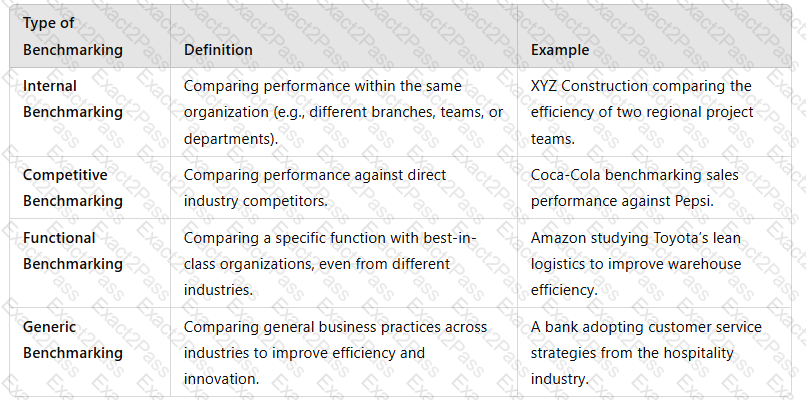
There are different types of benchmarking, including internal, competitive, functional, and generic benchmarking , each serving different strategic objectives.
1. Types of Benchmarking
Organizations can adopt different benchmarking approaches based on their goals:
 A screenshot of a computer
Description automatically generated
A screenshot of a computer
Description automatically generated
2. How Benchmarking Helps in Performance Analysis
Benchmarking provides quantifiable insights to assess and improve organizational performance in key areas:
✅ Identifies Performance Gaps – Highlights areas where an organization lags behind competitors or industry best practices. ✅ Improves Operational Efficiency – Helps streamline supply chain, production, and customer service processes . ✅ Enhances Strategic Decision-Making – Supports data-driven decisions for resource allocation, pricing strategies, and process optimization . ✅ Drives Continuous Improvement – Encourages a culture of innovation and best practice adoption . ✅ Boosts Competitive Advantage – Enables organizations to stay ahead in their market by implementing superior processes.
???? Example: A retail chain benchmarking delivery speed against Amazon may adopt AI-driven inventory management to reduce delays.
3. Advantages of Benchmarking
✅ Objective Performance Measurement – Uses industry data to provide realistic performance targets . ✅ Encourages Best Practice Adoption – Helps companies learn from successful competitors . ✅ Enhances Cost Efficiency – Identifies areas for cost reduction and resource optimization . ✅ Facilitates Strategic Growth – Helps companies improve customer experience, product innovation, and market positioning .
???? Example: McDonald's benchmarked Starbucks' digital loyalty program , leading to the launch of MyMcDonald’s Rewards , improving customer retention.
4. Limitations of Benchmarking
❌ Limited to Available Data – Confidential industry data may not always be accessible. ❌ Lack of Context – Differences in business models, resources, and market conditions can make direct comparisons misleading. ❌ Focus on Imitation Over Innovation – Firms may focus too much on copying competitors rather than developing unique strategies. ❌ Resource-Intensive – Conducting in-depth benchmarking requires time, expertise, and financial investment .
???? Example: XYZ Construction benchmarking against a large multinational may find certain strategies unrealistic due to scale differences .
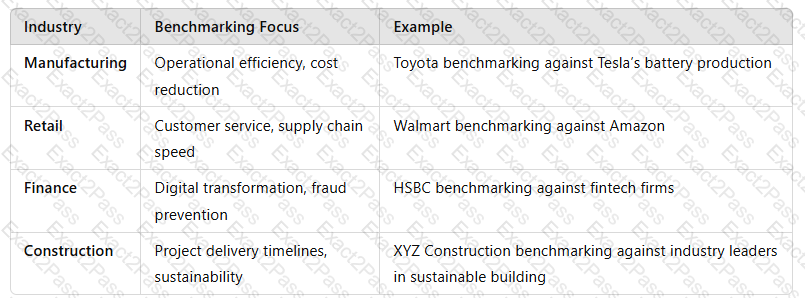
5. Application of Benchmarking in Different Sectors
Organizations across industries use benchmarking for performance analysis:
 A screenshot of a computer
Description automatically generated
A screenshot of a computer
Description automatically generated
Conclusion
Benchmarking is an effective performance analysis tool that helps organizations identify gaps, adopt best practices, and enhance competitiveness . However, it must be used carefully to avoid blind imitation and consider contextual differences . When integrated with other strategic models ( e.g., SWOT, Balanced Scorecard ), benchmarking provides a powerful framework for continuous improvement and strategic growth .
How can Minzburg’s 5Ps assist an organisation to develop its global strategy?
See the complete answer below in Explanation.
Mintzberg’s 5Ps and Global Strategy Development
Introduction
Henry Mintzberg’s 5Ps of Strategy is a framework that helps organizations understand the multiple perspectives of strategy. It recognizes that strategy is not just a planned activity but evolves through deliberate and emergent actions. The 5Ps—Plan, Ploy, Pattern, Position, and Perspective—help organizations develop an effective global strategy by providing a structured approach to decision-making and competitive positioning.
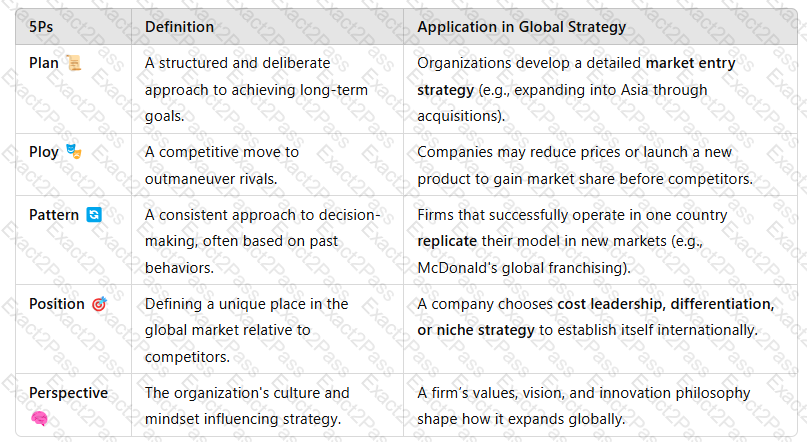
1. Explanation of Mintzberg’s 5Ps
Mintzberg’s 5Ps define strategy in five different ways, which help in shaping an organization’s global expansion and competitive positioning.
 A screenshot of a computer
Description automatically generated
A screenshot of a computer
Description automatically generated
2. How Mintzberg’s 5Ps Assist in Developing Global Strategy
1. Strategy as a Plan ???? – Setting a Clear Direction for Global Expansion
Organizations develop structured strategic plans for international growth, including market research, investment strategies, and risk assessments .
Example: Tesla planned its global expansion into China by building a Gigafactory, ensuring supply chain efficiency and market entry success.
✅ Benefit: Ensures a structured, well-researched approach to global expansion.
2. Strategy as a Ploy ???? – Gaining Competitive Advantage
Companies use strategic moves to block competitors or gain an early advantage in global markets.
Example: Amazon strategically enters new markets by offering discounts and acquiring local businesses to weaken competitors.
✅ Benefit: Helps organizations counter competition and establish dominance in new markets .
3. Strategy as a Pattern ???? – Replicating Successful Models
If a company has a proven business model , it can apply the same strategy across different regions.
Example: McDonald's follows a pattern-based global expansion model , using standardized menus but adapting products to local tastes (e.g., McAloo Tikki in India).
✅ Benefit: Allows organizations to scale efficiently while maintaining consistency.
4. Strategy as a Position ???? – Establishing a Competitive Market Position
Organizations must decide how they will compete globally —whether through cost leadership, differentiation, or niche markets .
Example: Apple positions itself as a premium brand worldwide, maintaining exclusivity through high pricing and innovation.
✅ Benefit: Helps organizations create a distinctive identity in international markets.
5. Strategy as a Perspective ???? – Aligning Culture and Global Vision
A company’s culture and values influence its global strategy.
Example: Patagonia’s sustainability-first approach shapes its expansion into environmentally conscious markets, aligning with global CSR expectations.
✅ Benefit: Ensures global expansion aligns with the company’s long-term values and mission .
3. Advantages of Using Mintzberg’s 5Ps in Global Strategy Development
✅ Holistic Approach – Ensures strategy is not just a rigid plan but adapts to competition and market trends . ✅ Enhances Competitive Agility – Organizations can pivot between strategies (e.g., using a Ploy to disrupt competitors). ✅ Supports Market Adaptation – Helps companies apply Pattern-based expansion while considering local market needs. ✅ Aligns Corporate Vision with Market Positioning – The Perspective approach ensures expansion aligns with organizational values.
4. Limitations of Mintzberg’s 5Ps in Global Strategy
❌ Lack of Emphasis on External Factors – Unlike PESTLE or Porter’s Five Forces , the 5Ps focus mainly on internal strategy . ❌ Can Be Overly Conceptual – May lack specific actionable steps for implementing global expansion. ❌ Does Not Account for Rapid Market Changes – In fast-changing industries (e.g., tech), rigid strategic planning may become outdated quickly .
???? Solution: Combine 5Ps with external analysis tools (e.g., PESTLE for macro-environmental risks, BCG for product portfolio management).
Conclusion
Mintzberg’s 5Ps of Strategy provide a comprehensive framework for developing global strategies , ensuring that businesses consider planning, competitive moves, consistency, positioning, and cultural alignment . However, it should be used in combination with other strategic models for a well-rounded approach to global expansion and decision-making .
Describe 5 strategic decisions a company can make and how these decisions could impact upon competitive advantage.
See the complete answer below in Explanation.
Five Strategic Decisions a Company Can Make and Their Impact on Competitive Advantage
Strategic decisions shape a company's direction and influence its long-term success. Below are five key strategic decisions and their impact on competitive advantage :
1. Market Entry Strategy
Decision: A company decides how to enter new markets (e.g., direct investment, joint ventures, exporting, franchising).
Impact on Competitive Advantage: ✅ Global Reach: Expanding into new markets increases revenue streams and reduces dependency on a single market. ✅ Risk Mitigation: Entering via joint ventures or alliances can reduce risks related to market unfamiliarity. ✅ Brand Positioning: Choosing premium vs. cost-leadership entry strategies can establish market dominance. ❌ Potential Risk: Poor market research can lead to financial loss and reputational damage.
Example: Tesla entering China through direct investment in Gigafactories to strengthen its supply chain and reduce production costs.
2. Supply Chain Strategy
Decision: Whether to adopt a globalized, localized, or hybrid supply chain model.
Impact on Competitive Advantage: ✅ Cost Reduction: Strategic sourcing from low-cost countries lowers production expenses. ✅ Resilience: A diverse supplier base reduces risks of disruptions (e.g., geopolitical risks, pandemics). ✅ Speed to Market: Nearshoring strategies improve lead times and response to demand fluctuations. ❌ Potential Risk: Over-reliance on global suppliers can lead to disruptions (e.g., semiconductor shortages).
Example: Apple’s dual sourcing strategy for chip manufacturing (Taiwan’s TSMC + US-based suppliers) improves resilience.
3. Innovation and R & D Investment
Decision: How much to invest in research and development (R & D) to drive product innovation.
Impact on Competitive Advantage: ✅ Differentiation: Unique and high-quality products create strong brand loyalty (e.g., iPhones, Tesla). ✅ First-Mover Advantage: Innovators set industry trends, making it difficult for competitors to catch up. ✅ Revenue Growth: New technologies create additional revenue streams (e.g., SaaS models in tech). ❌ Potential Risk: High R & D costs with no guaranteed success (e.g., Google Glass failure).
Example: Pfizer and BioNTech’s rapid COVID-19 vaccine development, giving them first-mover advantage.
4. Pricing Strategy
Decision: Whether to compete on cost leadership, differentiation, or premium pricing.
Impact on Competitive Advantage: ✅ Market Penetration: Low-cost pricing attracts price-sensitive customers (e.g., Walmart, Ryanair). ✅ Brand Exclusivity: Premium pricing enhances brand perception and profitability (e.g., Rolex, Louis Vuitton). ✅ Value-Based Pricing: Aligning price with perceived value increases customer retention. ❌ Potential Risk: A race to the bottom in pricing wars can erode profit margins (e.g., budget airlines struggle with profitability).
Example: Apple uses a premium pricing strategy while Xiaomi competes via cost leadership in smartphones.
5. Digital Transformation Strategy
Decision: Investment in automation, AI, and digital platforms to improve efficiency and customer engagement.
Impact on Competitive Advantage: ✅ Operational Efficiency: Automation reduces costs and increases productivity (e.g., Amazon’s AI-driven warehouses). ✅ Customer Experience: AI-driven personalization improves engagement (e.g., Netflix’s recommendation algorithms). ✅ Scalability: Digital platforms enable rapid global expansion (e.g., Shopify helping SMEs go digital). ❌ Potential Risk: High initial investment with slow ROI; risk of cyber threats.
Example: Starbucks using AI-powered personalization and mobile ordering to increase sales and customer loyalty.
Conclusion
Each strategic decision influences a company’s competitive positioning. The most successful companies align market expansion, supply chain strategies, innovation, pricing, and digital transformation to create a sustainable competitive advantage .
XYZ is a high fashion clothing designer and wishes to complete a benchmarking exercise. Discuss priority dimensions to be measured in the benchmarking exercise and propose a strategy for completing the exercise
See the complete answer below in Explanation.
Benchmarking Exercise for XYZ – A High Fashion Clothing Designer
Introduction
Benchmarking is a strategic performance measurement tool that helps businesses compare their processes, products, and strategies with industry leaders to identify areas for improvement.
As a high fashion clothing designer , XYZ must focus on key priority dimensions such as product quality, supply chain efficiency, sustainability, brand positioning, and customer engagement . A structured benchmarking strategy ensures that XYZ can achieve competitive advantage, optimize operations, and align with industry best practices .
1. Priority Dimensions to be Measured in Benchmarking
XYZ should focus on the following five key benchmarking dimensions to enhance its competitiveness in the luxury fashion market:
1. Product Quality and Design Innovation
✅ Why it’s important?
High fashion brands compete on premium materials, craftsmanship, and exclusivity .
Quality affects brand reputation, pricing strategy, and customer loyalty .
???? Example: XYZ can benchmark against Gucci or Chanel by comparing fabric sourcing, production techniques, and unique design elements.
2. Supply Chain Efficiency and Lead Times
✅ Why it’s important?
Speed-to-market is critical in high fashion , especially for seasonal collections.
Efficient supply chains reduce costs and enhance inventory management .
???? Example: Zara benchmarks against luxury brands to optimize supply chains while maintaining affordability.
???? Key Metrics to Benchmark:
Supplier lead times (raw materials to finished goods).
Production cycle time (design to retail store).
Logistics and distribution efficiency.
3. Brand Positioning and Market Perception
✅ Why it’s important?
A high fashion brand’s success depends on prestige, exclusivity, and perceived value .
Benchmarking against top competitors helps XYZ maintain a premium brand image .
???? Example: XYZ can compare its marketing strategies, social media presence, and celebrity endorsements with Louis Vuitton or Dior .
???? Key Metrics to Benchmark:
Brand awareness and perception (customer surveys).
Pricing strategy compared to competitors.
Effectiveness of marketing campaigns and influencer collaborations.
4. Sustainability and Ethical Sourcing
✅ Why it’s important?
Consumers expect eco-friendly, ethically produced fashion .
Sustainable brands gain a competitive edge and attract Gen Z and millennial buyers.
???? Example: Stella McCartney’s ethical fashion model is a benchmark for sustainable materials and responsible sourcing .
???? Key Metrics to Benchmark:
Use of sustainable materials (organic, recycled fabrics).
Ethical supplier compliance with fair labor practices .
Carbon footprint reduction in production and logistics.
5. Customer Engagement and Experience
✅ Why it’s important?
Luxury brands thrive on personalized customer experiences and loyalty programs .
Omnichannel retail (physical stores + digital platforms) enhances sales and retention.
???? Example: Burberry’s digital transformation provides a seamless luxury online shopping experience .
???? Key Metrics to Benchmark:
Online vs. in-store customer engagement levels.
AI-driven personalization in e-commerce.
Customer service responsiveness and return policies.
2. Proposed Strategy for Completing the Benchmarking Exercise
To complete the benchmarking process successfully, XYZ should follow a structured benchmarking approach using the 5-step process :
Step 1: Identify Benchmarking Objectives
???? Define what XYZ wants to achieve (e.g., reducing lead times, improving sustainability ). ???? Select benchmarking partners (competitors, industry leaders, cross-industry comparisons).
Step 2: Data Collection & Research
???? Use primary and secondary research to gather data:
Primary Research: Surveys, interviews, supplier audits.
Secondary Research: Competitor reports, industry data, fashion indexes.
???? Example: Studying annual sustainability reports from high fashion brands to benchmark against sustainability best practices.
Step 3: Analyze Performance Gaps
???? Compare XYZ’s current performance metrics with industry benchmarks. ???? Identify gaps and improvement opportunities (e.g., faster supply chain, better brand marketing).
???? Example Analysis:
XYZ’s supply chain lead time = 60 days vs. benchmark brand = 30 days → Strategy needed for optimization.
Step 4: Develop and Implement Improvement Strategies
???? Set SMART objectives (Specific, Measurable, Achievable, Relevant, Time-bound). ???? Adjust supply chain processes, brand positioning, marketing strategies , and customer experience initiatives.
???? Example Action Plan:
Supply Chain: Partner with local European suppliers to reduce lead times.
Sustainability: Introduce organic cotton & cruelty-free leather in the next collection.
Step 5: Continuous Monitoring and Review
???? Regularly review benchmarking outcomes. ???? Adjust strategies to remain competitive in the evolving high fashion market.
???? Example: Chanel adapts marketing campaigns every season to maintain exclusivity and desirability.
Conclusion
Benchmarking allows XYZ to measure product quality, supply chain efficiency, brand positioning, sustainability, and customer engagement against high fashion industry leaders . A structured 5-step benchmarking process ensures that XYZ continuously improves its strategic performance and maintains a competitive edge .

