Exact2Pass

Last Update 17 hours ago Total Questions : 114
The Fortinet NSE 5 - FortiSwitch 7.6 Administrator content is now fully updated, with all current exam questions added 17 hours ago. Deciding to include NSE5_FSW_AD-7.6 practice exam questions in your study plan goes far beyond basic test preparation.
You'll find that our NSE5_FSW_AD-7.6 exam questions frequently feature detailed scenarios and practical problem-solving exercises that directly mirror industry challenges. Engaging with these NSE5_FSW_AD-7.6 sample sets allows you to effectively manage your time and pace yourself, giving you the ability to finish any Fortinet NSE 5 - FortiSwitch 7.6 Administrator practice test comfortably within the allotted time.
Which two statements about managing a FortiSwitch stack on FortiGate are true? (Choose two.)
An administrator needs to deploy managed FortiSwitch devices in a remote location where multiple VLANs must be utilized to segment devices. No Layer 3 switch or router is present. The the only WAN connectivity is the router provided by the ISP connected to the public internet.
Which two items will the administrator need to use? (Choose two.)
You are designing a multi-tenant network using FortiSwitch devices in standalone mode. Security is a priority and each tenant’s servers must be completely isolated from one another, and from all other servers in the network, to prevent lateral communication. However, all servers must have access to the shared FortiGate firewall for internet access. Which type of private VLAN (PVLAN) configuration should you apply to meet these security requirements? (Choose one answer)
How are the ' by VLAN redirect MAC address quarantine ' mode and the ' by redirect MAC address quarantine ' mode on FortiGate similar?
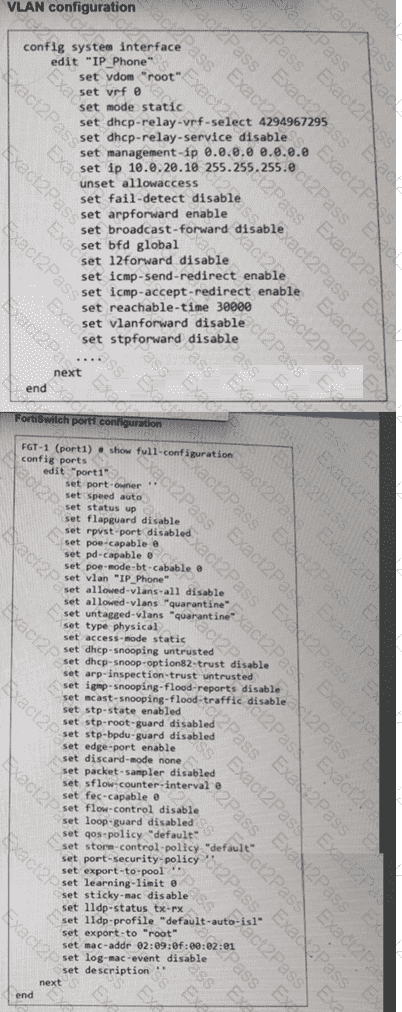
Refer to the exhibits. An IP phone is connected to port1 of FortiSwitch Access-1. The IP phone tags its traffic with VLAN ID 20. On FortiGate, VLAN IP_Phone (VLAN ID 20) has been configured, and port1 of Access-1 is set with VLAN 20 as the native VLAN. However, the IP phone cannot reach the network. The exhibit shows the partial VLAN configuration and the port1 configuration on Access-1.
Which configuration change must you make on FortiSwitch to allow ingress and egress traffic for the IP phone? (Choose one answer)
You are managing FortiSwitch ports from a FortiGate device with multiple VDOMs. Which two methods can you use to assign FortiSwitch ports to VDOMs? (Choose two answers)
Which QoS mechanism maps packets with specific CoS or DSCP markings to an egress queue?
Refer to the exhibit.
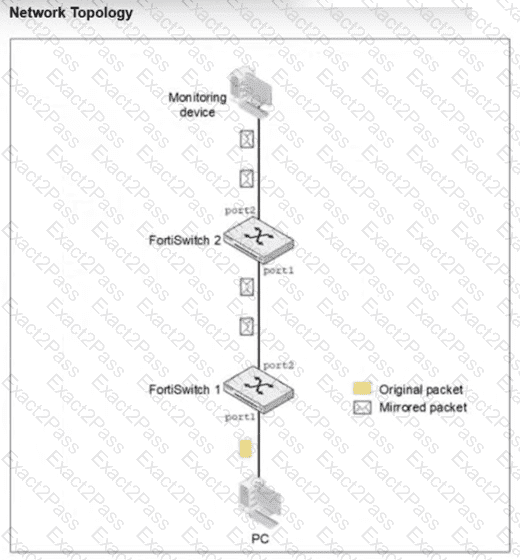
You configured Switched Port Analyzer (SPAN) to monitor traffic from a source port on FortiSwitch 1, but the monitoring device is connected to FortiSwitch 2. After port mirroring configuration on FortiSwitch 1, the monitoring device is not receiving any mirrored traffic.
What is the most likely reason the mirrored traffic is not reaching the monitoring device? (Choose one answer)
Which two rules used by MSTP are similar to rules used by other STP methods? (Choose two.)
What are two ways in which automatic MAC address quarantine works on FortiSwitch? (Choose two.)