Exact2Pass

Last Update 19 hours ago Total Questions : 96
The Fortinet NSE 6 - SD-WAN 7.6 Enterprise Administrator content is now fully updated, with all current exam questions added 19 hours ago. Deciding to include NSE6_SDW_AD-7.6 practice exam questions in your study plan goes far beyond basic test preparation.
You'll find that our NSE6_SDW_AD-7.6 exam questions frequently feature detailed scenarios and practical problem-solving exercises that directly mirror industry challenges. Engaging with these NSE6_SDW_AD-7.6 sample sets allows you to effectively manage your time and pace yourself, giving you the ability to finish any Fortinet NSE 6 - SD-WAN 7.6 Enterprise Administrator practice test comfortably within the allotted time.
Refer to the exhibit.
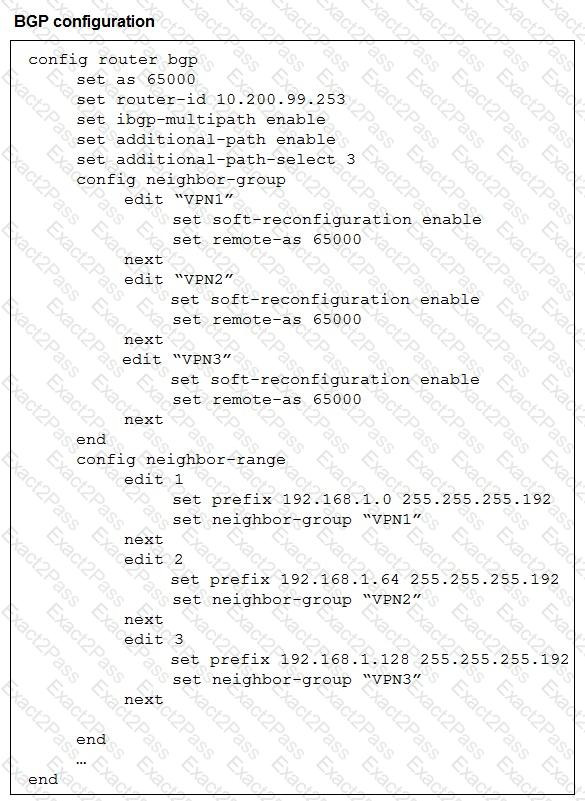
The exhibit shows the BGP configuration on the hub in a hub-and-spoke topology. The administrator wants BGP to advertise prefixes from spokes to other spokes over the IPsec overlays, including additional paths. However, when looking at the spoke routing table, the administrator does not see the prefixes from other spokes and the additional paths
Which three settings must the administrator configure inside each BGP neighbor group so spokes can learn the prefixes of other spokes and their additional paths? (Choose three.)
An SD-WAN member is no longer used to steer SD-WAN traffic. The administrator updated the SD-WAN configuration and deleted the unused member. After the configuration update, users report that some destinations are unreachable. You confirm that the affected flow does not match an SD-WAN rule.
What could be a possible cause of the traffic interruption?
Exhibit.
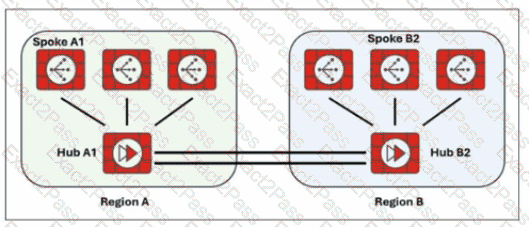
Two hub-and-spoke groups are connected through redundant site-to-site IPsec VPNs between Hub 1 and Hub 2
Which two configuration settings are required for the spoke A1 to establish an ADVPN shortcut with the spoke B2? (Choose two.)
Refer to the exhibits.
You use FortiManager to configure SD-WAN on three branch devices.
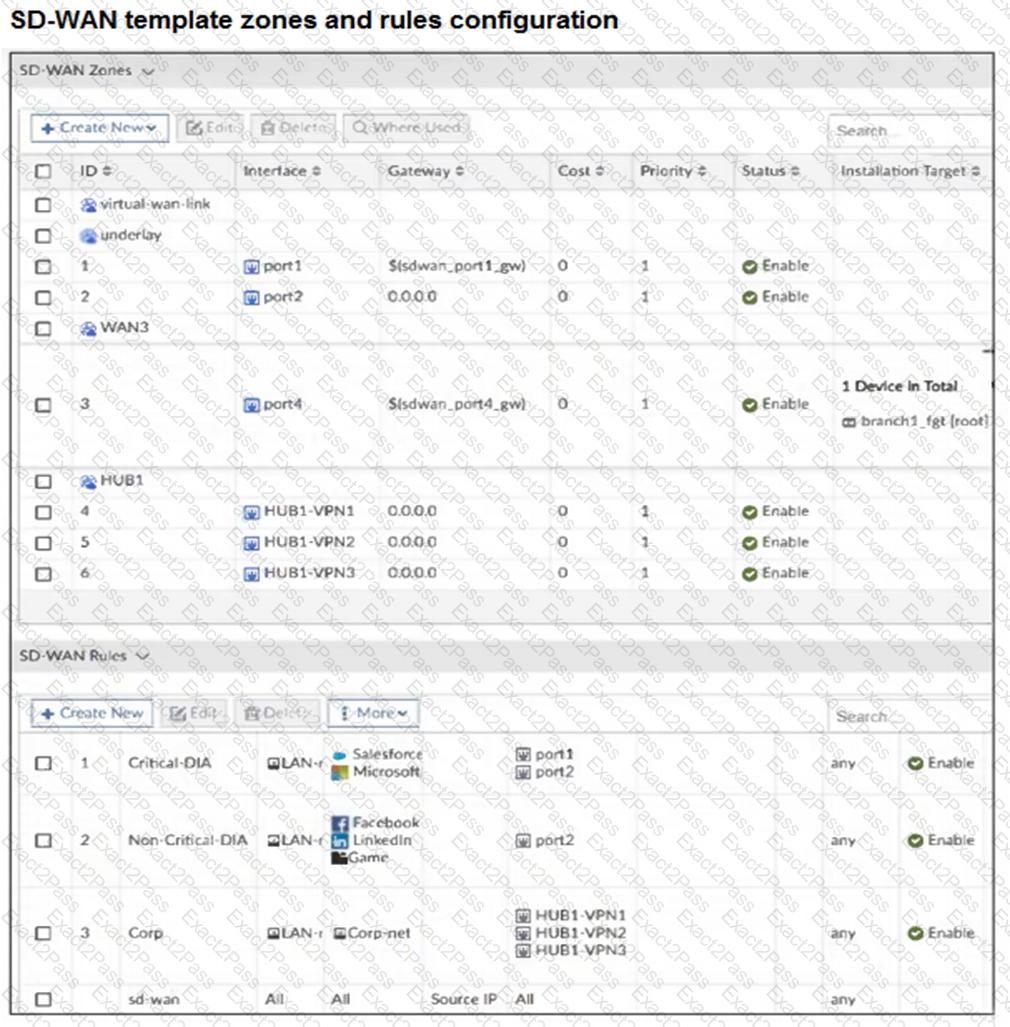
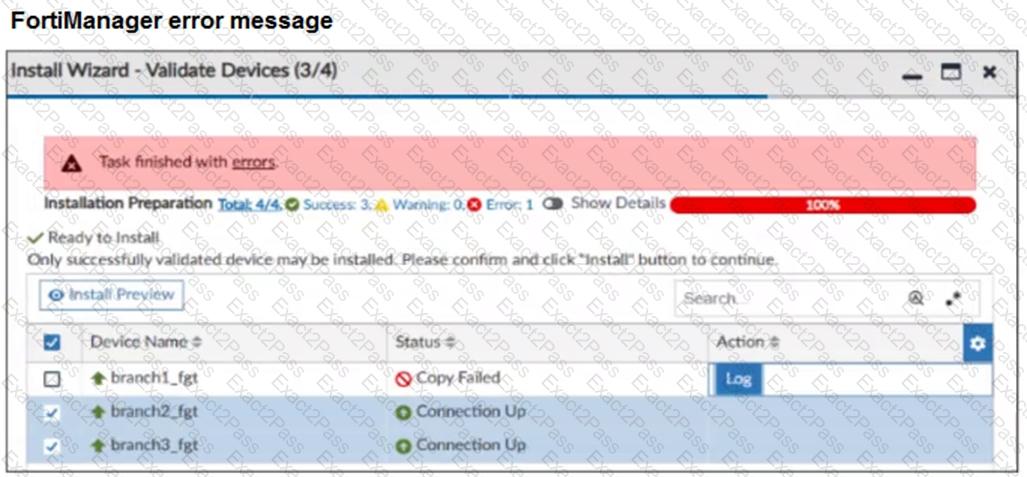
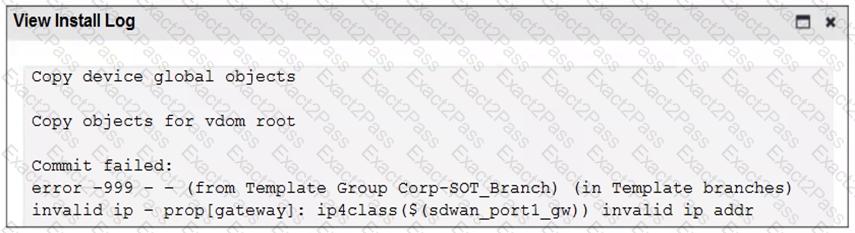
When you install the device settings, FortiManager prompts you with the error “Copy Failed” for the device branch1_fgt. When you click the log button, FortiManager displays the message shown in the exhibit.
There are two different ways to resolve this issue. Based on the exhibits, which methods could you use? (Choose two.)
Refer to the exhibits.
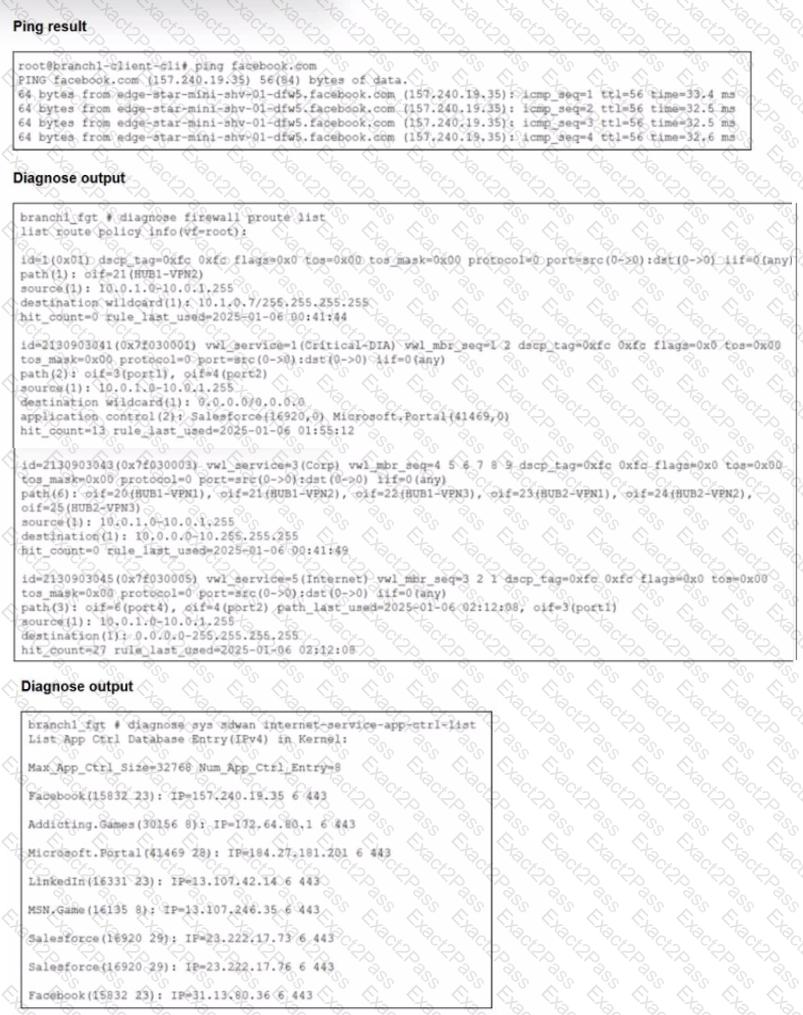
You connect to a device behind a branch FortiGate device and initiate a ping test. The device is part of the LAN subnet and its IP address is 10.0.1.101.
Based on the exhibits, which interface uses branch 1_fgt to steer the test traffic?
Refer to the exhibits.
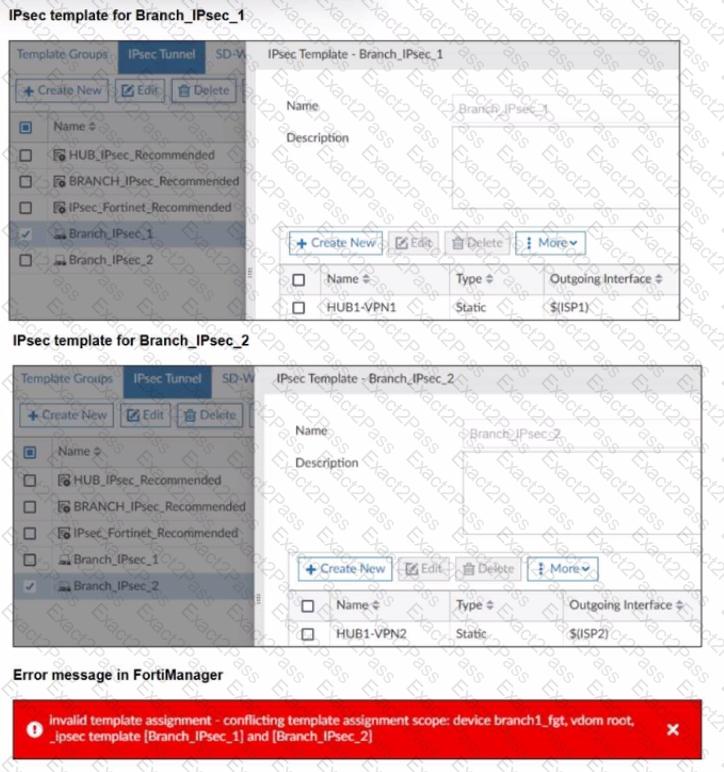
The exhibits show two IPsec templates to define Branch IPsec 1 and Branch_IPsec_2. Each template defines a VPN tunnel. The error message that FortiManager displayed when the administrator tried to assign the second template to the FortiGate device is also shown.
Which statement best describes the cause of the issue?
You configured an SD-WAN rule with the best quality strategy and selected the predefined health check, Default_FortiGuard, to check the link performances against FortiGuard servers.
For the quality criteria, you selected Custom-profile-1.
Which factors does FortiGate use, and in which order. to determine the link that it should use to steer the traffic?
Refer to the exhibit.
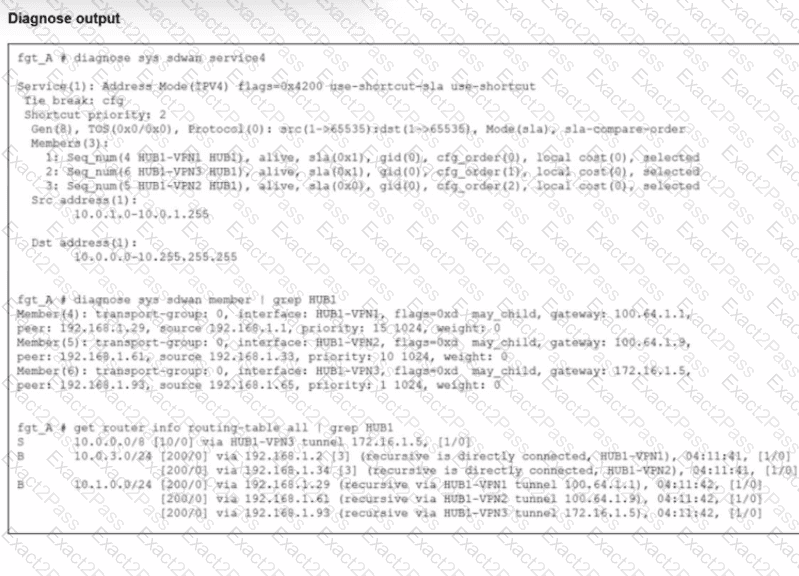
An administrator is troubleshooting SD-WAN on FortiGate. A device behind branch1_fgt generates traffic to the 10.0.0.0/8 network.
The administrator expects the traffic to match SD-WAN rule ID 1 and be routed over HUB1-VPN1. However, the traffic is routed over HUB1-VPN3.
Based on the output shown in the exhibit, which two reasons, individually or together, could explain the observed behavior? (Choose two.)
Refer to the exhibits.
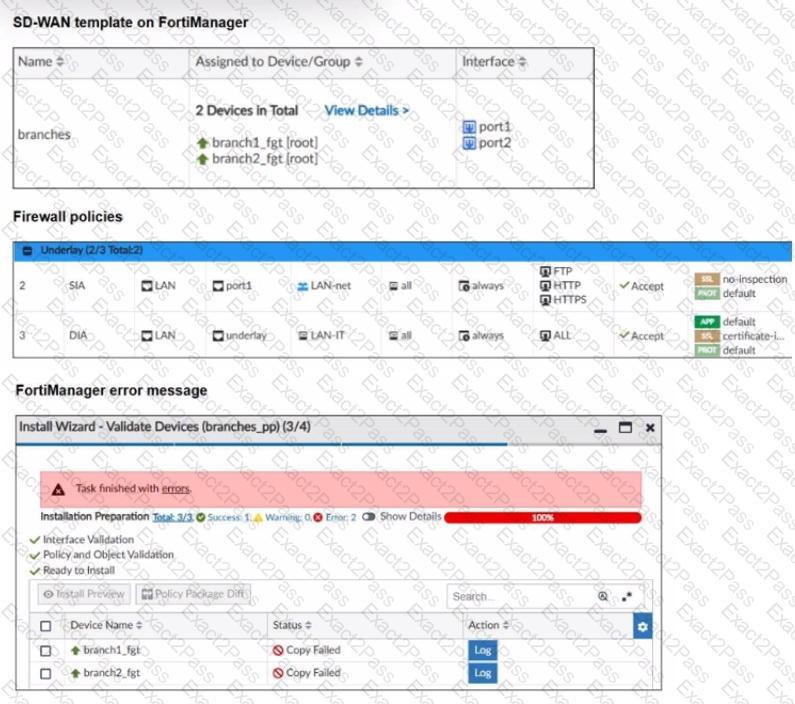
You use FortiManager to manage the branch devices and configure the SD-WAN template. You have configured direct internet access (DIA) for the IT department users. Now. you must configure secure internet access (SIA) for all local LAN users and have set the firewall policies as shown in the second exhibit.
Then, when you use the install wizard to install the configuration and the policy package on the branch devices, FortiManager reports an error as shown in the third exhibit.
Which statement describes why FortiManager could not install the configuration on the branches?
(When you deploy SD-WAN, you can choose from several common designs. Each design best applies to specific contexts.
Which two statements correctly associate a common SD-WAN design with its main indication or constraint? Choose two answers.)

