Spring Sale Special Limited Time 70% Discount Offer - Ends in 0d 00h 00m 00s - Coupon code: buysanta

Exact2Pass Menu

Fortinet NSE 7 - LAN Edge 7.0

Last Update 21 hours ago Total Questions : 61

The Fortinet NSE 7 - LAN Edge 7.0 content is now fully updated, with all current exam questions added 21 hours ago. Deciding to include NSE7_LED-7.0 practice exam questions in your study plan goes far beyond basic test preparation.

You'll find that our NSE7_LED-7.0 exam questions frequently feature detailed scenarios and practical problem-solving exercises that directly mirror industry challenges. Engaging with these NSE7_LED-7.0 sample sets allows you to effectively manage your time and pace yourself, giving you the ability to finish any Fortinet NSE 7 - LAN Edge 7.0 practice test comfortably within the allotted time.

Question # 11

Which two statements about the use of digital certificates are true? (Choose two.)

A.

A chain of trust may include one or more intermediate CAs.

B.

In a chain of trust, the root CA is signed by another certificate.

C.

To validate the signature on a certificate, an endpoint does not need to know the CA of that certificate.

D.

An intermediate CA can sign other certificates.

Question # 12

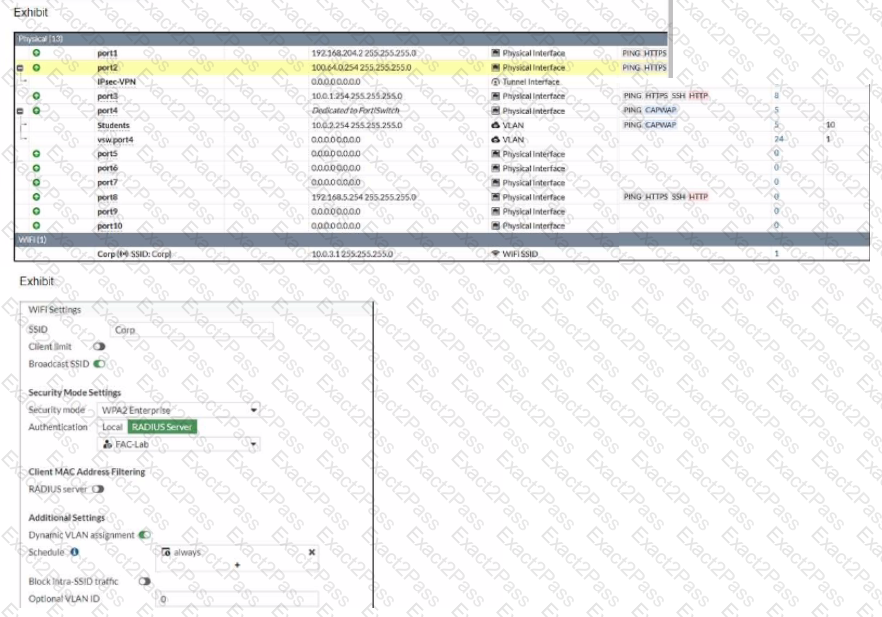
Refer to the exhibits.

An administrator has configured FortiGate with an SSID (Corp) with dynamic VLAN assignment, and also configured a RADIUS server to send IETF 64, IETF 65, and IETF 81 VSAs.

The administrator has verified that the RADIUS server is sending all the required information to FortiGate. However, FortiGate is not assigning correct VLANs to the wireless clients.

What is causing the problem?

A.

Wireless clients must be assigned an IP address from the 10.0.3.0/24 subnet.

B.

The RADIUS server must send the framed-ip attribute to assign wireless clients an IP address.

C.

The administrator must define the corresponding VLANs that are sent by the RADIUS server.

D.

The administrator must configure a firewall policy to allow wireless clients to communicate with the RADIUS server.

Question # 13

Which statement correctly describes the guest portal behavior on FortiAuthenticator?

A.

FortiAuthenticator uses POST parameters and a RADIUS client configuration to map the request to a guest portal for authentication.

B.

Sponsored accounts cannot authenticate using guest portals.

C.

All self-registered and sponsored accounts are listed on the local Users GUI page on FortiAuthenticator.

D.

All guest accounts must be activated using SMS or email activation codes.

Question # 14

Where can FortiGate learn the FortiManager IP address or FQDN for zero-touch provisioning'?

A.

From an LDAP server using a simple bind operation

B.

From a TFTP server

C.

From a DHCP server using options 240 and 241

D.

From a DNS server using A or AAAA records

Question # 15

An administrator is deploying AP's that are connecting over an IPsec network. All APs have been configured to connect to FortiGate manually. FortiGate can discover the APs and authorize them. However, FortiGate is unable to establish CAPWAP tunnels to manage the APs.

Which configuration setting can the administrator perform to resolve the problem?

A.

Upgrade the FortiAP firmware image to ensure compatibility with the FortiOS version.

B.

Decrease the CAPWAP tunnel MTU size for APs to prevent fragmentation.

C.

Enable CAPWAP administrative access on the IPsec interface.

D.

Assign a custom AP profile for the remote APs with the set mpls-connection option enabled.

Question # 16

An administrator has deployed multiple dual-band wireless APs in a wireless network. APs are installed at measured distances to ensure fast roaming for the clients. Multiple 2.4 GHz-only wireless clients are connecting to the network, and subsequent monitoring shows that individual AP 2.4 GHz interfaces are being overloaded with wireless connections.

Which configuration change would best resolve the overloading issue?

A.

Configure load balancing AP handoff on both AP interfaces on all Aps.

B.

Configure a client limit on all AP 2.4 GHz interfaces.

C.

Configure load balancing frequency handoff on both AP interfaces.

D.

Configure load balancing AP handoff on only the 2.4 GHz interfaces of all APs.

Question # 17

Which two pieces of information can the diagnose test authserver ldap command provide? (Choose two.)

A.

It displays whether the admin bind user credentials are correct

B.

It displays whether the user credentials are correct

C.

It displays the LDAP codes returned by the LDAP server

D.

It displays the LDAP groups found for the user

Question # 18

Refer to the exhibit.

Examine the FortiGate RSSO configuration shown in the exhibit.
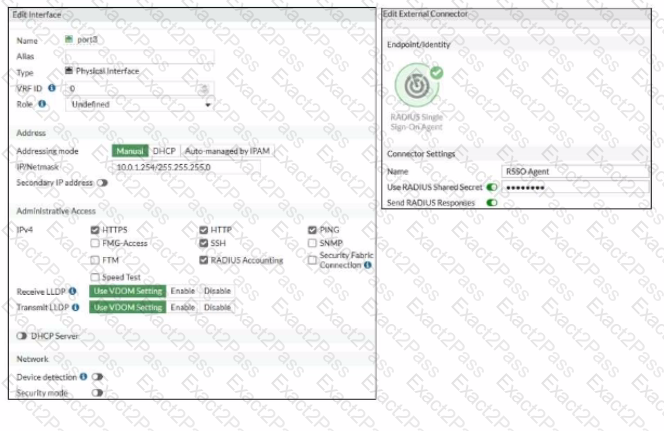
FortiGate is configured to receive RADIUS accounting messages on port3 to authenticate RSSO users. The incoming RADIUS accounting messages contain the username and group membership information in the User-Name and Class RADIUS attributes, respectively.

Which three settings must you configure on FortiGate to successfully authenticate RSSO users and match them to the existing RSSO user groups? (Choose three)


A.

The rasc-endpoint-attribute CLI setting in the RSSO agent configuration should be set to User-Name.

B.

Device detection and Security Fabric Connection should be enabled on port3.

C.

The RADIUS Attribute Value setting configured for an RSSO user group should match the Class RADIUS attribute value in the RADIUS accounting message.

D.

RSSO user groups should be assigned to all firewall policies.

E.

The sso-attribute CLI setting in the RSSO agent configuration should be set to Class.

Go to page: