
Summer Sale Special Limited Time 70% Discount Offer - Ends in 0d 00h 00m 00s - Coupon code: buysanta

Exact2Pass Menu

Fortinet NSE 7 - Network Security 7.2 Support Engineer

Last Update 18 hours ago Total Questions : 40

The Fortinet NSE 7 - Network Security 7.2 Support Engineer content is now fully updated, with all current exam questions added 18 hours ago. Deciding to include NSE7_NST-7.2 practice exam questions in your study plan goes far beyond basic test preparation.

You'll find that our NSE7_NST-7.2 exam questions frequently feature detailed scenarios and practical problem-solving exercises that directly mirror industry challenges. Engaging with these NSE7_NST-7.2 sample sets allows you to effectively manage your time and pace yourself, giving you the ability to finish any Fortinet NSE 7 - Network Security 7.2 Support Engineer practice test comfortably within the allotted time.

Question # 1

Which three common FortiGate-to-collector-agent connectivity issues can you identify using the FSSO real-time debug? (Choose three.)

A.

Refused connection. Potential mismatch of TCP port.

B.

Mismatched pre-shared password.

C.

Inability to reach IP address of the collector agent.

D.

Log is full on the collector agent.

E.

Incompatible collector agent software version.

Question # 2

Refer to the exhibit, which shows two entries that were generated in the FSSO collector agent logs.

What three conclusions can you draw from these log entries? (Choose three.)

A.

Remote registry is not running on the workstation.

B.

The FortiGate firmware version is not compatible with that of the collector agent

C.

DNS resolution is unable to resolve the workstation name.

D.

The user's status shows as "not verified" in the collector agent

E.

A firewall is blocking traffic to port 139 and 445.

Question # 3

Refer to the exhibit, which shows oneway communication of the downstream FortiGate with the upstream FortiGate within a Security Fabric.
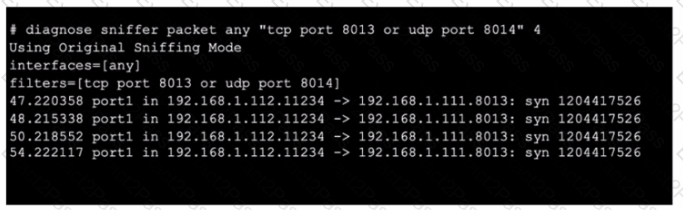
What three actions must you take to ensure successful communication? (Choose three.)

A.

Ensure the port for Neighbor Discovery has been changed.

B.

FortiGate must not be in NAT mode.

C.

Ensure TCP port 8013 is not blocked along the way

D.

You must authorize the downstream FortiGate on the root FortiGate.

E.

You must enable Security Fabric/Fortitelemetry on the receiving interface of the upstream FortiGate.

Question # 4

Refer to the exhibit, which shows a session table entry.
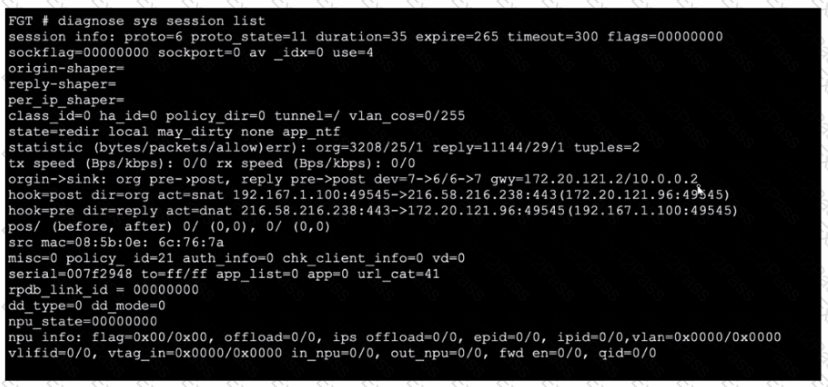
Which statement about FortiGate behavior relating to this session is true?

A.

FortiGate forwarded this session without any inspection.

B.

FortiGate is performing a security profile inspection using the CPU.

C.

FortiGate redirected the client to the captive portal to authenticate, so that a correct policy match could be made.

D.

FortiGate applied only IPS inspection to this session.

Question # 5

What is the diagnose test application ipsmonitor 5 command used for?

A.

To disable the IPS engine

B.

To provide information regarding IPS sessions

C.

To restart all IPS engines and monitors

D.

To enable IPS bypass mode

Question # 6

What are two functions of automation stitches? (Choose two.)
A.

You can configure automation stitches on any FortiGate device in a Security Fabric environment.

B.

You can create automation stitches to run diagnostic commands and attach the results to an email message when CPU or memory usage exceeds specified thresholds.

C.

An automation stitch configured to execute actions sequentially can take parameters from previous actions as input for the current action.

D.

You can set an automation stitch configured to execute actions in parallel to insert a specific delay between actions.

Question # 7

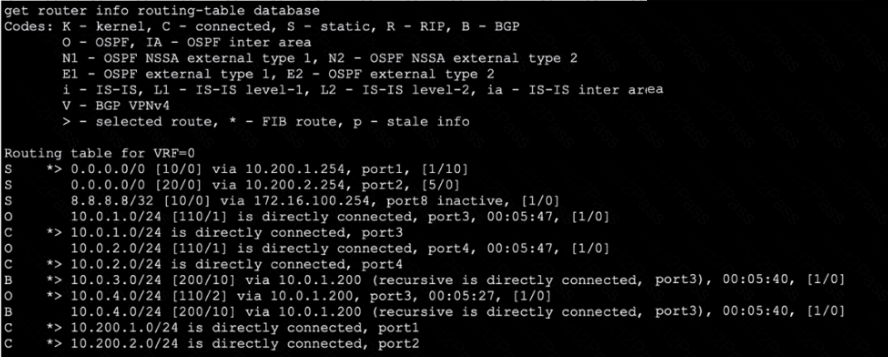
Refer to the exhibit, which shows the modified output of the routing kernel.

Which statement is true?

A.

The BGP route to 10.0.4.0/24 is not in the forwarding information base.

B.

The default static route through port2 is in the forwarding information base.

C.

The default static route through 10.200.1.254 is not in the forwarding information base.

D.

The egress interface associated with static route 8.8.8.8/32 is administratively up.

Question # 8

Which statement about IKE and IKE NAT-T is true?

A.

IKE is used to encapsulate ESP traffic in some situations, and IKE NAT-T is used only when the local FortiGate is using NAT on the IPsec interface.

B.

IKE is the standard implementation for IKEv1 and IKE NAT-T is an extension added in IKEv2.

C.

They each use their own IP protocol number.

D.

They both use UDP as their transport protocol and the port number is configurable.

Question # 9

Which of the following regarding protocol states is true?

A.

proto_state=00 indicates that UDP traffic flows in both directions.

B.

proto_state-01 indicates an established TCP session.

C.

proto_state=10 indicates an established TCP session.

D.

proto state=01 indicates one-way ICMP traffic.

Question # 10

Refer to the exhibit, which shows a truncated output of a real-time LDAP debug.

What two conclusions can you draw from the output? (Choose two.)


A.

The name of the configured LDAP server is Lab.

B.

The user is authenticating using CN=John Smith.

C.

FortiOS is able to locate the user in step 3 (Bind Request) of the LDAP authentication process.

D.

FortiOS is performing the second step (Search Request) in the LDAP authentication process.

Go to page: