Exact2Pass

Last Update 19 hours ago Total Questions : 96
The Netskope Certified Cloud Security Integrator (NCCSI) content is now fully updated, with all current exam questions added 19 hours ago. Deciding to include NSK200 practice exam questions in your study plan goes far beyond basic test preparation.
You'll find that our NSK200 exam questions frequently feature detailed scenarios and practical problem-solving exercises that directly mirror industry challenges. Engaging with these NSK200 sample sets allows you to effectively manage your time and pace yourself, giving you the ability to finish any Netskope Certified Cloud Security Integrator (NCCSI) practice test comfortably within the allotted time.
A customer wants to use Netskope to prevent PCI data from leaving the corporate sanctioned OneDrive instance. In this scenario. which two solutions would assist in preventing data exfiltration? (Choose two.)
Review the exhibit.
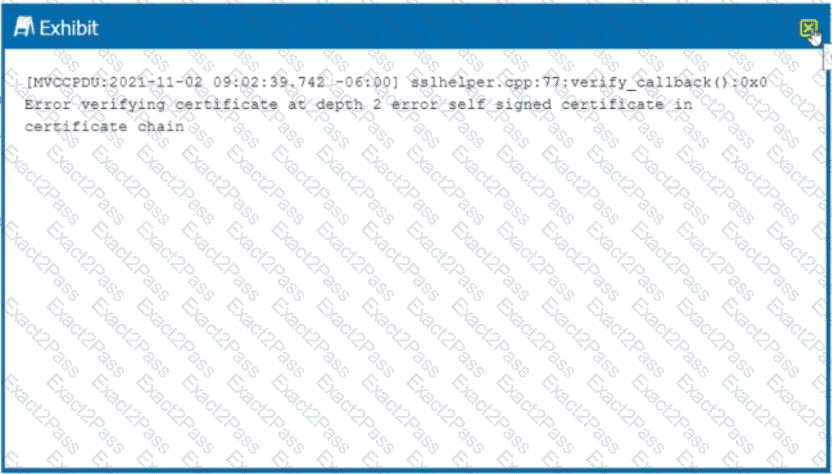
While diagnosing an NPA connectivity issue, you notice an error message in the Netskope client logs.
Referring to the exhibit, what does this error represent?
You use Netskope to provide a default Malware Scan profile for use with your malware policies. Also, you want to create a custom malware detection profile.
In this scenario, what are two additional requirements to complete this task? (Choose two.)
You created the Netskope application in your IdP for user provisioning and validated that the API Integration settings are correct and functional. However, you are not able to push the user groups from the IdP into your Netskope tenant.
Which statement describes how Netskope ' s REST API, v1 and v2, handles authentication?
Your company asks you to use Netskope to integrate with Endpoint Detection and Response (EDR) vendors such as Crowdstrike.
Which two requirements are needed for a successful integration and sharing of threat data? (Choose two.)
A city uses many types of forms, including permit applications. These forms contain personal and financial information of citizens. Remote employees download these forms and work directly with the citizens to complete them. The city wants to be able to identify and monitor the specific forms and block the employees from downloading completed forms.
Which feature would you use to accomplish this task?
You are asked to grant access for a group of users to an application using NPA. So far, you have created and deployed the publisher and created a private application using the Netskope console.
Which two steps must also be completed to enable your users access to the application? (Choose two.)
You want to prevent a document stored in Google Drive from being shared externally with a public link. What would you configure in Netskope to satisfy this requirement?
Review the exhibit.
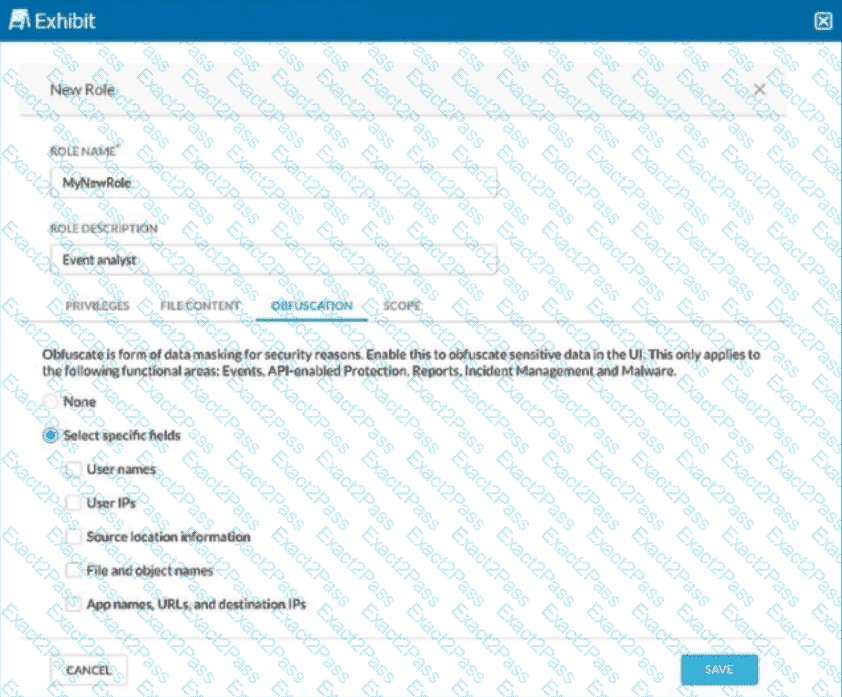
You are asked to create a new role that allows analysts to view Events and Reports while providing user privacy. You need to avoid directly exposing identities and user location information.
Which three fields must you obfuscate in this scenario? (Choose three.)

