Exact2Pass

Last Update 18 hours ago Total Questions : 96
The Netskope Certified Cloud Security Integrator (NCCSI) content is now fully updated, with all current exam questions added 18 hours ago. Deciding to include NSK200 practice exam questions in your study plan goes far beyond basic test preparation.
You'll find that our NSK200 exam questions frequently feature detailed scenarios and practical problem-solving exercises that directly mirror industry challenges. Engaging with these NSK200 sample sets allows you to effectively manage your time and pace yourself, giving you the ability to finish any Netskope Certified Cloud Security Integrator (NCCSI) practice test comfortably within the allotted time.
After setting up the Netskope client in an explicit proxy environment, the Netskope client establishes the SSL tunnel between the client and the Netskope gateway. The client cannot connect directly through the default gateway to establish the SSL tunnel. In this scenario, what needs to be done for the client to connect to the Netskope gateway?
Netskope is being used as a secure Web gateway. Your organization ' s URL list changes frequently. In this scenario, what makes It possible for a mass update of the URL list in the Netskope platform?
Your customer is concerned about malware in their AWS S3 buckets. What two actions would help with this scenario? (Choose two.)
Review the exhibit.
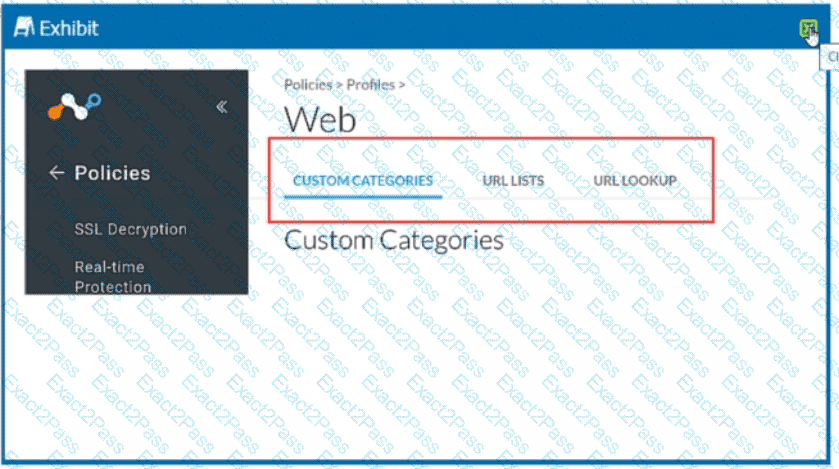
You want to create a custom URL category to apply a secure Web gateway policy combining your own list of URLs and Netskope predefined categories.
In this scenario, which task must be completed?
Recently your company implemented Zoom for collaboration purposes and you are attempting to inspect the traffic with Netskope. Your initial attempt reveals that you are not seeing traffic from the Zoom client that is used by all users. You must ensure that this traffic is visible to Netskope.
In this scenario, which two steps must be completed to satisfy this requirement? (Choose two.)
Your organization has three main locations with 30.000 hosts in each location. You are planning to deploy Netskope using iPsec tunnels for security.
What are two considerations to make a successful connection in this scenario? (Choose two.)
Review the exhibit.
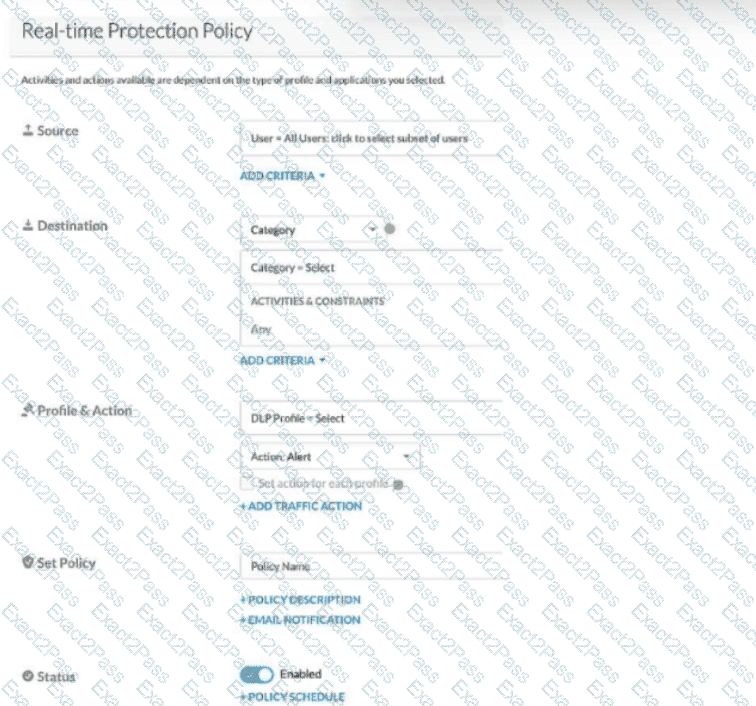
Given the information shown below:
-for PCI data uploads, you want to provide no notification,
-for PHI data uploads, you want to allow users to proceed by clicking OK,
-for GDPR data uploads, you want to provide block notification,
-if none of the above matches, you want to provide no notification.
You want to reduce the number of policies by combining multiple DLP profiles Into one policy.
Referring to the exhibit, which two statements are true? (Choose two.)
You have deployed a development Web server on a public hosting service using self-signed SSL certificates. After some troubleshooting, you determined that when the Netskope client is enabled, you are unable to access the Web server over SSL. The default Netskope tenant steering configuration is in place.
In this scenario, which two settings are causing this behavior? (Choose two.)
You are configuring GRE tunnels from a Palo Alto Networks firewall to a Netskope tenant with the Netskope for Web license enabled. Your tunnel is up as seen from the Netskope dashboard. You are unable to ping hosts behind the Netskope gateway.
Which two statements are true about this scenario? (Choose two.)
You are asked to prevent Netskope from inspecting Google traffic while maintaining visibility. According to Netskope, what is the recommended way to accomplish this task?

