Exact2Pass

Last Update 1 hour ago Total Questions : 172
The TOGAF Enterprise Architecture Part 1 Exam (English) content is now fully updated, with all current exam questions added 1 hour ago. Deciding to include OGEA-101 practice exam questions in your study plan goes far beyond basic test preparation.
You'll find that our OGEA-101 exam questions frequently feature detailed scenarios and practical problem-solving exercises that directly mirror industry challenges. Engaging with these OGEA-101 sample sets allows you to effectively manage your time and pace yourself, giving you the ability to finish any TOGAF Enterprise Architecture Part 1 Exam (English) practice test comfortably within the allotted time.
Complete the sentence. Risk management involves: risk classification, identification,
Refer to the table below:
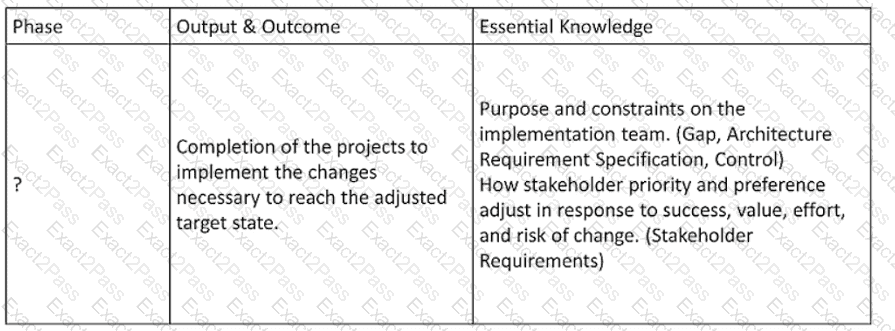
Which ADM Phase does this describe?
Complete the following sentence. In the ADM, documents which are under development and have not undergone any formal review and approval process are called______ Documents which have been reviewed and approved are called ______
Which of the following best describes the class of information known as the Reference Library within the Architecture Repository?
Complete the following sentence.
________ provide context for architecture work, by describing the needs and ways of working employed by the enterprise.
When considering the Gap Analysis technique, which of the following is an example of a business domain gap?
Full Question:
Complete the following sentence:
Presenting different ____________ and ____________ to stakeholders helps architects to extract hidden agendas, principles, and requirements that could impact the final Target Architecture.
Complete the sentence Business Transformation Readiness Assessment is_________________.
According to the TOGAF Standard, what are the two levels of risk that should be monitored?
Complete the sentence. When considering agile development, Architecture to Support Portfolio will identify what products the Enterprise needs, the boundary of the products, and what constraints a product owner has; this defines the Enterprise ' s

