Exact2Pass

Last Update 1 hour ago Total Questions : 172
The TOGAF Enterprise Architecture Part 1 Exam (English) content is now fully updated, with all current exam questions added 1 hour ago. Deciding to include OGEA-101 practice exam questions in your study plan goes far beyond basic test preparation.
You'll find that our OGEA-101 exam questions frequently feature detailed scenarios and practical problem-solving exercises that directly mirror industry challenges. Engaging with these OGEA-101 sample sets allows you to effectively manage your time and pace yourself, giving you the ability to finish any TOGAF Enterprise Architecture Part 1 Exam (English) practice test comfortably within the allotted time.
Consider the following statements:
1. Each contracted party is required to act responsibly to the organization and its stakeholders.
2. All decisions taken, processes used, and their implementation will not be allowed to create unfair advantage to any one particular party.
3. Digital Transformation and operations will be more effective and efficient.
4. Strategic decision-making by C-Level executives and business leaders will be more effective.
Which statements highlight the value and necessity for Architecture Governance to be adopted within organizations?
Which ADM Phase provides architectural oversight of the implementation?
Consider the following statement.
According to the TOGAF standard, a governed approach of a particular deliverable will ensure adherence to the principles, standards, and requirements of the existing or developing architectures.
Which deliverable does this refer to?
Complete the sentence. A business scenario describes
Consider the following ADM phases objectives.
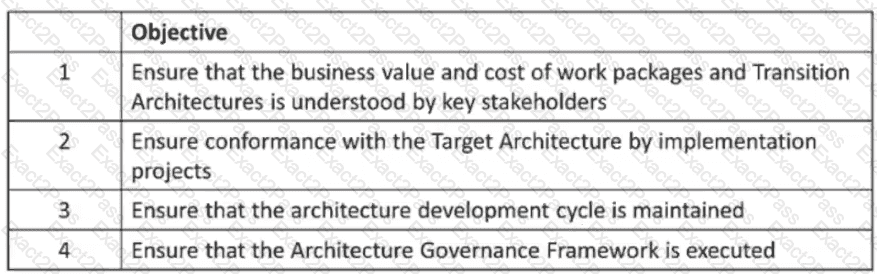
Which phase does each objective match?
In the ADM, what is the name for documents that are not finished and not approved?
Consider the following ADM phases objectives:
Ensure that the business value and cost of work packages and Transition Architectures is understood by key stakeholders
Ensure conformance with the Target Architecture by implementation projects
Ensure that the architecture development cycle is maintained
Ensure that the Architecture Governance Framework is executed
Which phase does each objective match?
Which statement best summarizes the TOGAF Content Framework?
Which statement about Requirements Management is most correct?
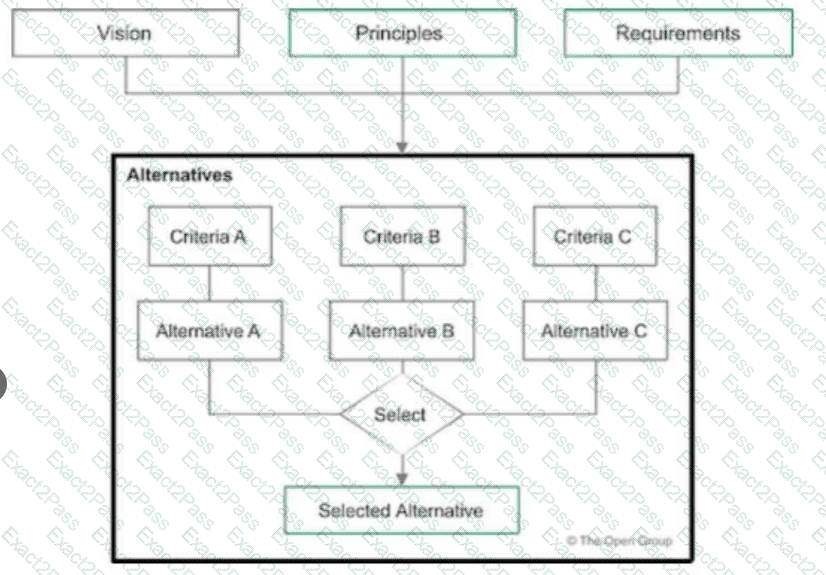
Consider the graphic from the TOGAF Standard.
The graphic shows Vision, Principles, and Requirements feeding into a box labeled Alternatives. Inside that box, multiple alternatives are assessed against Criteria A, Criteria B, and Criteria C. A selection step then leads to a Selected Alternative.
What does this illustrate?

