Exact2Pass

Last Update 1 hour ago Total Questions : 172
The TOGAF Enterprise Architecture Part 1 Exam (English) content is now fully updated, with all current exam questions added 1 hour ago. Deciding to include OGEA-101 practice exam questions in your study plan goes far beyond basic test preparation.
You'll find that our OGEA-101 exam questions frequently feature detailed scenarios and practical problem-solving exercises that directly mirror industry challenges. Engaging with these OGEA-101 sample sets allows you to effectively manage your time and pace yourself, giving you the ability to finish any TOGAF Enterprise Architecture Part 1 Exam (English) practice test comfortably within the allotted time.
Full Question:
Consider the image showing basic architectural concepts.
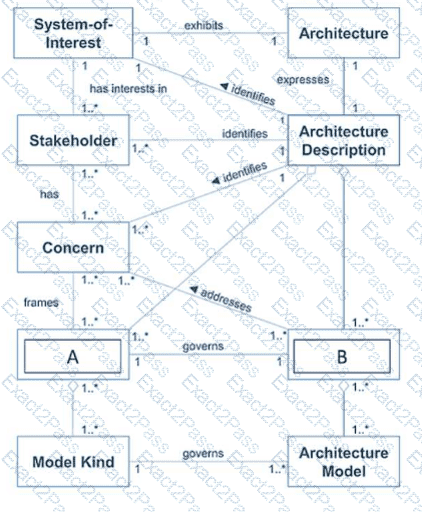
Complete the sentence: Item A ____________, while item B ____________.
Which of the following best describes the TOGAF Architecture Development Method?
Complete the sentence. The four purposes that typically frame the planning horizon, depth and breadth of an Architecture Project, and the contents of the EA Repository are Strategy, Portfolio,
What criteria for a good architecture principle indicates that it is sufficiently definitive and precise to support consistent decision-making in complex situations?
Complete the sentence. Architecture effort at the Logical abstraction level is about:
What structural framework does the TOGAF Standard define to support the management, leverage, and storage of architectural work products?
Complete the sentence. The dimensions used to scope an architecture are time period, depth, and
Consider the following extract of the purpose of an ADM Phase:
Phase Output & Outcome / Essential Knowledge
? — “A set of work packages that address the set of gaps, with an indication of value produced and effort required, and dependencies between the work packages to reach the adjusted target.”
What ADM Phase is this?
Consider the following chart:
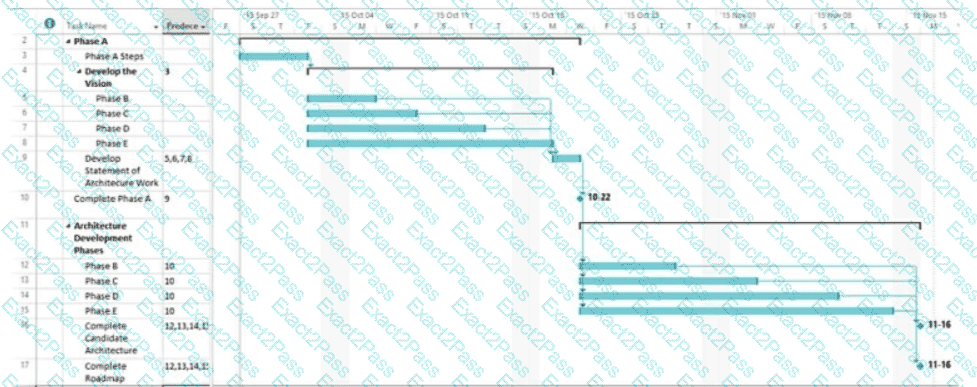
Question:
Which concept for Enterprise Architecture Practitioners does it illustrate?
Consider the following description of the purpose of an ADM Phase:
To develop a domain architecture approved by the stakeholders for the problem being addressed, together with a set of gaps, and work to clear the gaps understood by the stakeholders.
Which ADM Phase does this describe?

