Exact2Pass

Modern enterprise architecture governance, capability-based planning, and digital business transformation demand structural cohesion between high-level business strategy and underlying technology execution. As organizations modernize complex multi-cloud ecosystems and agile delivery pipelines using the TOGAF Standard, 10th Edition, enterprise architects, lead solution designers, and technology consultants must master both conceptual principles and practitioner-level execution. Achieving the TOGAF Enterprise Architecture Practitioner credential via the Open Group OGEA-103 examination validates your ability to navigate the full Architecture Development Method (ADM) lifecycle across business, data, application, and technology domains while maintaining continuous stakeholder alignment.
The OGEA-103 combined assessment evaluates both foundational comprehension and applied situational judgment across two distinct testing sections within a single 150-minute proctored session. Relying on passive review sheets or high-yield ogea-103 exam questions leaves candidates ill-prepared for the dual challenge of clearing 40 closed-book multiple-choice questions in Section 1 and analyzing complex, open-book scenario case studies in Section 2. Candidates must understand how to trace Architecture Building Blocks (ABBs) to Solution Building Blocks (SBBs), formulate Transition Architectures in Phase E, sequence work packages in Phase F, and enforce Architecture Contracts during Phase G implementation governance.
True architectural mastery requires developing diagnostic capabilities across gap analysis, risk management, and dispensation workflows supervised by the Architecture Board in Phase H. Utilizing an updated togaf enterprise architecture combined part 1 and part 2 ogea-103 study guide alongside realistic simulation tools gives you the analytical rigor needed to achieve the required 60% passing threshold across both sections. Exact2Pass provides calibrated, scenario-driven preparation environments that mirror official Open Group evaluation standards, equipping you with the practical decision-making skills required to pass on your first attempt.
The OGEA-103 certification exam evaluates your complete architectural competency, testing both theoretical framework recall and advanced scenario-driven problem-solving under strict proctored time limits. Our realistic simulation platform replicates the official Open Group testing environment, pairing rapid-fire conceptual questions with multi-paragraph architectural case studies and integrated reference materials. Practicing within timed conditions trains you to balance pace across both sections, interpret stakeholder power-interest matrices, and make sound governance decisions with confidence.
Consider the following ADM phases objectives.
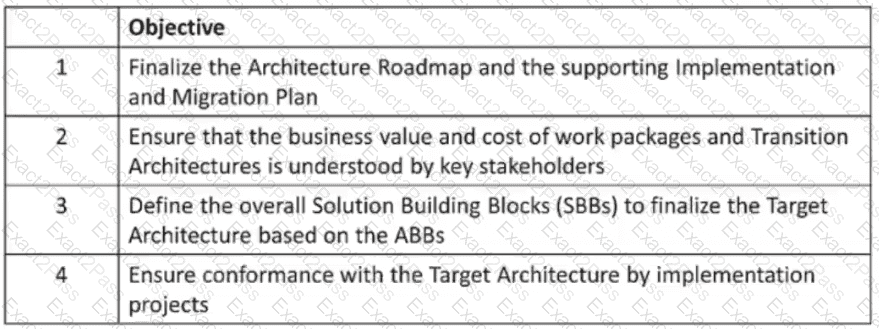
Which phase does each objective match?
Consider the following statements
1 A whole corporation or a division of a corporation
2 A government agency or a single government department
3 Partnerships and alliances of businesses working together such as a consortium or supply chain
What are those examples of according to the TOGAF Standard?
Consider the following statements:
1. Each contracted party is required to act responsibly to the organization and its stakeholders.
2. All decisions taken, processes used, and their implementation will not be allowed to create unfair advantage to any one particular party.
3. Digital Transformation and operations will be more effective and efficient.
4. Strategic decision-making by C-Level executives and business leaders will be more effective.
Which statements highlight the value and necessity for Architecture Governance to be adopted within organizations?
Complete the sentence. The purpose of the Gap Analysis technique is to
Consider the following descriptions of deliverables consumed and produced across the TOGAF ADM cycle.
General rules and guidelines, intended to be enduring and seldom amended, that inform and support the way in which an organization sets about fulfilling its mission
A set of quantitative statements that outline what an implementation project must do in order to comply with the architecture.
A document that is sent from the sponsoring organization to the architecture organization to trigger the start of an architecture development cycle
The scope and approach that will be used to complete an architecture development cycle
Complete the sentence. Deliverable 3 is the, deliverable 4 is a deliverable from
Complete the sentence. Risk management involves: risk classification, identification,
Which of the following supports the need to govern Enterprise Architecture?
According to the TOGAF standard, what are the two levels of risk that should be monitored?
Consider the following ADM phases objectives.
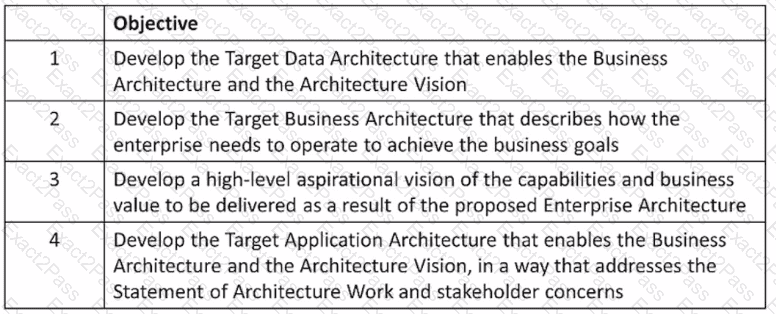
Which phase does each objective match?
Full Question:
When considering Architecture Governance, what is the benefit that derives from discipline?