Winter Sale 65% Discount Offer - Ends in 0d 00h 00m 00s - Coupon code: ex2p65

Exact2Pass Menu

PRINCE2 7 Practitioner (7th Edition) Exam

Last Update 23 hours ago Total Questions : 263

The PRINCE2 7 Practitioner (7th Edition) Exam content is now fully updated, with all current exam questions added 23 hours ago. Deciding to include Prince2-Practitioner practice exam questions in your study plan goes far beyond basic test preparation.

You'll find that our Prince2-Practitioner exam questions frequently feature detailed scenarios and practical problem-solving exercises that directly mirror industry challenges. Engaging with these Prince2-Practitioner sample sets allows you to effectively manage your time and pace yourself, giving you the ability to finish any PRINCE2 7 Practitioner (7th Edition) Exam practice test comfortably within the allotted time.

Question # 4

Scenario

Product Summary

A list of customers will be collated. This will use existing information from the Accounts department about current customers, and existing information from the Marketing department about prospective customers.

Using the tariff of mailing costs available from the Post Office, a production cost forecast will be produced to allow the CEO and the Marketing Director to decide whether to continue with the project. If they decide to continue, they will give the approval to launch the internal label design competition. Competition rules will be required to communicate details of the competition to the staff. The chosen label design will then be selected from the competition entries.

The photos for the calendar must be based on existing photo design ideas available from the Marketing department. The selected photos will be chosen from these. Monthly calendar displays will be created to show the required layout of each page.

Product Breakdown Structure (contains errors)

Extract from Stage Plan for stage 3.

(All entries are true statements but may not be shown under the correct heading or in the correct document).

Using the Project Scenario and the Extract from Stage Plan for stage 3 provided as additional intonation for this question in the Scenario Booklet, answer the following 5 questions.

The Stage Plan for stage 3 has been produced.

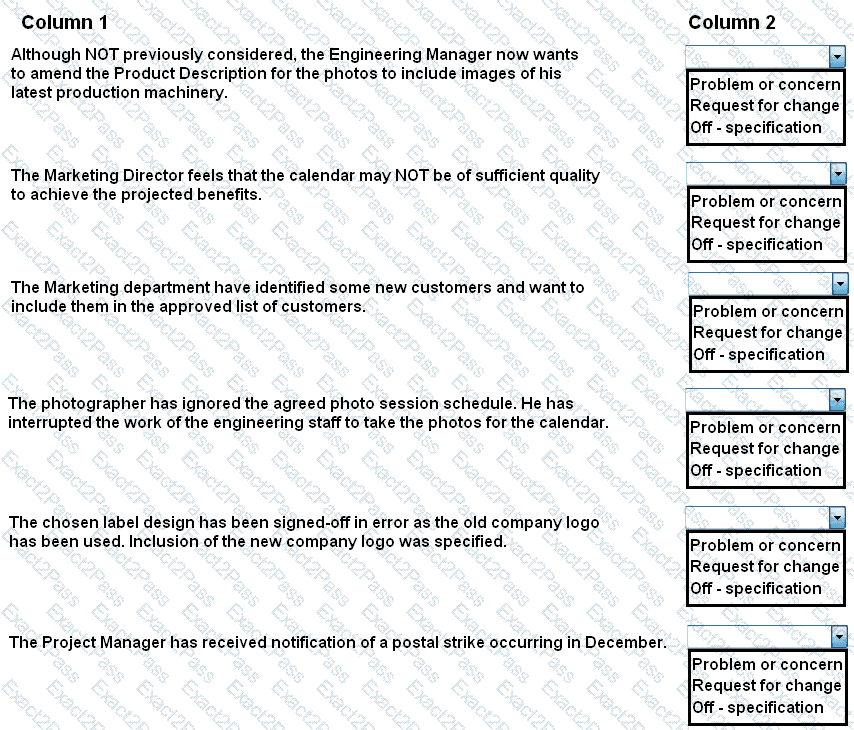
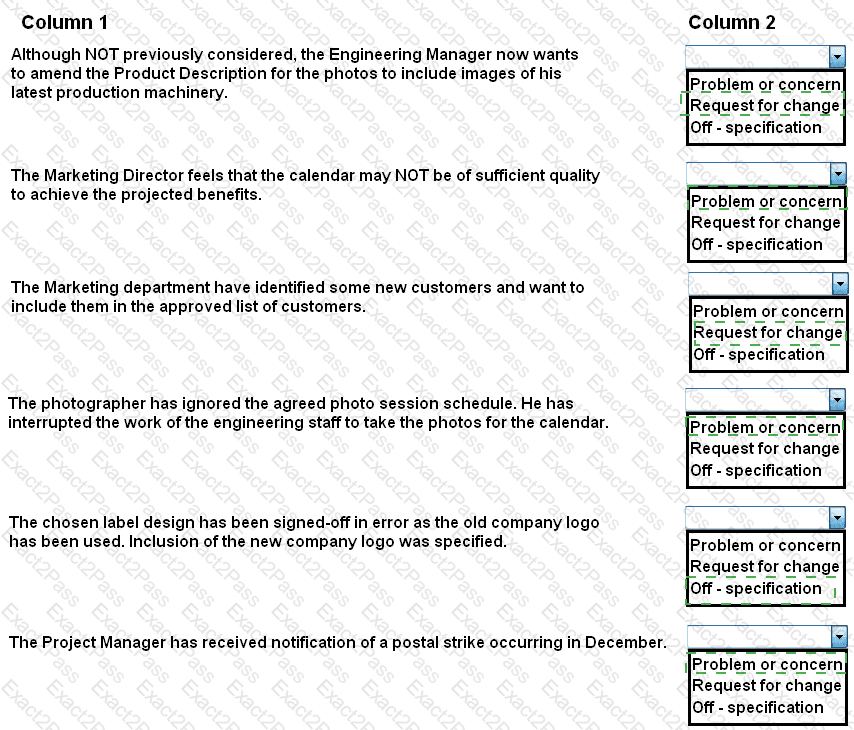
The Engineering Manager insists that there are to be no interruptions to operations whilst photographs are being taken of the engineering staff performing their everyday duties and operating machinery. Two weeks ago the professional photographer produced the photo session schedule based on the operational staff schedule. The operational staff schedule is produced weekly and maintained by the Engineering Manager.

None of the £500 change budget has been used to date and this is available for the stage.

Which 2 statements apply to the Budgets section?

A.

Amend entry 15 because it should also include the cost of management activities.

B.

Delete entry 16 because timescales should NOT be shown under the heading of budgets.

C.

Delete entry 17 because the risk budget should be shown in the Risk Management Strategy.

D.

Add 'Change budget - £500'.

E.

Add 'Cost tolerance - +£6k 1-£6k

Question # 5

PRINCE2 proposes 3 levels of Plan, which are they?

A.

Initiation, Project and Stage Plans

B.

Project, Stage and Exception Plans

C.

Initiation, Project and Benefit Review Plans

D.

Project, Stage and Team Plans

Question # 6

Project Scenario – Health and Safety Training Project:

ABC Company is a well-established training company that uses a standard model to develop training materials and deliver courses to customers.

ABC Company has commissioned a project in response to recent changes in government legislation relating to health and safety on construction sites. The project will deliver “capability to provide health and safety training”, including the materials needed for classroom-based training and e-learning. The expected benefits for construction companies include a reduction in lost days and legal costs due to accidents.

The e-learning course will be developed by a specialist external consultancy. The materials for classroom-based training will be delivered by ABC Company’s development team. All course materials will be piloted before they are used. ABC Company will deliver training to its customers and also hopes to sell the course materials to other training companies as part of their operational business. ABC Company will use their own sales and marketing departments to promote the courses.

The legislation requires construction companies to comply with the new legislation within two years. The course materials and trainers have to be accredited by a government agency before courses can be delivered. ABC Company is planning to deliver pilot courses within five months of starting the project.

The ABC Company standard development model for new courses recommends the following stages:

End of the Project scenario.

Additional Information:

The Chief Executive Officer (CEO) founded the company five years ago. Under her leadership, ABC Company has grown quickly into a successful training company. It delivers a range of accredited professional training.

The Finance Director is also a founder member of ABC Company and is responsible for authorizing budgets for the Operations and Development Teams. She authorizes all large contracts personally.

The Purchasing Manager reports to the Finance Director and is responsible for managing and monitoring supplier contracts.

The Operations Director is responsible for the delivery off all training and for the training development budget. His department organizes courses, venues and trainers. They work with the Product and the Sales teams to provide a comprehensive training schedule. ABC Company’s IT manager reports to the Operations Director.

The Business Development Director has recently been appointed to identify new training needs and propose new products. She will work with the Operations. Director to ensure a cost-conscious approach and that appropriate development technologies are used for the health and safety course.

The Training Development Manager reports to the Business Development Director and is responsible for developing training materials and gaining accreditation, in accordance with the standard course development model. Course developers in his team have skills in a range of development technologies and are allocated to projects as needed.

The Training Delivery Manager, who reports to the Operations Director, is responsible for ensuring that internal and external trainers deliver ABC Company training courses to the required standard. He also checks course materials to ensure they are fit for purpose and of the required quality.

The Central Services Director has responsibility for corporate communications, facilities management and configuration management. He recently led a project to consolidate all company quality systems into one quality management system and set up a corporate quality department, now managed by the Corporate Quality Manager.

The Corporate Document Manager reports to the Central Services Director. She helped establish the company’s document management system and now operates it across the business. She manages a team of administrators and contracts staff when workload is high.

The Sales Director joined ABC Company two months ago and is keen to establish himself by suggesting new markets for the courses and material. All account managers and the marketing team report to him. They promote existing training courses to other training companies and existing customers.

End of the additional information.

ABC Company produces a corporate business plan which includes the targets for the next 12 months. For the Health and Safety Training Project, a feasibility study was carried out and, as a result, the expected sales were included in this plan. During the 'starting up a project' process, the executive advised the project manager that the corporate business plan provides sufficient justification to initiate the project.

Is this a correct application of the 'continued business justification' principle, and why?

A.

Yes, because the executive is responsible for the project's continued business justification.

B.

Yes, because the business justification needs to be recorded and approved in some form.

C.

No, because the feasibility study provides sufficient business justification for the project.

D.

No, because business justification is not required until the 'initiating a project' process.

Question # 7

The project is approaching the end of stage 3, and stage 4 is being planned as part of the 'managing a stage boundary' process.

Which action should the project manager carry out as part of the 'update the project plan' activity?

A.

Include the actual time and cost of the work to prepare the 'marketing materials' in the project plan.

B.

Ensure that the team manager for the work package 'delivered pilot courses' is included as a resource.

C.

Update the project's business case to show any new key risks that have been identified.

D.

Include the tolerances for the work package 'delivered pilot courses' in the project plan.

Question # 8

The senior user is concerned that the trainers' limited availability could delay their accreditation. This was discussed during the 'starting up a project' process, but during the 'initiating a project' process the project manager notices that it has not been recorded.

Which action should the project manager take FIRST?

A.

Add appropriate activities to the project plan to manage the concern and avoid any adverse impact.

B.

Raise an exception report to manage the impact that any such delay would have on the project plan.

C.

Raise an issue report so that the trainers' time can be allocated to the accreditation activities.

D.

Add the information to the risk register so that it can be evaluated and an action decided.

Question # 9

PROGRESS

Here are three statements relating to controlling the progress of the project.

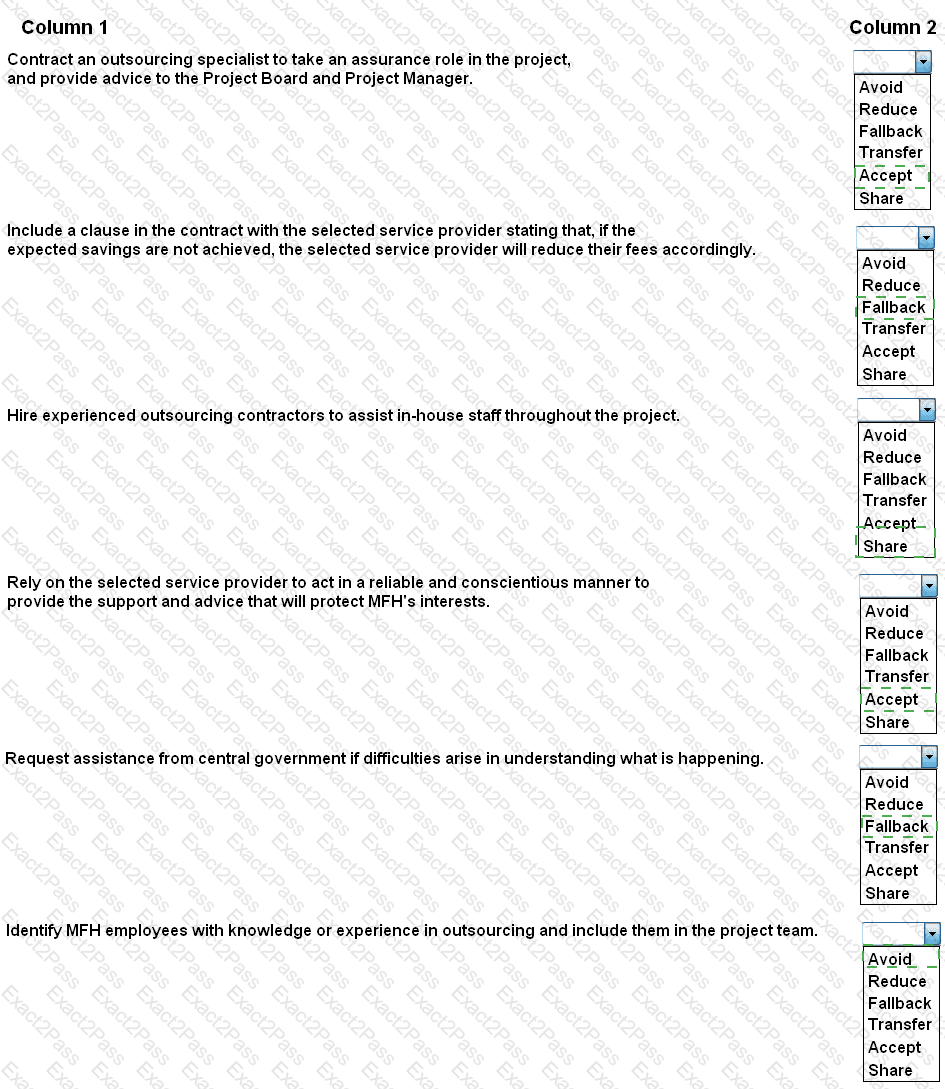
In which management product (A-E) should each statement be recorded?

Choose only one product for each statement. Each product can be used once, more than once, or not at all.

Question # 10

Project Scenario – Health and Safety Training Project:

ABC Company is a well-established training company that uses a standard model to develop training materials and deliver courses to customers.

ABC Company has commissioned a project in response to recent changes in government legislation relating to health and safety on construction sites. The project will deliver “capability to provide health and safety training”, including the materials needed for classroom-based training and e-learning. The expected benefits for construction companies include a reduction in lost days and legal costs due to accidents.

The e-learning course will be developed by a specialist external consultancy. The materials for classroom-based training will be delivered by ABC Company’s development team. All course materials will be piloted before they are used. ABC Company will deliver training to its customers and also hopes to sell the course materials to other training companies as part of their operational business. ABC Company will use their own sales and marketing departments to promote the courses.

The legislation requires construction companies to comply with the new legislation within two years. The course materials and trainers have to be accredited by a government agency before courses can be delivered. ABC Company is planning to deliver pilot courses within five months of starting the project.

The ABC Company standard development model for new courses recommends the following stages:

End of the Project scenario.

Additional Information:

The Chief Executive Officer (CEO) founded the company five years ago. Under her leadership, ABC Company has grown quickly into a successful training company. It delivers a range of accredited professional training.

The Finance Director is also a founder member of ABC Company and is responsible for authorizing budgets for the Operations and Development Teams. She authorizes all large contracts personally.

The Purchasing Manager reports to the Finance Director and is responsible for managing and monitoring supplier contracts.

The Operations Director is responsible for the delivery off all training and for the training development budget. His department organizes courses, venues and trainers. They work with the Product and the Sales teams to provide a comprehensive training schedule. ABC Company’s IT manager reports to the Operations Director.

The Business Development Director has recently been appointed to identify new training needs and propose new products. She will work with the Operations. Director to ensure a cost-conscious approach and that appropriate development technologies are used for the health and safety course.

The Training Development Manager reports to the Business Development Director and is responsible for developing training materials and gaining accreditation, in accordance with the standard course development model. Course developers in his team have skills in a range of development technologies and are allocated to projects as needed.

The Training Delivery Manager, who reports to the Operations Director, is responsible for ensuring that internal and external trainers deliver ABC Company training courses to the required standard. He also checks course materials to ensure they are fit for purpose and of the required quality.

The Central Services Director has responsibility for corporate communications, facilities management and configuration management. He recently led a project to consolidate all company quality systems into one quality management system and set up a corporate quality department, now managed by the Corporate Quality Manager.

The Corporate Document Manager reports to the Central Services Director. She helped establish the company’s document management system and now operates it across the business. She manages a team of administrators and contracts staff when workload is high.

The Sales Director joined ABC Company two months ago and is keen to establish himself by suggesting new markets for the courses and material. All account managers and the marketing team report to him. They promote existing training courses to other training companies and existing customers.

End of the additional information.

Checkpoint reports are being produced monthly. A week after the last checkpoint report was prepared, the team responsible for developing the 'classroom-based training materials' have realized that they will not be able to deliver the materials to the accreditor by the work package completion deadline.

Which action demonstrates application of the 'manage by exception' principle?

A.

The team manager reports the issue in the next checkpoint report.

B.

The team manager immediately produces an exception plan to replace the current plan.

C.

The team manager immediately reports the issue to the project manager.

D.

The team manager raises a risk that the deadline may be missed.

Go to page: