Exact2Pass

Last Update 21 hours ago Total Questions : 77
The Qlik Sense Data Architect Certification Exam–2022 content is now fully updated, with all current exam questions added 21 hours ago. Deciding to include QSDA2022 practice exam questions in your study plan goes far beyond basic test preparation.
You'll find that our QSDA2022 exam questions frequently feature detailed scenarios and practical problem-solving exercises that directly mirror industry challenges. Engaging with these QSDA2022 sample sets allows you to effectively manage your time and pace yourself, giving you the ability to finish any Qlik Sense Data Architect Certification Exam–2022 practice test comfortably within the allotted time.
A customer has a dataset that contains latitude and longitude data for service points around the country. The data is retrieved using the following statement:

It must be clear to the end user that this is geographic data. Drag and drop, map-based visualization of this data is required. Which two steps should the data architect take to support this data? (Select two.)
Refer to the exhibit.
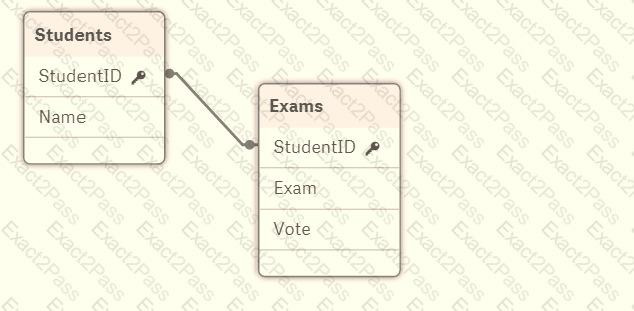
A data architect builds a simple data model to show the relationship between students and exams. The data is loaded. Every StudentID in the Exams table should be found in the Students table. Some students have NOT taken an exam.
The data architect selects the field "StudentID" from the Students table and sees the following:
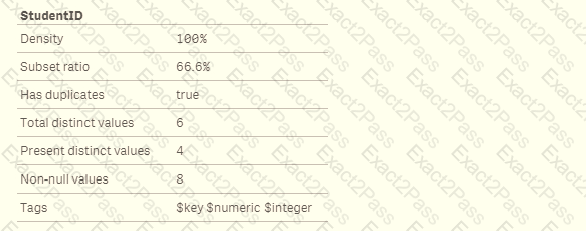
A data architect needs to fix this anomaly.
What should the data architect do to ensure data integrity?
Refer to the exhibit.
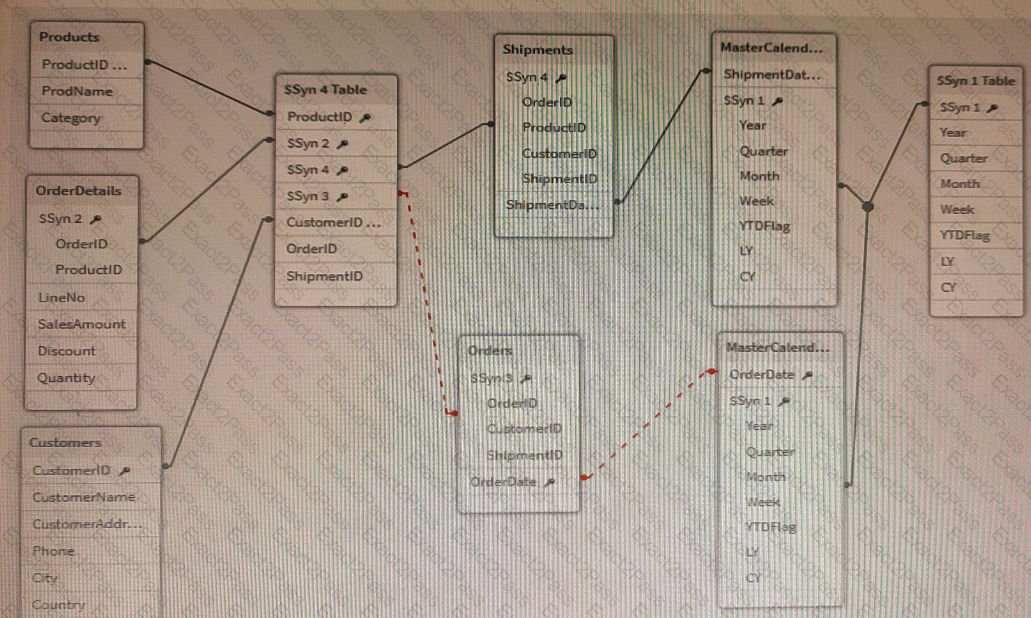
A data architect is working on a Qlik Sense app the business has created to analyze the company orders and shipments. To understand the table structure, the business has given the following summary:
• Every order creates a unique orderlD and an order date in the Orders table
• An order can contain one or more order lines one for each product ID in the order details table
• Products in the order are shipped (shipment date) as soon as tliey are ready and can be shipped separately
• The dates need to be analyzed separately by Year Month, and Quarter
The data architect realizes the data model has issues that must be fixed.
Which steps should the data architect perform?
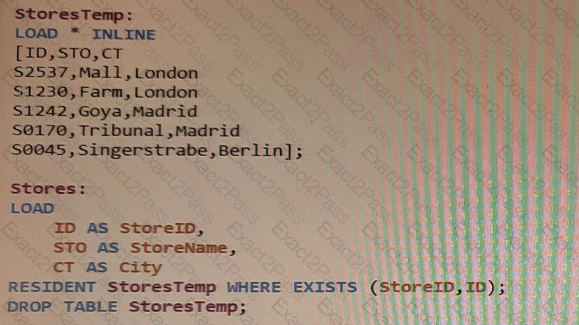
Refer to the exhibit
A data architect develops an app for Coffee4all, a coffee company with stores located throughout Europe
The script runs successfully, but the Stores table does not have any values.
What should the data architect do?
A data architect needs to create an app that combines employee data from the Sales system and the Human Resources (HR) system.
These systems identify employees differently Employees in the HR system are identified with an alpha-numeric key Employees in the Sales system are identified using an integer key.
The Human Resources manager creates a table that maps these keys to another, called Associations.
The resultant data model must meet the following requirements:
• Associations must be valid
• The model must be optimized for performance
• The option must support multiple tables added
Which solution should the data architect use to meet these requirements?
A company decides to migrate all apps from QlikView to Qlik Sense. After converting an apps: there are several unconverted objects What should the data architect do?
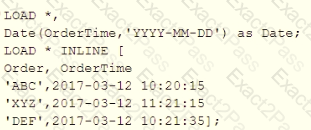
A table is generated resulting from the following script
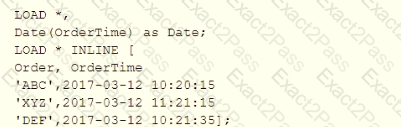
When the data architect selects a date, some, but NOT all, orders for that date are shown How should the data architect modify the script to show all orders for the selected date?
A)
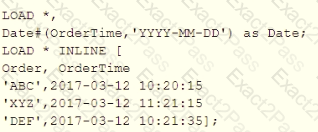
B)
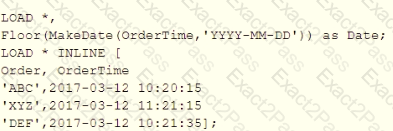
C)
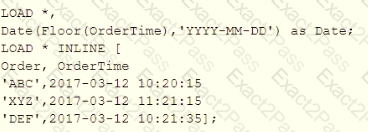
D)
Refer to the exhibit.
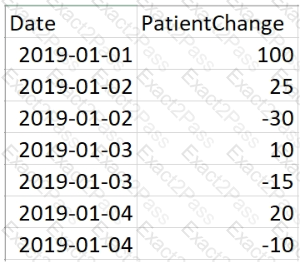
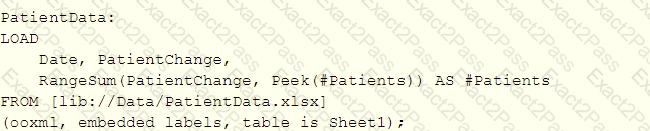
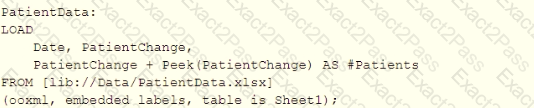
This table contains information about the number of admissions and discharges of patients in a hospital. The values can be positive or negative. The data architect needs to create an extra column that contains the number of patients that are currently in the hospital.
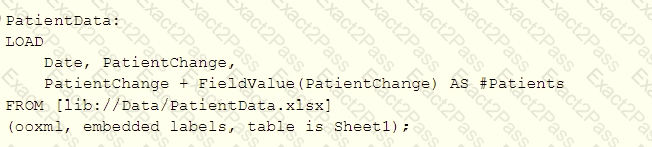
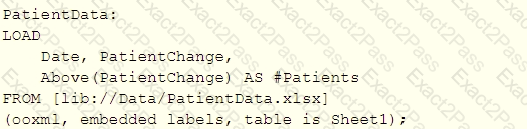
Which script should the data architect use ?
A)
B)
C)
D)
Refer to the exhibit.
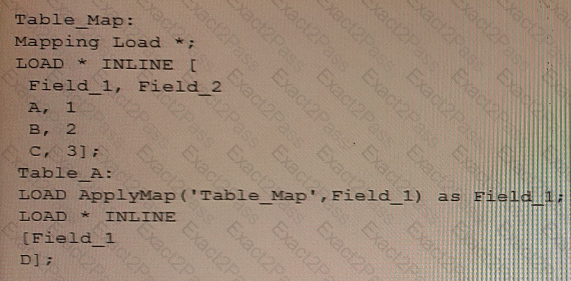
A data architect executes the script.
What will be the value of the first row for Field_1?
A company generates 1 GB of ticketing data daily. The data is stored in multiple tables Business users need to see trends of tickets processed for the past. 2 years Users very rarely access the transaction-level data for a specific date. Only the past 2 years of data must be loaded which is 720 GB of data
Which method should a data architect use to meet these requirements?

