Exact2Pass

Last Update 13 hours ago Total Questions : 50
The Qlik Sense Data Architect Certification Exam – 2024 content is now fully updated, with all current exam questions added 13 hours ago. Deciding to include QSDA2024 practice exam questions in your study plan goes far beyond basic test preparation.
You'll find that our QSDA2024 exam questions frequently feature detailed scenarios and practical problem-solving exercises that directly mirror industry challenges. Engaging with these QSDA2024 sample sets allows you to effectively manage your time and pace yourself, giving you the ability to finish any Qlik Sense Data Architect Certification Exam – 2024 practice test comfortably within the allotted time.
Exhibit.
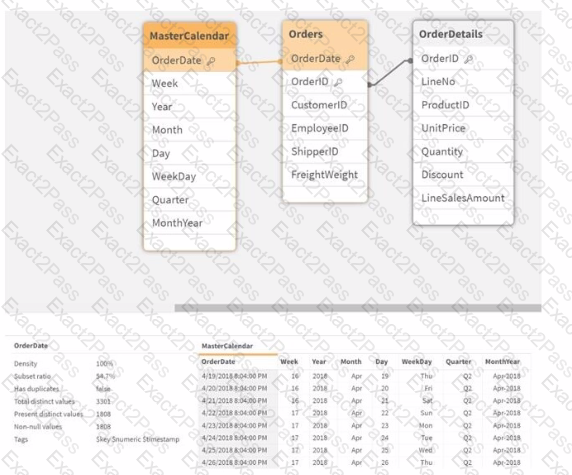
Refer to the exhibit.
A business analyst informs the data architect that not all analysis types over time show the expected data.
Instead they show very little data, if any.
Which Qlik script function should be used to resolve the issue in the data model?
Exhibit.
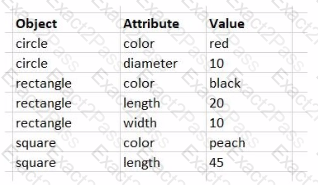
While performing a data load from the source shown, the data architect notices it is NOT appropriate for the required analysis.
The data architect runs the following script to resolve this issue:
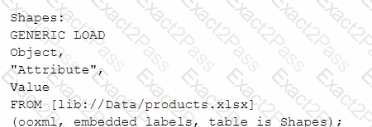
How many tables will this script create?
A Chief Information Officer has hired Qlik to enhance the organization's inventory analytics. In the initial meeting, the client's focus was determined to be forecasting inventory levels.
Which stakeholder should be consulted first when gathering requirements?
A startup company is about have its Initial Public Offering (IPO) on the New York Stock Exchange.
This startup company has used Qlik Sense for many years for data-based decision making for Sales and Marketing efforts, as well as for input into Financial Reporting. The startup's Qlik Sense applications use variables that have different values at different points in time.
Due to the increased rigor required in record keeping for public companies, these variables must be clearly recorded in the script reload logs of the Qlik Sense applications. These logs are refreshed daily.
The data architect wants to have the variables names, with their current values, written into the script reload logs. Which script statement should the data architect use?
Exhibit.
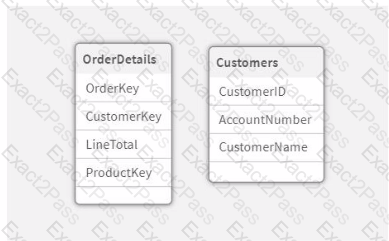
Refer to the exhibit.
A data architect is loading two tables into a data model from a SQL database. These tables are related on key fields CustomerlD and Customer Key.
Which script should the data architect use?
A)
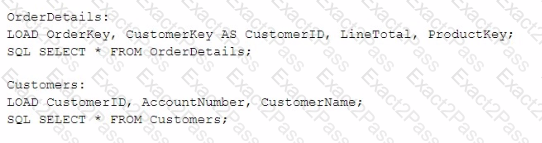
B)
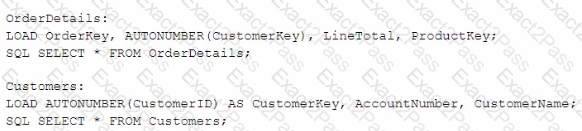
C)
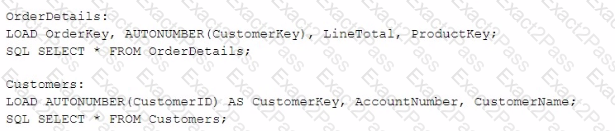
D)
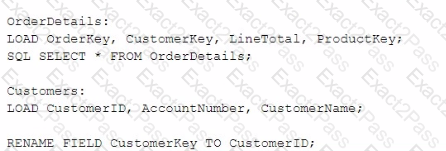
Exhibit.
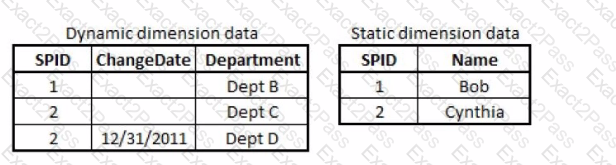
A large electronics company re-assigns sales people once per year from one Department to another.
SPID is the Salesperson ID; the SPID for each individual sales person Name remains constant. The Department for a SPID may change; each change is stored in the Dynamic Dimension data.
Four tables need to be linked correctly: a transaction table, a dynamic salesperson dimension, a static salesperson dimension, and a department dimension.
Which script prefix should the data architect use?
Exhibit.
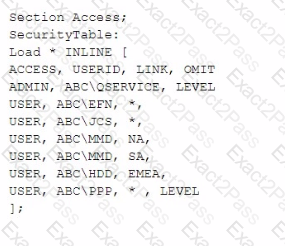
The Section Access security table for an app is shown. User ABC\PPP opens a Qlik Sense app with a table using the field called LEVEL on one of the table columns.
Which is the result?
Exhibit.
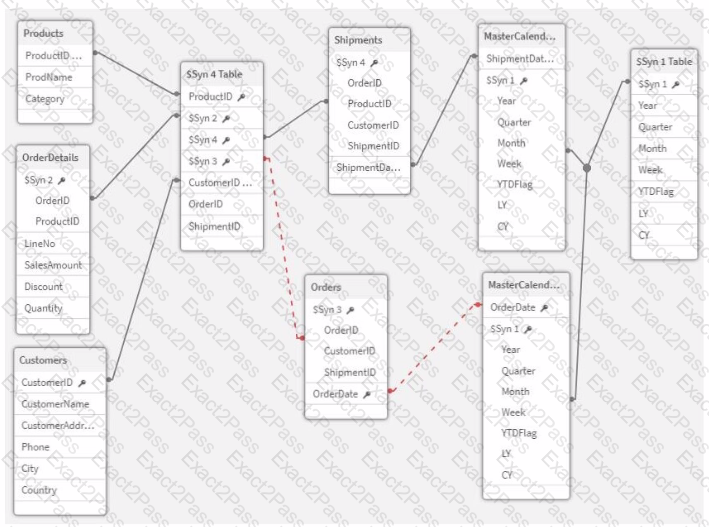
Refer to the exhibit.
A data architect is working on a Qlik Sense app the business has created to analyze the company orders and shipments.
To understand the table structure, the business has given the following summary:
• Every order creates a unique orderlD and an order date in the Orders table
• An order can contain one or more order lines one for each product ID in the order details table
• Products In the order are shipped (shipment date) as soon as they are ready and can be shipped separately
• The dates need to be analyzed separately by Year, Month, and Quarter
The data architect realizes the data model has issues that must be fixed. Which steps should the data architect perform?
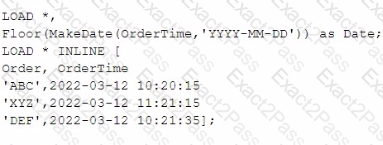
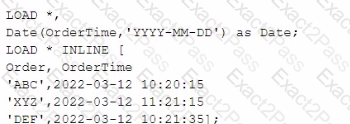
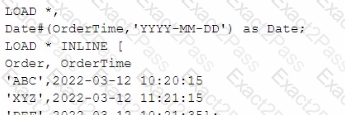
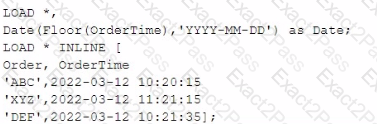
A table is generated resulting from the following script:
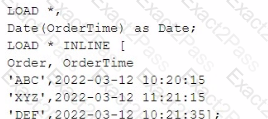
When the data architect selects a date, some, but NOT all, orders for that date are shown.
How should the data architect modify the script to show all orders for the selected date?
A)
B)
C)
D)
A data architect needs to retrieve data from a REST API. The data architect needs to loop over a series of items that are being read using the REST connection.
What should the data architect do?

