Exact2Pass

Modern enterprise cloud engineering, hybrid infrastructure operations, and machine learning architectures require robust identity perimeters, resilient data safeguards, and proactive posture management across mission-critical services. As organizations integrate foundation models, generative AI endpoints, and automated data pipelines into Microsoft Azure, security engineers and infrastructure specialists must protect both traditional cloud assets and specialized AI workloads. Achieving the Microsoft Certified: Cloud and AI Security Engineer Associate credential via the SC-500 examination validates your practical capacity to enforce end-to-end security controls using Microsoft Entra ID, Azure Key Vault, Microsoft Defender for Cloud, Microsoft Sentinel, and Microsoft Security Copilot. However, many cybersecurity practitioners encounter significant hurdles on this proctored 120-minute evaluation because they rely on simple UI point-and-click memorization. Memorizing static answer keys or context-stripped question repositories found on unverified public forums cannot prepare you for the complex situational logic of mitigating prompt injection vectors on Azure OpenAI endpoints, resolving private endpoint routing across multi-tenant vector stores, or diagnosing Managed Identity privilege escalation under production workloads.
True success on this scenario-driven technical assessment requires an active, multi-dimensional grasp of defense-in-depth methodologies, data encryption lifecycles, and automated compliance baselines. Security practitioners must demonstrate sharp diagnostic judgment when configuring customer-managed keys (CMK) in Azure Key Vault, securing Azure SQL dynamic data masking, isolating Azure Kubernetes Service (AKS) container clusters, and fine-tuning prompt shields within Azure AI Studio. Candidates frequently spend several months searching for high-yield sc-500 exam questions online, hoping to locate an updated microsoft cloud and ai security engineer sc-500 study guide to measure their operational readiness, or reviewing telemetry pipelines to verify Microsoft Sentinel data ingestion connectors. Without interactive workspace environments, an updated cloud and AI security curriculum, or targeted practical simulator practice that can provide actual help in exam preparation, passive reading fails to build the diagnostic capabilities needed to handle data exfiltration attempts or isolate misconfigurations across hybrid AI architectures. At Exact2Pass, our premium preparation workspace simulates real Azure security administration portals, automated policy governance templates, and real-time posture analytics consoles, ensuring you score comfortably above the required 700 threshold on your very first try.
The SC-500 certification exam evaluates your real-world capability to architect, configure, harden, and monitor secure environments across enterprise cloud and AI ecosystems. Our realistic simulation platform replicates active Azure security dashboards, identity entitlement blades, and live threat-hunting query editors instead of serving up generic recall questionnaires. You will master the underlying cryptographic safeguards, operator-driven RBAC hierarchies, and AI-era telemetry frameworks of the active Microsoft security platform, preparing you to tackle complex multiple-choice and scenario-driven case studies with complete confidence.
Note: This section contains one or more sets of questions with the same scenario and problem. Each question presents a unique solution to the problem. You must determine whether the solution meets the stated goals. More than one solution in the set might solve the problem. It is also possible that none of the solutions in the set solve the problem.
After you answer a question in this section, you will NOT be able to return. As a result, these questions do not appear on the Review Screen.
You have a Microsoft Sentinel workspace
You have a multi-tier Security Operations Center (SOC) team.
You need to ensure that all new security incidents are assigned immediately to the Tier 1 analysts group and flagged for triage.
Solution: You create an analytics rule.
Does this meet the goal?
You need to delegate a user to implement the planned change for Defender for Cloud. The solution must follow the principle of least privilege.
Which user should you choose?
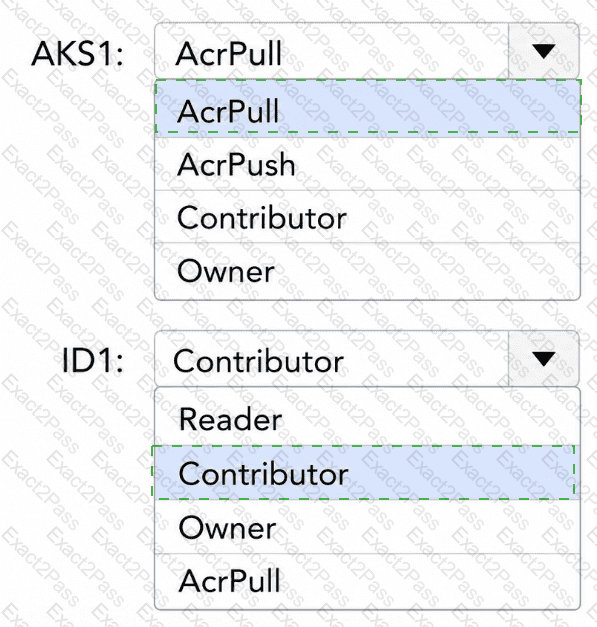
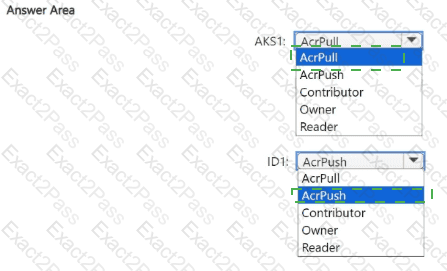
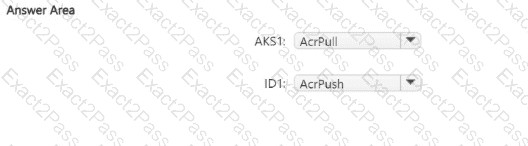
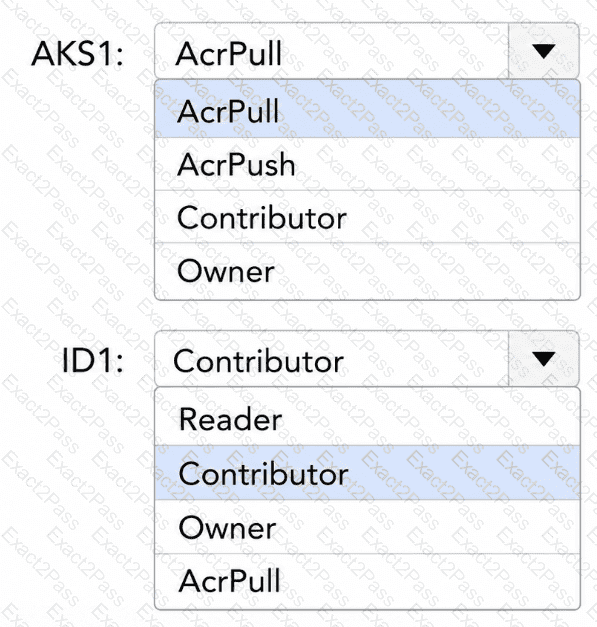
You need to configure the AKS1 and ID 1 managed identities to meet the technical requirements. The solution must follow the principle of least privilege.
Which role should you assign to each identity? To answer, select the appropriate options in the answer area.
NOTE: Each correct selection is worth one point.
You need to implement the planned change for storage2. The solution must meet the technical requirements for storage encryption.
What should you do?
You need to implement the planned change for VM1 to access storage1. The solution must meet the technical requirements.
What should you do first?
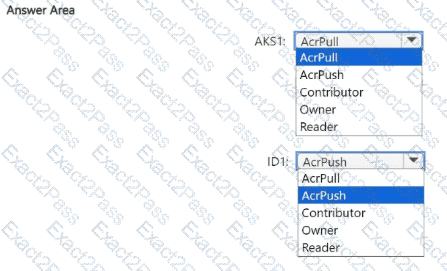
You need to configure the AKS1 and ID1 managed identities to meet the technical requirements. The solution must follow the principle of least privilege.
Which role should you assign to each identity? To answer, select the appropriate options in the answer area.
NOTE: Each correct selection is worth one point.
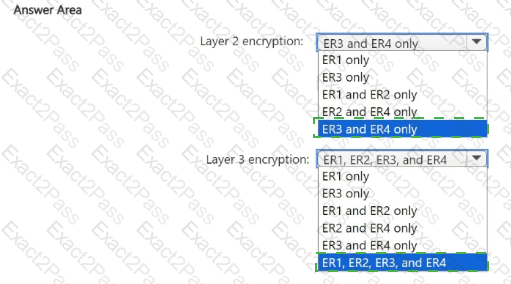
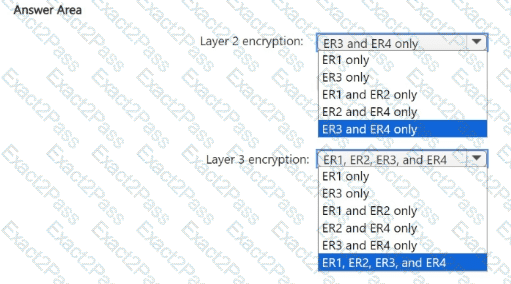
You need to recommend an encryption solution for the planned ExpressRoute implementation. The solution must meet the technical requirements.
Which ExpressRoute circuit should you recommend for each type of encryption? To answer, select the appropriate options in the answer area.
NOTE: Each correct selection is worth one point.
You need to implement the function apps to meet the technical requirements.
Which apps should you include in the implementation?
Lab Task
use the following login credentials as needed:
To enter your username, place your cursor in the Sign in box and click on the username below.
To enter your password. place your cursor in the Enter password box and click on the password below.
Azure Username: Userl -28681041@ExamUsers.com
Azure Password: GpOAe4@lDg
If the Azure portal does not load successfully in the browser, press CTRL-K to reload the portal in a new browser tab.
The following information is for technical support purposes only:
Lab Instance: 28681041
Task 10
You need to create a new Azure AD directory named 28681041.onmicrosoft.com. The new directory must contain a new user named user1@28681041.onmicrosoft.com.
Lab Task
use the following login credentials as needed:
To enter your username, place your cursor in the Sign in box and click on the username below.
To enter your password. place your cursor in the Enter password box and click on the password below.
Azure Username: Userl -28681041@ExamUsers.com
Azure Password: GpOAe4@lDg
If the Azure portal does not load successfully in the browser, press CTRL-K to reload the portal in a new browser tab.
The following information is for technical support purposes only:
Lab Instance: 28681041
Task 1
You need to configure Azure to allow RDP connections from the Internet to a virtual machine named VM1. The solution must minimize the attack surface of VM1.