Exact2Pass

Last Update 1 hour ago Total Questions : 135
The Microsoft Certified: Cloud and AI Security Engineer Associate content is now fully updated, with all current exam questions added 1 hour ago. Deciding to include SC-500 practice exam questions in your study plan goes far beyond basic test preparation.
You'll find that our SC-500 exam questions frequently feature detailed scenarios and practical problem-solving exercises that directly mirror industry challenges. Engaging with these SC-500 sample sets allows you to effectively manage your time and pace yourself, giving you the ability to finish any Microsoft Certified: Cloud and AI Security Engineer Associate practice test comfortably within the allotted time.
Note: This section contains one or more sets of questions with the same scenario and problem. Each question presents a unique solution to the problem. You must determine whether the solution meets the stated goals. More than one solution in the set might solve the problem. It is also possible that none of the solutions in the set solve the problem.
After you answer a question in this section, you will NOT be able to return. As a result, these questions do not appear on the Review Screen.
You have a Microsoft Sentinel workspace
You have a multi-tier Security Operations Center (SOC) team.
You need to ensure that all new security incidents are assigned immediately to the Tier 1 analysts group and flagged for triage.
Solution: You create an analytics rule.
Does this meet the goal?
You need to delegate a user to implement the planned change for Defender for Cloud. The solution must follow the principle of least privilege.
Which user should you choose?
You need to configure Microsoft Sentinel to meet the technical requirements.
To what should you set Analytics retention for DnsEvents?
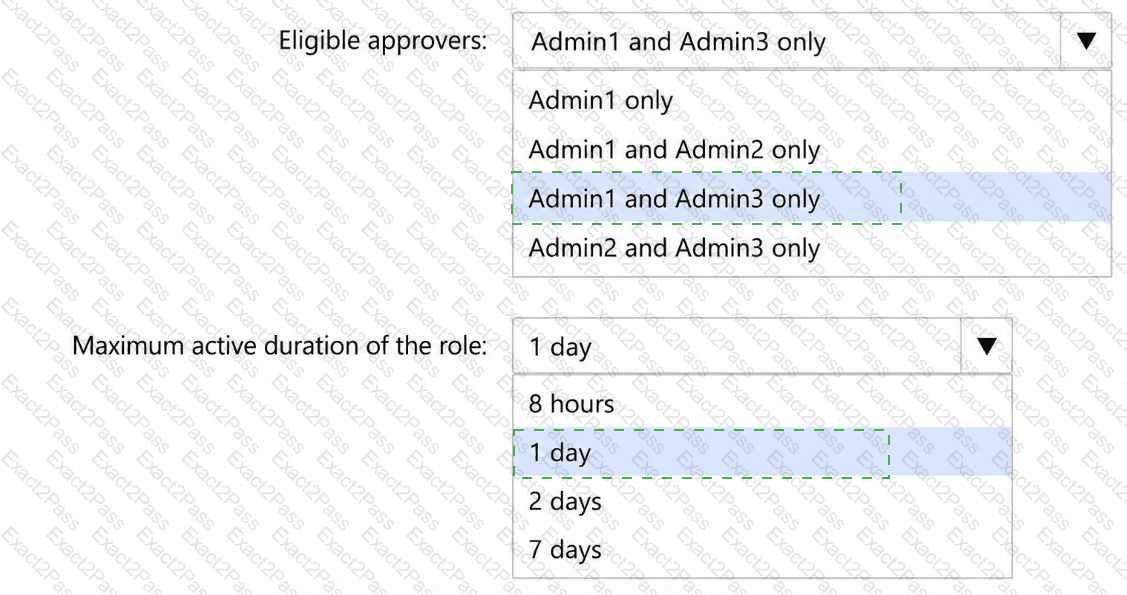
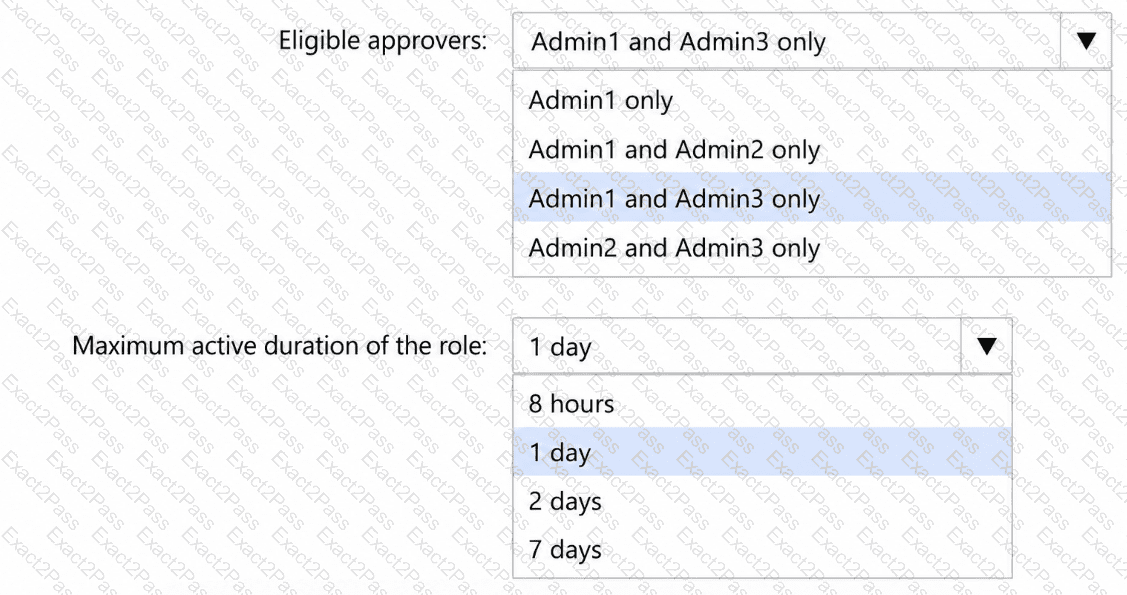
User1 has requested to use the AI Administrator role.
Which approvers can approve the request, and how long will User1 be an AI administrator after the role is approved? To answer, select the appropriate options in the answer area.
NOTE: Each correct selection is worth one point.
You need to implement the planned change for the AKS1 integration.
What should you configure for AKS1?
Note: This section contains one or more sets of questions with the same scenario and problem. Each question presents a unique solution to the problem. You must determine whether the solution meets the stated goals. More than one solution in the set might solve the problem. It is also possible that none of the solutions in the set solve the problem.
After you answer a question in this section, you will NOT be able to return. As a result, these questions do not appear on the Review Screen.
You have an Azure subscription that contains two virtual machines named VM1 and VM2. Each virtual machine has system-assigned managed identity enabled.
You have an Azure Storage account named storage1. Public access from all networks is enabled for storage1.
You need to ensure that VM1 and VM2 can access storage1.
Solution: You add each virtual machine to a role on storage1.
Does this meet the goal?
You have an Azure Storage account named storage1 that hosts a blob container named container1.
You have an Azure Functions app named app1 that uses a managed identity.
You need to configure app1 to read, write, and delete blobs in container1. The solution must follow the principle of least privilege.
What should you do?
You have a Microsoft Entra tenant that uses Privileged Identity Management (PIM).
You need to modify the AI Administrator role settings to meet the following requirements:
•Elevated access must be evaluated by another administrator before it is granted
•Privileged access must be removed automatically after a fixed period.
Which two settings should you configure? Each correct answer presents part of the solution.
NOTE: Each correct selection is worth one point.
You have a Microsoft 365 subscription. All users have Microsoft Exchange Online mailboxes.
You use Microsoft Entra Agent ID to register and manage AI agents.
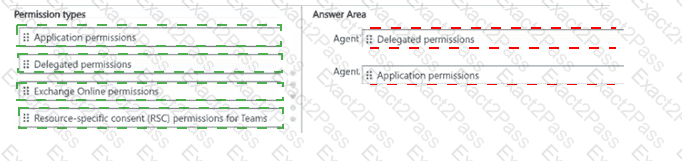
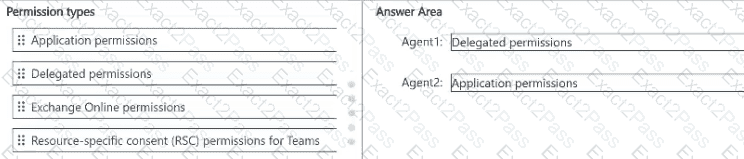
The developers at your company create the following two agents:
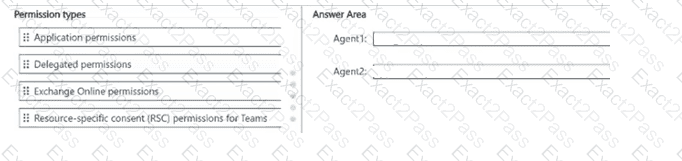
•Agent 1: An interactive agent that helps users summarize their own Exchange Online email
•Agent2: An autonomous agent that sends nightly updates to a Microsoft Teams channel
You need to grant each agent access to Microsoft Graph. The solution must minimize the access scope, while meeting each agent ' s operating model.
Which type of permission should you assign to each agent? To answer, drag the appropriate permission types to the correct agents. Each permission type may be used once, more than once, or not at all. You may need to drag the split bar between panes or scroll to view content.
NOTE: Each correct selection is worth one point.
You have an Azure subscription that contains the resources shown in the following table.
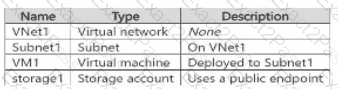
VM1 contains an application that accesses storage1. Another application accesses storage1 from a public IP address of 131.107.10.20.
For storage1, you set Public network access to Enabled from selected virtual networks and IP addresses. You add an IP network rule for 131.107.10.20.
After the configuration, only connections from 131.107.10.20 succeed.
You need to ensure that both VM1 and 131.107.10.20 can access storage1 over the public endpoint, while preventing all other access.
What should you do?