Exact2Pass

Last Update 9 hours ago Total Questions : 40
The Scaled Professional Scrum (SPS) Exam content is now fully updated, with all current exam questions added 9 hours ago. Deciding to include SPS practice exam questions in your study plan goes far beyond basic test preparation.
You'll find that our SPS exam questions frequently feature detailed scenarios and practical problem-solving exercises that directly mirror industry challenges. Engaging with these SPS sample sets allows you to effectively manage your time and pace yourself, giving you the ability to finish any Scaled Professional Scrum (SPS) Exam practice test comfortably within the allotted time.
Scenario A: Nexus Sprint Review with Five Scrum Teams
There are five Scrum Teams working on a product. During the Nexus Sprint Review, the teams
present the results of the Sprint. After introductions, each team takes time to present their work
for inspection by individually showing the new features they have built. They are not using a
shared environment. The stakeholders do not provide much feedback. The event ends and
people filter out of the room.
Since teams are not using a shared environment, what is likely?
(choose the best two answers)
The purpose of Nexus Sprint Planning is to:
(choose the best two answers)
Scenario C: Dependencies and Product Backlog items
During Nexus Sprint Planning, representatives from each of the 9-member Scrum Teams
identify many dependencies. This makes it hard for them to choose the work they could pull
into their individual teams for the next Sprint. No matter how they reorganize the Product
Backlog items, they continually find more or new dependencies.
What should the Scrum Teams do to effectively deal with their dependencies?
(choose the best answer)
Scenario C: Dependencies and Product Backlog items
During Nexus Sprint Planning, representatives from each of the 9-member Scrum Teams
identify many dependencies. This makes it hard for them to choose the work they could pull
into their individual teams for the next Sprint. No matter how they reorganize the Product
Backlog items, they continually find more or new dependencies.
What would you recommend to the two teams that are continually dependent on each other to
help them manage their work?
(choose the best answer)
A company has five products and are using Scrum for product delivery. Which statements
represent the best option for how Product Ownership might be structured?
(choose the best two answers)
Scenario B: Six Team Nexus with complex dependencies
A six team Nexus is developing a complex product, with different parts of the product that only
certain Scrum Teams can work on. In fact, there are some highly specialized individuals outside
the Nexus that are required for some of the work. In past Sprints the Nexus encountered
challenges dealing with the many dependencies between Scrum Teams.
Some individual Scrum Teams in this Nexus have said that they do not see how the work they
are doing is contributing to the product ' s progress. What is the best remedy for this situation?
(choose the best answer)
True or False: All Scrum Team members must attend the Nexus Daily Scrum.
You have been assigned as the Scrum Master of six new Scrum Teams that will build one
product. What conditions should you strive for in this scenario?
(choose the best two answers)
During Cross-Team Refinement, the ordered Product Backlog (1 through 9) is mapped out so
the Nexus can visualize dependencies. For example, PBI 5 for Team Orange is dependent on
Team Red completing PBI 1.
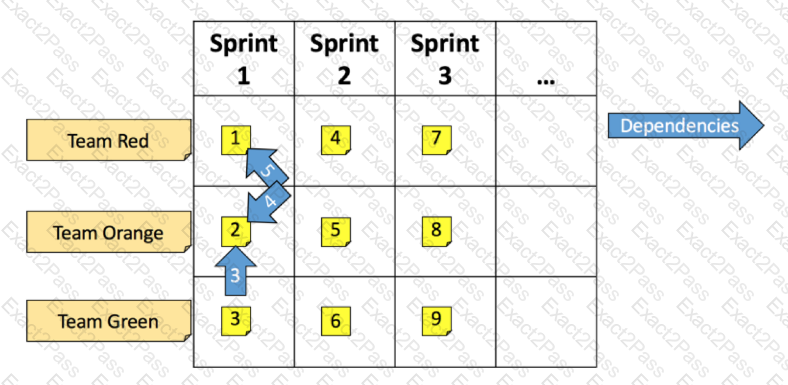
All else being equal, which PBI is most concerning?
(choose the best answer)
Scenario A: Nexus Sprint Review with Five Scrum Teams
There are five Scrum Teams working on a product. During the Nexus Sprint Review, the teams
present the results of the Sprint. After introductions, each team takes time to present their work
for inspection by individually showing the new features they have built. They are not using a
shared environment. The stakeholders do not provide much feedback. The event ends and
people filter out of the room.
If this pattern of Nexus Sprint Reviews continues for multiple Sprints, what may be the effects?
(choose the best two answers)

