Spring Sale Special Limited Time 70% Discount Offer - Ends in 0d 00h 00m 00s - Coupon code: buysanta

Exact2Pass Menu

Systems Security Certified Practitioner

Last Update 18 hours ago Total Questions : 1074

The Systems Security Certified Practitioner content is now fully updated, with all current exam questions added 18 hours ago. Deciding to include SSCP practice exam questions in your study plan goes far beyond basic test preparation.

You'll find that our SSCP exam questions frequently feature detailed scenarios and practical problem-solving exercises that directly mirror industry challenges. Engaging with these SSCP sample sets allows you to effectively manage your time and pace yourself, giving you the ability to finish any Systems Security Certified Practitioner practice test comfortably within the allotted time.

Question # 201

Which of the following statements pertaining to using Kerberos without any extension is false?

A.

A client can be impersonated by password-guessing.

B.

Kerberos is mostly a third-party authentication protocol.

C.

Kerberos uses public key cryptography.

D.

Kerberos provides robust authentication.

Question # 202

Kerberos is vulnerable to replay in which of the following circumstances?

A.

When a private key is compromised within an allotted time window.

B.

When a public key is compromised within an allotted time window.

C.

When a ticket is compromised within an allotted time window.

D.

When the KSD is compromised within an allotted time window.

Question # 203

Which of the following Kerberos components holds all users ' and services ' cryptographic keys?

A.

The Key Distribution Service

B.

The Authentication Service

C.

The Key Distribution Center

D.

The Key Granting Service

Question # 204

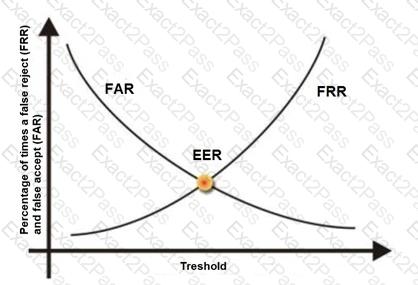
What is called the percentage at which the False Rejection Rate equals the False Acceptance Rate?

A.

False Rejection Rate (FRR) or Type I Error

B.

False Acceptance Rate (FAR) or Type II Error

C.

Crossover Error Rate (CER)

D.

Failure to enroll rate (FTE or FER)

Question # 205

Which of the following is not a physical control for physical security?

A.

lighting

B.

fences

C.

training

D.

facility construction materials

Question # 206

Considerations of privacy, invasiveness, and psychological and physical comfort when using the system are important elements for which of the following?

A.

Accountability of biometrics systems

B.

Acceptability of biometrics systems

C.

Availability of biometrics systems

D.

Adaptability of biometrics systems

Question # 207

Single Sign-on (SSO) is characterized by which of the following advantages?

A.

Convenience

B.

Convenience and centralized administration

C.

Convenience and centralized data administration

D.

Convenience and centralized network administration

Question # 208

Which of the following biometric parameters are better suited for authentication use over a long period of time?

A.

Iris pattern

B.

Voice pattern

C.

Signature dynamics

D.

Retina pattern

Question # 209

Which of the following statements pertaining to biometrics is FALSE?

A.

User can be authenticated based on behavior.

B.

User can be authenticated based on unique physical attributes.

C.

User can be authenticated by what he knows.

D.

A biometric system ' s accuracy is determined by its crossover error rate (CER).

Question # 210

When a biometric system is used, which error type deals with the possibility of GRANTING access to impostors who should be REJECTED?

A.

Type I error

B.

Type II error

C.

Type III error

D.

Crossover error

Question # 211

In non-discretionary access control using Role Based Access Control (RBAC), a central authority determines what subjects can have access to certain objects based on the organizational security policy. The access controls may be based on:

A.

The societies role in the organization

B.

The individual ' s role in the organization

C.

The group-dynamics as they relate to the individual ' s role in the organization

D.

The group-dynamics as they relate to the master-slave role in the organization

Question # 212

The number of violations that will be accepted or forgiven before a violation record is produced is called which of the following?

A.

clipping level

B.

acceptance level

C.

forgiveness level

D.

logging level

Question # 213

Who first described the DoD multilevel military security policy in abstract, formal terms?

A.

David Bell and Leonard LaPadula

B.

Rivest, Shamir and Adleman

C.

Whitfield Diffie and Martin Hellman

D.

David Clark and David Wilson

Question # 214

The number of violations that will be accepted or forgiven before a violation record is produced is called which of the following?

A.

clipping level

B.

acceptance level

C.

forgiveness level

D.

logging level

Question # 215

Which of the following statements pertaining to key management is incorrect?

A.

The more a key is used, the shorter its lifetime should be.

B.

When not using the full keyspace, the key should be extremely random.

C.

Keys should be backed up or escrowed in case of emergencies.

D.

A key ' s lifetime should correspond with the sensitivity of the data it is protecting.

Question # 216

What algorithm was DES derived from?

A.

Twofish.

B.

Skipjack.

C.

Brooks-Aldeman.

D.

Lucifer.

Question # 217

Which of the following services is NOT provided by the digital signature standard (DSS)?

A.

Encryption

B.

Integrity

C.

Digital signature

D.

Authentication

Question # 218

In a Public Key Infrastructure, how are public keys published?

A.

They are sent via e-mail.

B.

Through digital certificates.

C.

They are sent by owners.

D.

They are not published.

Question # 219

The Diffie-Hellman algorithm is primarily used to provide which of the following?

A.

Confidentiality

B.

Key Agreement

C.

Integrity

D.

Non-repudiation

Question # 220

What can be defined as a value computed with a cryptographic algorithm and appended to a data object in such a way that any recipient of the data can use the signature to verify the data ' s origin and integrity?


A.

A digital envelope

B.

A cryptographic hash

C.

A Message Authentication Code

D.

A digital signature

Go to page: