Exact2Pass

Last Update 6 hours ago Total Questions : 269
The Implementing Cisco Service Provider Advanced Routing Solutions content is now fully updated, with all current exam questions added 6 hours ago. Deciding to include 300-510 practice exam questions in your study plan goes far beyond basic test preparation.
You'll find that our 300-510 exam questions frequently feature detailed scenarios and practical problem-solving exercises that directly mirror industry challenges. Engaging with these 300-510 sample sets allows you to effectively manage your time and pace yourself, giving you the ability to finish any Implementing Cisco Service Provider Advanced Routing Solutions practice test comfortably within the allotted time.
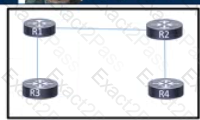
Refer to the exhibit. Unified MPLS is implemented on this network to provide end-to-end services A network engineer noticed that R3 is failing to receive labels from R1 However, R2 is receiving labels from R1 R3 can ping R1 normally Which action resolves the issue?
A network administrator is planning an upgrade for a PE router that has BGP peering sessions with several CE routers. The SLA has stringent uptime requirements, so the administrator wants to implement BGP NSR with SSO to provide fast convergence during the upgrade. Which action must the engineer take as part of the NSR implementation?
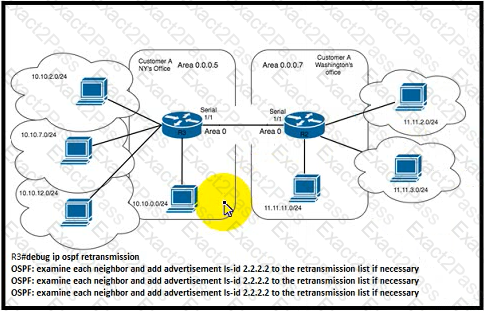
Refer to the exhibit. Customer A is a small media company with two offices connected by a 512 Kbps line. Their NY office is connected to several external partners by static routes on router R3. V oIP services use VoIP codec G729 Users reported poor voice quality and slow data transfer between the offices A network engineer configured ip tcp header-compression iphc-format on R2 and R3 routers Which additional action must the engineer take to fix the issue?
Refer to the exhibit.
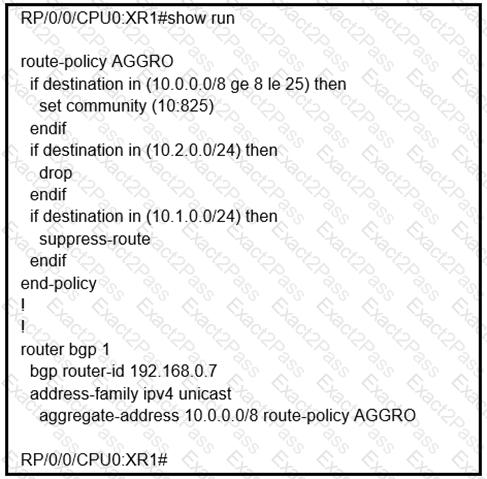
A network operator is working to filter routes from being advertised that are covered under
an aggregate announcement. The receiving router of the aggregate announcement block is still getting some of the more specific routes plus the aggregate. Which configuration change ensures that only the aggregate is announced now and in the future if other networks are to be added?
Refer to the exhibit. R1 is sending data traffic to R6 using the same SRGB range as the other routers in the topology, but it is also using a non-default SRLB range. Which two configuration tasks must the engineer perform to enable normal SRGB and SRLB operations on this network? (Choose two.)
Refer to the exhibit.
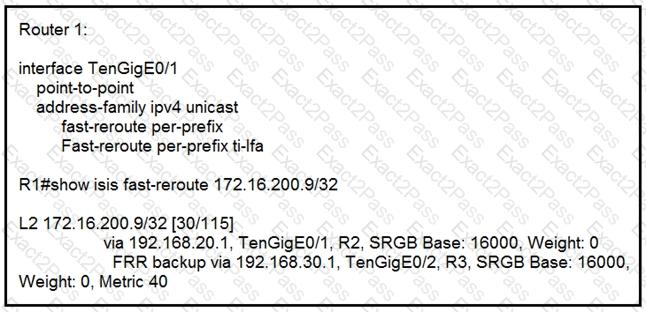
Router 1 is connected to router 2 on interface TenGigE0/1. Which interface provides the
alternate path to 172.16.200.9/32 when the link between router 1 and router 2 goes down?
Refer to the exhibit.
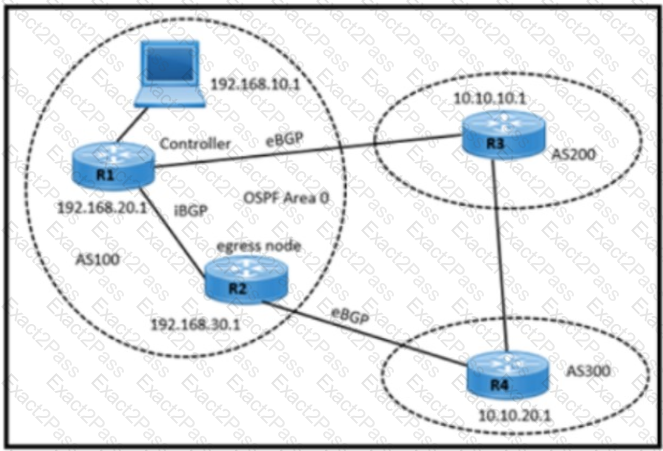
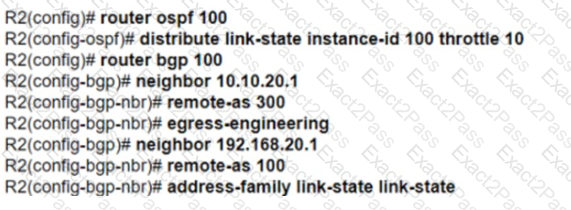
A network engineer must enable segment routing between the three autonomous systems with these requirements:
· OSPF link-state data for area 0 routers must be distributed to the controller via BGP LS.
· EPE must be enabled on the egress node in AS 100.
· Routers must advertise peer node SIDs to the controller R1 via BGP LS.
Which configuration must the engineer apply?
A)
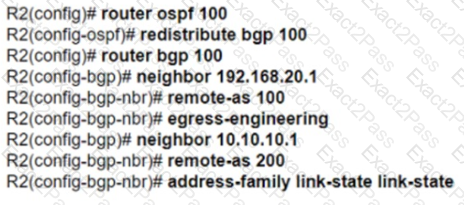
B)
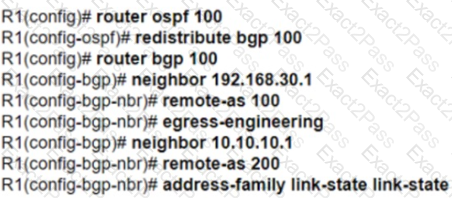
C)
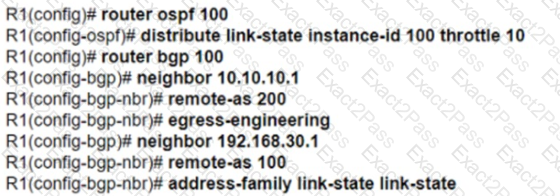
D)
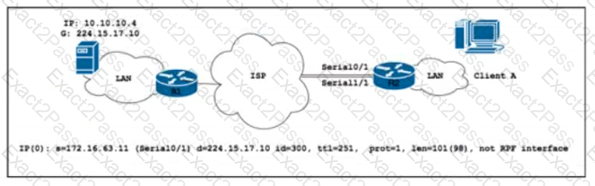
Refer to the exhibit. Mid-sized company Z connected two branch offices via a multicast-enabled ISP using the BGP routing protocol. PIM was implemented to support multicast streaming between the branches via MSDP Client A cannot connect to the multicast stream source of company Z. The network engineer ran a debug on the edge of the network as shown. Which action resolves the issue?
Refer to the exhibit.
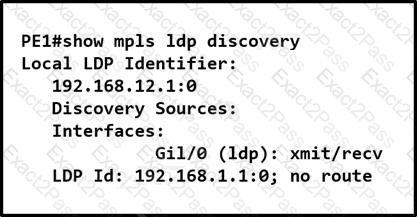
An administrator is troubleshooting network issues on a customer’s network PE1 cannot form an LDP relationship with PE2 using LDP ID 192 168.1.1. Due to this connectivity issue, the customer’s routes behind both PE routers cannot be exchanged. Which action must the administrator take to correct the problem?
Which difference should be considered when intradomain or interdomain multicast routing is implemented?

