Exact2Pass

Last Update 23 hours ago Total Questions : 247
The Implementing Cisco Application Centric Infrastructure content is now fully updated, with all current exam questions added 23 hours ago. Deciding to include 300-620 practice exam questions in your study plan goes far beyond basic test preparation.
You'll find that our 300-620 exam questions frequently feature detailed scenarios and practical problem-solving exercises that directly mirror industry challenges. Engaging with these 300-620 sample sets allows you to effectively manage your time and pace yourself, giving you the ability to finish any Implementing Cisco Application Centric Infrastructure practice test comfortably within the allotted time.
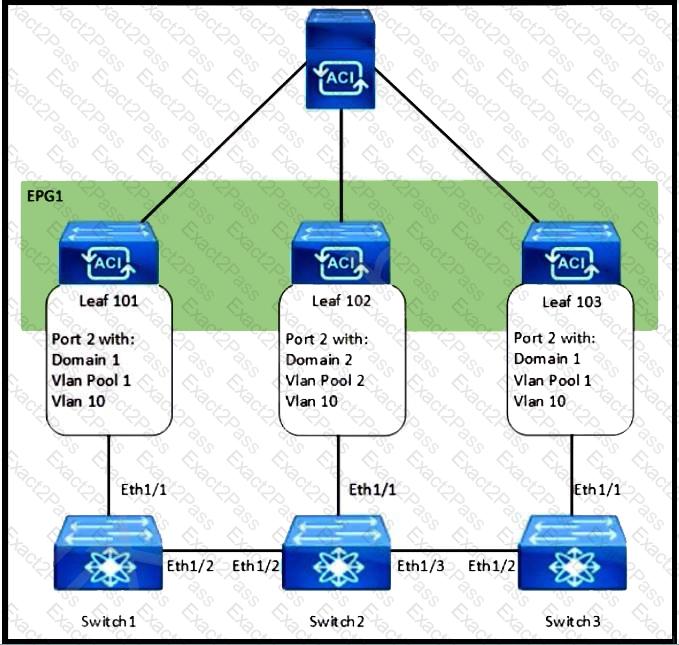
Refer to the exhibit. How are the STP BPDUs forwarded over Cisco ACI fabric?
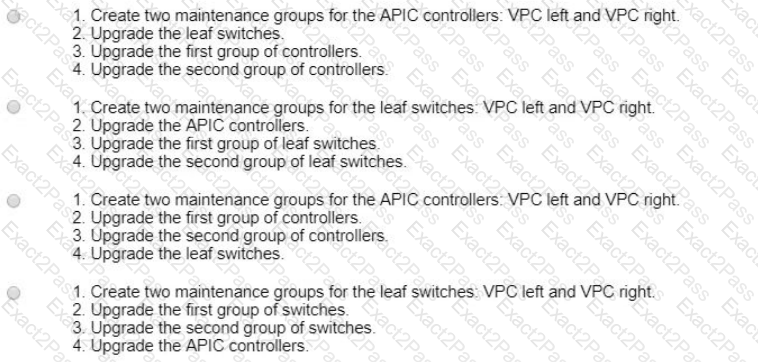
A data center administrator is upgrading an ACI fabric. There are 3 APIC controllers in the fabric and all the servers are dual-homed to pairs of leaf switches configured in VPC mode. How should the fabric be upgraded to minimize possible traffic impact during the upgrade?
What are two PBR characteristics of the Cisco ACI Active-Active Across Pods deployment mode in Cisco ACI Multi-Pod design? (Choose two.)
What does a bridge domain represent?
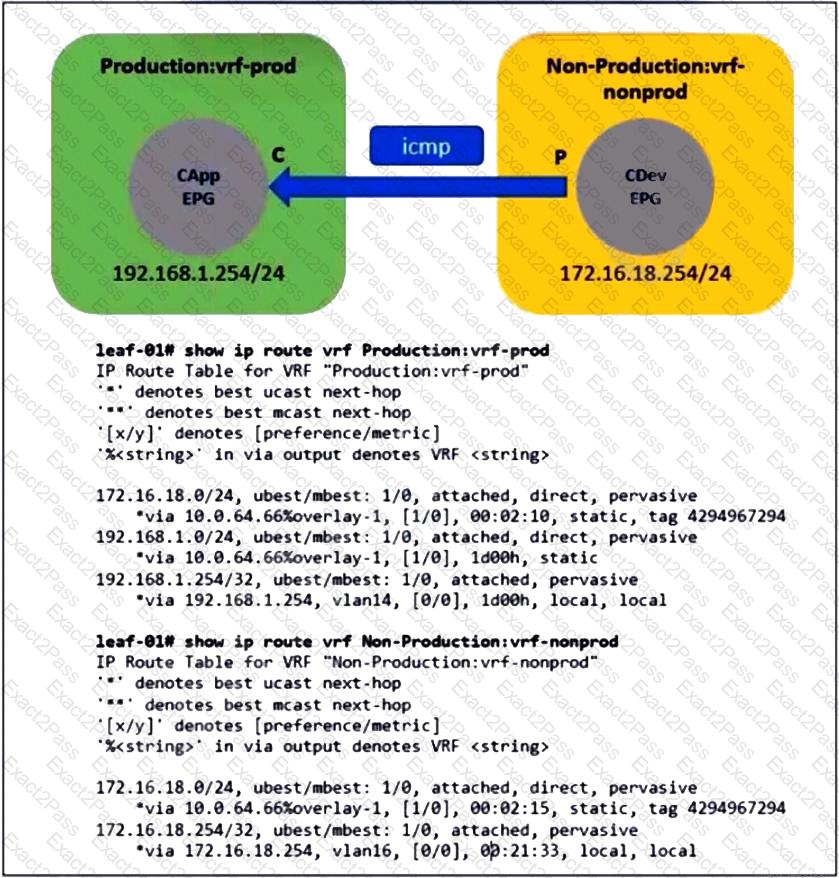
Refer to the exhibit. An administrator configures inter-VRF route leaking between Production:vrf-prod and Non-Production:vrf-nonprod. However, the route in the Non-Production:vrf-nonprod VRF to the production tenant is missing. Which action resolves the VRF route leaking issue?
Network engineer configured a Cisco ACI fabric as follows:
• An EPG called EPG-A is created and associated with a VMM domain called North. •The EPG-A is associated with BD-A and is in an application profile called Apps-A.
• The BD-A is associated with VRF-1 in the Prod tenant.
Which port group must be selected to place VMs in EPG-A?
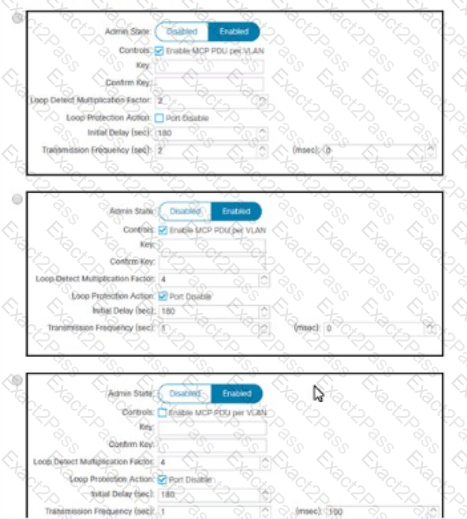
A network engineer must configure a Cisco ACI system to detect network loops for untagged and tagged traffic The loop must be detected and slopped by disabling an interface within 4 seconds Which configuration must be used?
What represents the unique identifier of an ACI object?
The Application team reports that a previously existing port group has disappeared from vCenter. An engineer confirms that the VM domain association for the EPG is no longer present. Which action determines which user is responsible for the change?
Which setting prevents the learning of Endpoint IP addresses whose subnet does not match the bridge domain subnet?

