Exact2Pass

Last Update 10 hours ago Total Questions : 189
The BIG-IP LTM Specialist: Architect, Setup, and Deploy (301a) content is now fully updated, with all current exam questions added 10 hours ago. Deciding to include 301a practice exam questions in your study plan goes far beyond basic test preparation.
You'll find that our 301a exam questions frequently feature detailed scenarios and practical problem-solving exercises that directly mirror industry challenges. Engaging with these 301a sample sets allows you to effectively manage your time and pace yourself, giving you the ability to finish any BIG-IP LTM Specialist: Architect, Setup, and Deploy (301a) practice test comfortably within the allotted time.
An LTM Specialist needs to add a pool that will load balance MYSOL services. It has four members, each with differing hardware platforms. All pool members are already assigned to another pool for load balancing FTP traffic.
Which load balancing method is most effective when the LTM Specialist sets up the pool?
An LTM is configure an application that is separated into several subdomains across multiple virtual servers. Many of these subdomains require encryption and could be accessed by anyone on the internet. The configuration must NOT result in SSL warnings to end users.
How should the LTM Specialist configure the SSL profiles for these virtual servers?
An LTM Specialist needs to deploy a virtual server that will load balance traffic targeting https://register.example.com to a set of three web servers. Persistence needs to be ensured. No persistence mirroring is allowed SSL offloading is required.
A fourth web server with fewer resources will be used to handle requests from engine bots to https://register.example.comvrobots.txt by an iRule. The (Rule will use the HTTP_REQUEST event. .
What are the required profile and persistence settings to implement this
Refer to the exhibit.
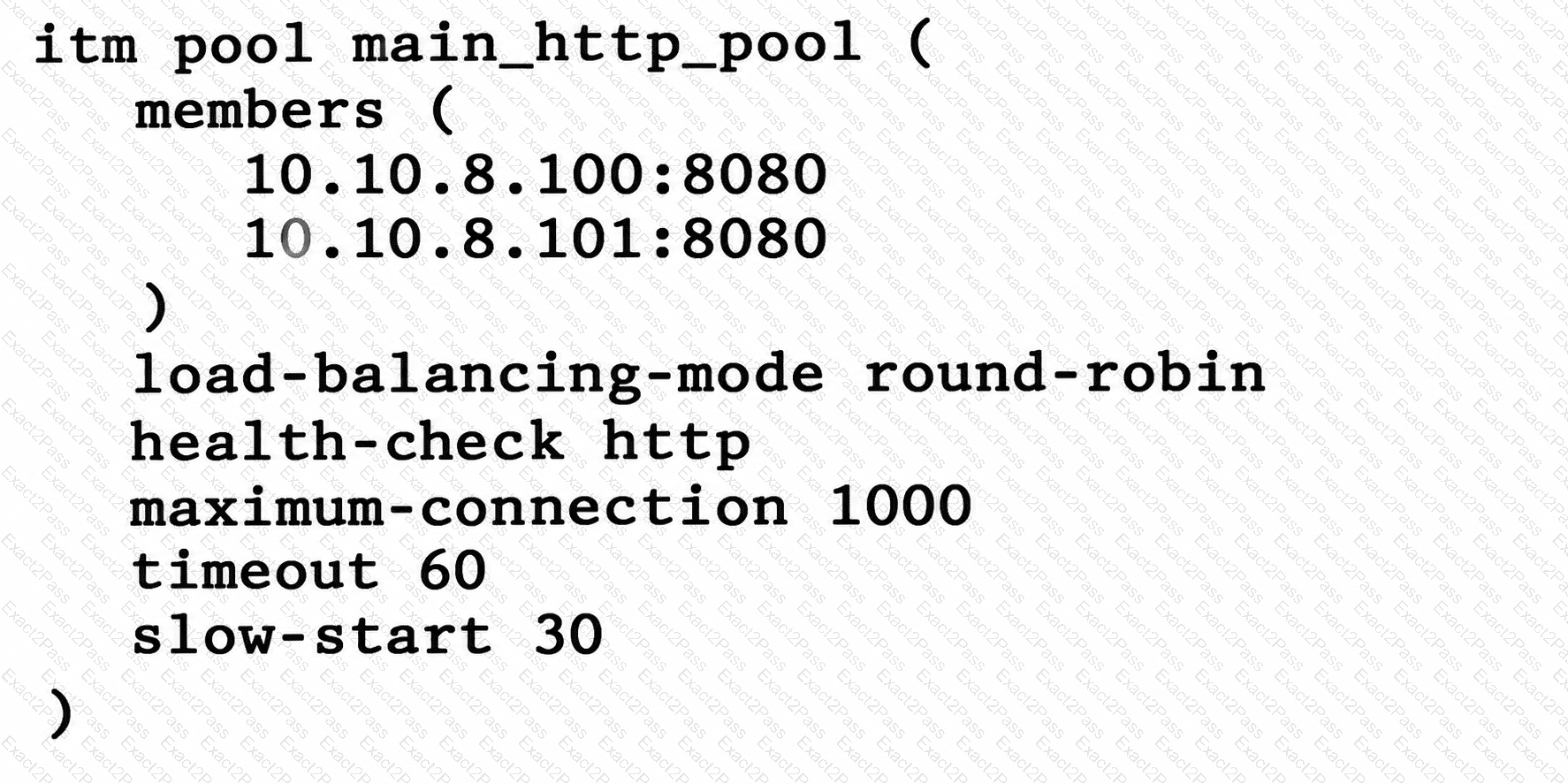
A pool is contoured with four members. A user has a current connection established with 10.18.1.40. The virtual server has a persistence Profile configured.
An LTM device configuration is as shown:
An LTM device configuration is as shown
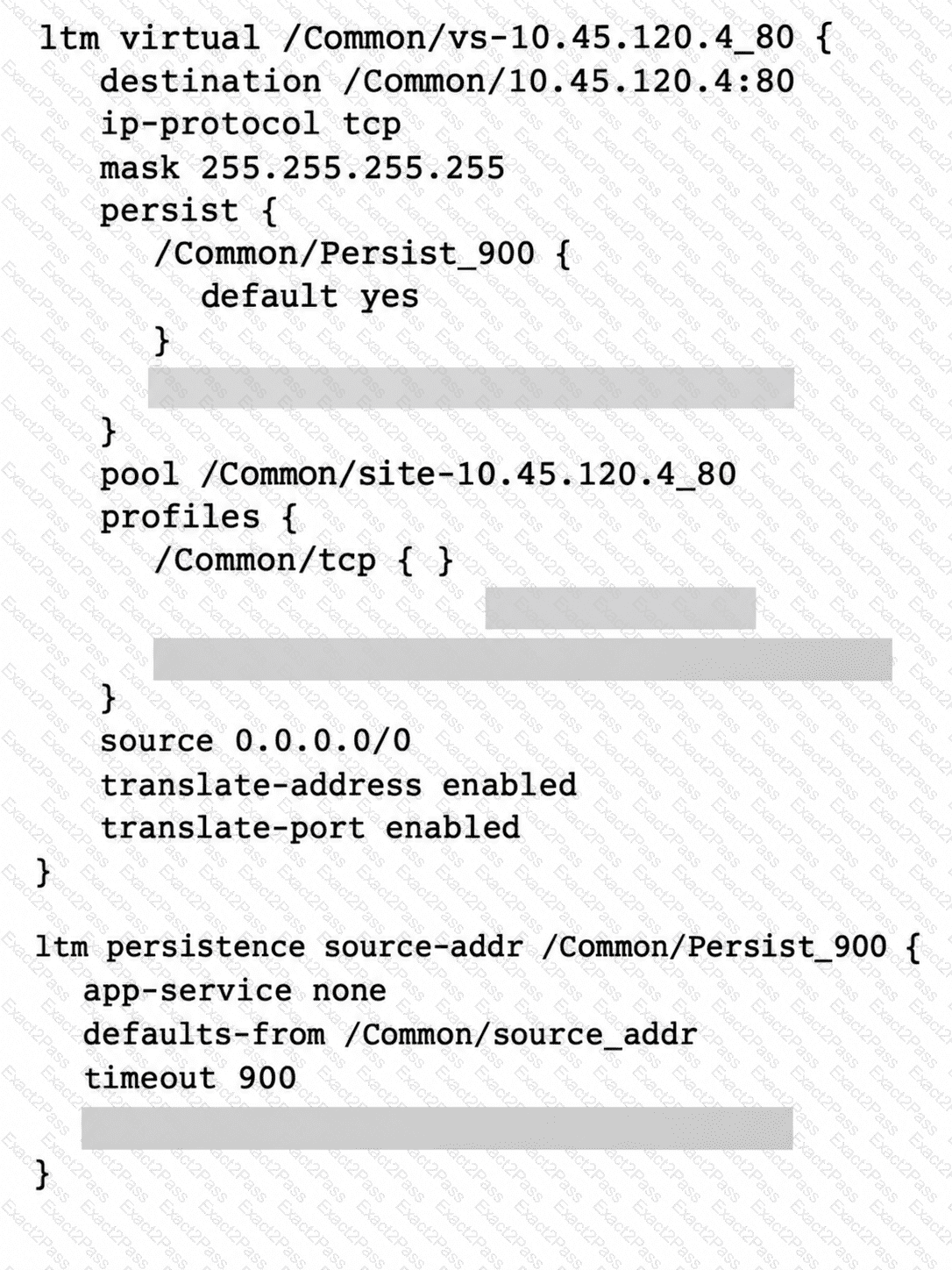
What should be the two expected outcomes based on this configuration? (Choose two.)
An LTM device configured with a management IP address and route and a series of self-IPs and TMM routes. Both management and TMM have a routing entry for 101 10/24 Application traffic is being load balanced and sent to pool member 10.1.1.123 with SNAT Automap and configured.
Which route will the LTM device use?
RADIUS authentication has been configured on the LTM device. The default remote user access requirements are as shown:
Read only access to the configuration Utility
Access to TMOS shell
Which two items need to be configured in this situation? (Choose two)
An LTM Specialist must reconfigure a BIG-IP system that load balances traffic to a web application. The security department has informed the LTM Specialist that the following cipher string must be used for TLS connections from BIG-IP to the web application.
NATIVE:IMDS:EXPORT:IDHE:EDH@SPEED
In which virtual server profile should the cipher string be configured?
Client SSL optional certificate request
To improve application security, an LTM Specialist must configure BIG-IP to authenticate a client certificate before allowing application access. BIG-IP must also support redirecting users to a certificate-enrollment system without a browser TLS error. Which Client Certificate setting should be used in the Client SSL profile? (Choose one answer.)
Block unwanted admin source by packet filter
An unwanted IP address tries to connect to the Configuration utility through a Self IP. An LTM Specialist needs to block the attempts based on the IP address without affecting other users. How should the LTM Specialist block the attempts? (Choose one answer.)