Exact2Pass

Last Update 12 hours ago Total Questions : 520
The BIG-IP ASM Specialist content is now fully updated, with all current exam questions added 12 hours ago. Deciding to include 303 practice exam questions in your study plan goes far beyond basic test preparation.
You'll find that our 303 exam questions frequently feature detailed scenarios and practical problem-solving exercises that directly mirror industry challenges. Engaging with these 303 sample sets allows you to effectively manage your time and pace yourself, giving you the ability to finish any BIG-IP ASM Specialist practice test comfortably within the allotted time.
-- Exhibit –
-- Exhibit --
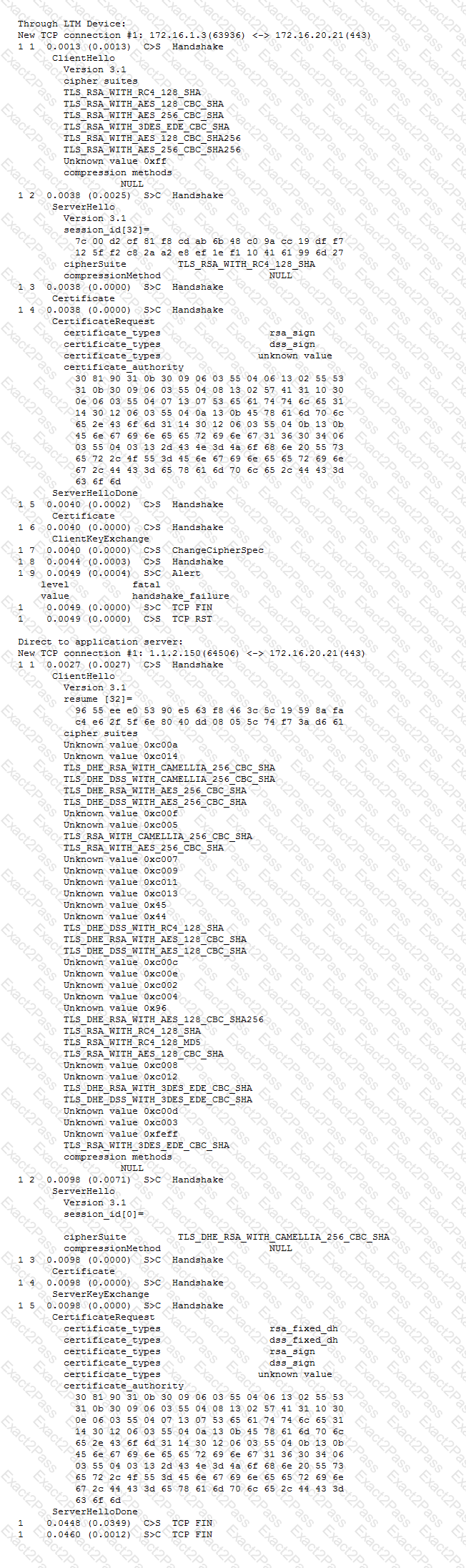
Refer to the exhibit.
An LTM Specialist has created a virtual server to load balance traffic to a pool of HTTPS servers. The servers use client certificates for user authentication. The virtual server has clientssl, serverssl, and http profiles enabled. Clients are unable to connect to the application through the virtual server. Clients are able to connect to the application servers directly.
What is the root cause of the problem?
Exhibit.
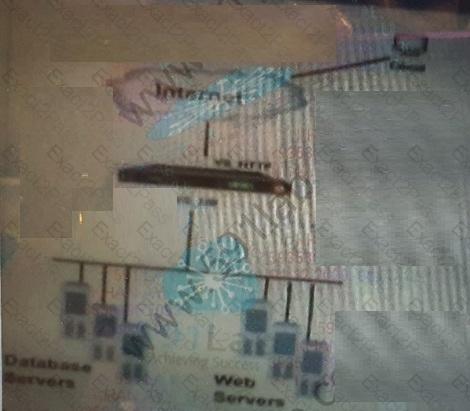
An LTM Specialist needs to configure VS^HTTP and VS_DB for an online shopping site. The VS HTTP passes the client requests to the webservers. The webservers query the database servers through the VS_DB. Initially, the LTM Specialist finds the database servers directly return the packets to the webservers.
which setting must be enabled for the configuration to function correctly?
A BIG-IP Administrator is configuring a pool with members who have differing capabilities. Connections
to pool members must be load balanced appropriately.
Which load balancing method should the BIG-IP Administrator use?
An LTM Specialist is troubleshooting an issue with a new virtual server. When connecting through the virtual server, clients receive the message "The connection was reset" in the browser, although connections directly to the pool member show the application is functioning correctly.
ltm pool srv1_https_pool {
members {
192.168.2.1:https{
address 192.168.2.1
}
}
}
ltm virtual https_example_vs {
destination 192.168.1.155:https
ip-protocol tcp
mask 255.255.255.255
pool srv1_https_pool
profiles {
http { }
tcp { }
}
snat automap
vlans-disabled
}
How should the LTM Specialist resolve this issue?
An LTM device pool has suddenly been marked down by a monitor. The pool consists of members 10.0.1.1:443 and 10.0.1.2:443 and are verified to be listening. The affected virtual server is 10.0.0.1:80.
Which two tools should the LTM Specialist use to troubleshoot the associated HTTPS pool monitor via the command line interface? (Choose two.)
Refer to the exhibit.

The BIG-IP Administrator has modified an iRule on one device of an HA pair. The BIG-IP Administrator
notices there is NO traffic on the BIG-IP device in which they are logged into.
What should the BIG-IP Administrator do to verify if the iRule works correctly?
An LTM Specialist creates an Analytics wide to show the type of browsers used to access a certain application. However, the generated statistics only sum up all transaction for that application under one item called ‘ Aggregated.’’
What should the LTM Specialist do to resolve this problem?
A pool with a default connection limit is configured to use Round Robin as the load balancing method. An LTM Specialist needs to ensure that the LTM device selects a server with the fewest number of connections when new clients connect. Another pool is using the same set of backend servers.
Which load balancing-method should the pool be changed to?
Refer to the exhibit.
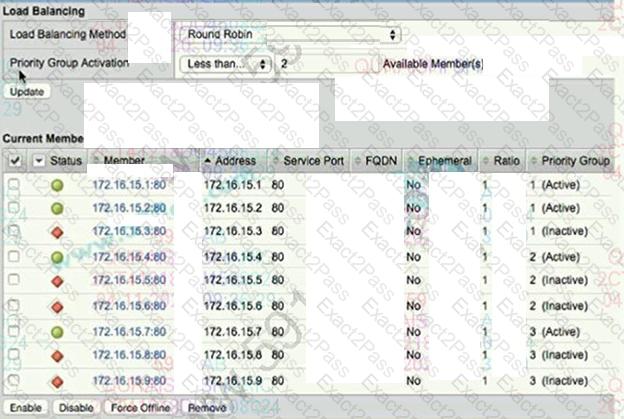
Which two pool members should be chosen for a new connection? (Choose two.)
Given the log entry:
011f0005:3: HTTP header (32800) exceeded maximum allowed size of 32768 (Client sidE. vip=/Common/VS_web profile=http pool=/Common/POOL_web client_ip=10.0.0.1)
Which HTTP profile setting can be modified temporarily to resolve the issue?
-- Exhibit –

-- Exhibit --
Refer to the exhibit.
An LTM Specialist is troubleshooting a sync-failover group of three BIG-IP LTM devices. The command used is "tmsh run cm watch-devicegroup-device."
What does the output mean?
A Client makes the request displayed below to the application server.
Which virtual server type should an LTM Specialist use to load balance based on the URI?
.A. Forwarding (Layer 2)
B. Stateless
C. Standard
D. Performance (Layer 4)
These log entries can have different root causes:
Jun 28 05:01:21 LTM_A notice mcpd[27545]: 0107143a:5: CMI reconnect timer: enabled
Jun 28 05:01:21 LTM_A notice mcpd[27545]: 01071431:5: Attempting to connect to CMI peer 1.1.1.2 port 6699
Jun 28 05:01:21 LTM_A notice mcpd[27545]: 01071432:5: CMI peer connection established to 1.1.1.2 port 6699
Jun 28 05:01:26 LTM_A notice mcpd[27545]: 0107143a:5: CMI reconnect timer: disabled, all peers are connected
Which two commands should be used to obtain additional information on these entries? (Choose two.)
-- Exhibit –

-- Exhibit --
Refer to the exhibit.
A virtual server is set up on an LTM device as follows:
Virtual server address 78.24.213.79
Default Persistence ProfilE. source_addr, 600s.
Pool NamE. Pool1
Pool Members: 10.72.250.52:80 and 10.72.250.60:80 (both on Internal Vlan)
There are several current connections to the virtual server, and pool member 10.72.250.52:80 has been set to a "Disabled" state.
A tcpdump on the Internal Vlan shows traffic going to 10.72.250.52:80.
How soon after the persistence table query was run can existing connections be refreshed/renewed to ensure that no requests are sent to 10.72.250.52?
A BIG-IP Administrator assigns the default http health monitor to a pool that has three members listening on port 80 When the administrator connects to each pool member via the CURL utility, two of the members respond with a status of 404 Not Found while the third responds with 200 OK. What will the pool show for member availability?

