Spring Sale Special Limited Time 70% Discount Offer - Ends in 0d 00h 00m 00s - Coupon code: buysanta

Exact2Pass Menu

Cisco Certified Design Expert Practical Exam

Last Update 11 hours ago Total Questions : 249

The Cisco Certified Design Expert Practical Exam content is now fully updated, with all current exam questions added 11 hours ago. Deciding to include 352-011 practice exam questions in your study plan goes far beyond basic test preparation.

You'll find that our 352-011 exam questions frequently feature detailed scenarios and practical problem-solving exercises that directly mirror industry challenges. Engaging with these 352-011 sample sets allows you to effectively manage your time and pace yourself, giving you the ability to finish any Cisco Certified Design Expert Practical Exam practice test comfortably within the allotted time.

Question # 51

An operations engineer asks for your help with a new switching deployment. The engineer confirms that STP is enabled on an edge switch, and a particular port is connected to another switch. The switch is not receiving configuration BPDUs, although it appears that everything is functioning correctly in the network. What is the design explanation?

A.

Bridge Assurance is enabled on the port

B.

Storm control broadcast is enabled on the port

C.

REP is enabled on the port

D.

BPDU Guard is enabled on the port

Question # 52

Company ABC grew organically and now their single-area OSPF network has an unacceptably slow convergence time after a topology change. To address the slow convergence time, they want to introduce a multiarea OSPF design and implement address summarization at the area border routers, which option should be their main concern about this redesign?

A.

Routing is suboptimal

B.

SPF calculation takes longer

C.

Operations complexity is increased

D.

More memory is needed across the routers on the network

Question # 53

Which two options are potential problems with route aggregation? (Choose two)

A.

Maintaining host IP addresses during migrations

B.

Route flapping

C.

Suboptimal routing

D.

Topology hiding

E.

Asymmetric routing

F.

Prefix hijacking

Question # 54

A service provider is designing a new backbone based on an IGP and MPLS what are two valid reasons for implementing MPLS-TE as well? (Choose two)

A.

MPLS-TE is required to reroute traffic within less than 1 second in case of a link failure inside the backbone

B.

MPLS-TE can detect and react to neighbor failures faster than IGPs can

C.

MPLS-TE is required to route different MPLS QoS Service classes through different paths

D.

MPLS-TE is required to create backup paths independently from the IGP

E.

MPLS-TE is a prerequisite for implementing RSVP in the backbone

Question # 55

Which aspect is a significant disadvantage of containers?

A.

Security

B.

Time to deploy

C.

Inefficiency

D.

Reduced operational overhead

E.

Resource consumption

Question # 56

A retail company connects its 250 branches across the globe to the core using MPLS Layer 3 VPN. The company is planning to migrate its traditional telephony services to VoIp, in order to reduce the cost of international calls. What are the two primary concerns when implementing this migration? (Choose two)

A.

Jitter

B.

Call routing design

C.

SRST

D.

MTU

E.

Available bandwidth

Question # 57

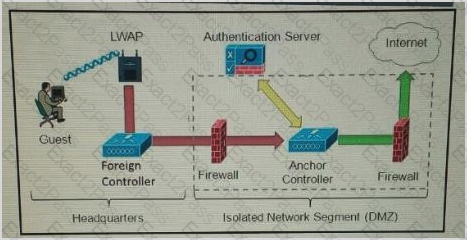
Refer to the exhibit.

Which solution must be used to send traffic from the foreign wireless LAN controller to the anchor wireless LAN controller?

A.

Encapsulate packets into an EoIP tunnel and send them to the anchor controller

B.

Send packets from the foreign controller to the anchor controller via Layer 3 MPLS VPN or VRF-Lite

C.

Send packets from the foreign controller to the anchor controller via IPinIP or IPsec tunnel

D.

Send packets without encapsulation to the anchor controller over the routed network

Question # 58

Which two options are two advantages of summarizing networks at the aggregation layer rather than at the core? (Choose two.)

A.

It prevents the core from having unnecessary routes.

B.

It no longer needs a core layer.

C.

It prevents black hole routing.

D.

It avoids network-wide impact upon VLAN changes local to the aggregation devices.

E.

it allows for optimal routing

Question # 59

A multisite data center network runs OSPF and DWDM point-to-point interfaces for site to-site connectivity. Which method to detect interfaces the fastest?

A.

interface event dampening

B.

LoS/AJS event faults

C.

UDLD

D.

fast-hello > timers

Question # 60

Which design benefit of Bridge Assurance is true?

A.

It prevents switched traffic from traversing suboptimal paths on the network.

B.

It prevents switched loops caused by unidirectional point-to-point, link condition on Rapid PVST+ and MST

C.

It allows small unmanaged switches to be plugged into ports of access scenes without the risk of switch loops.

D.

It suppresses a spanning-tree topology change upon connecting and disconnecting a station on a port.

Go to page: