Exact2Pass

Last Update 15 hours ago Total Questions : 92
The VMware vSphere 8.x Advanced Design content is now fully updated, with all current exam questions added 15 hours ago. Deciding to include 3V0-21.23 practice exam questions in your study plan goes far beyond basic test preparation.
You'll find that our 3V0-21.23 exam questions frequently feature detailed scenarios and practical problem-solving exercises that directly mirror industry challenges. Engaging with these 3V0-21.23 sample sets allows you to effectively manage your time and pace yourself, giving you the ability to finish any VMware vSphere 8.x Advanced Design practice test comfortably within the allotted time.
An architect is discussing the design of a vSphere solution with a customer. The following requirements have been defined for the solution:
The solution must provide data encryption at rest
The solution must provide the ability to reduce the amount of storage consumed from duplicate data
The solution must minimize the amount of resources consumed by the encryption process.
The architect has made a design decision that VM Encryption will be used to meet these requirements.
Which two implications should the architect include in the design in relation to this design decision? (Choose two.)
An architect is tasked with designing the VMware Validated Solutions in an existing VMware Cloud Foundation environment.
The design must meet the following requirements:
Must not allow logical networks to span physical network boundaries or locations
Must support static routing
What should the architect recommend based on these requirements?
An architect is creating the design for a vSphere platform that will be used as the target for a migration from multiple legacy vSphere platforms that are being decommissioned. The customer has provided the following information:
Each legacy platform has its own set of virtual machine templates stored in OVF format.
All of the templates need to be migrated to the new platform.
After migration, the templates should be centralized into a single location.
The templates must be accessible to all clusters in the new platform vCenter instance.
Any new templates added to the central location must be automatically available to all clusters.
Administrators must be able to deploy new virtual machines directly from the template instances.
The customer also confirmed that after the migrations are complete, the new platform will be the only vSphere solution available.
Which design choice should the architect evaluate in the logical design for the storage and management of virtual machine templates?
Refer to the exhibit.
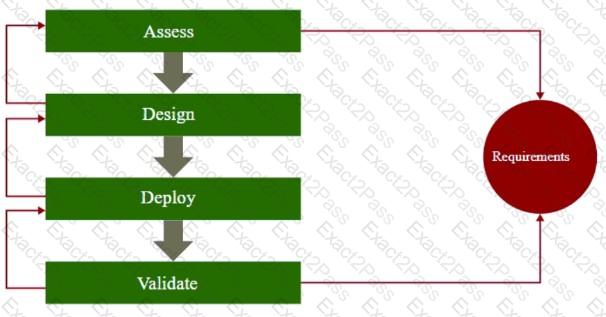
An architect is assigned a new project to design a VMware hybrid cloud solution.
The project is following a proven design methodology following the V-Model of systems engineering and verification. The selected methodology follows these phases: Assess, Design, Deploy and Validate.
Which activity would be conducted during the Design phase?
An architect is designing a solution for a customer to meet the following business objectives:
Pass compliance audits
Reuse compute hardware
Grow by 10% per year
Move to a subscription-based consumption model
Which business objective translates as a conceptual model constraint?
An architect is working on the cluster layout design for a new vSphere solution. The resource requirements for the first cluster state that memory demand can experience spikes of up to 20% over the documented average demand during peak business hours and the cluster must be able to handle these spikes without contention.
Which design quality is being referenced?
An architect will be updating an existing vSphere data center design.
The following information has been provided:
The new design must carry over existing VLANs for workloads.
The networking for storage must not share the data path with workload traffic.
The new design must be able to add additional VLANS.
The new design must reduce management overhead.
The new replacement servers have two 100 GB network cards.
Which design will meet the requirements for existing workload networks and allow scaling of additional networks?
An architect is responsible for designing a vSphere-based solution for a customer. The customer has the following requirements:
The solution must provide redundancy and load balancing for storage traffic
The solution must tolerate at least one failure
There must be no single point of failure in the solution
Which three considerations regarding physical host design should the architect analyze when making storage related design decisions? (Choose three.)
Which two vSphere cluster-related design details would an architect document in a physical design? (Choose two.)
A company will be replacing the external storage array that is currently providing storage to the vSphere environment. The architect must design a storage architecture for existing and future workloads. Company policy required storage separation of workloads by departments.
Which design decision should the architect make to satisfy the requirement and scale for additional departments?

